P0251–P0258: Injection Pump Fuel Metering Control Codes
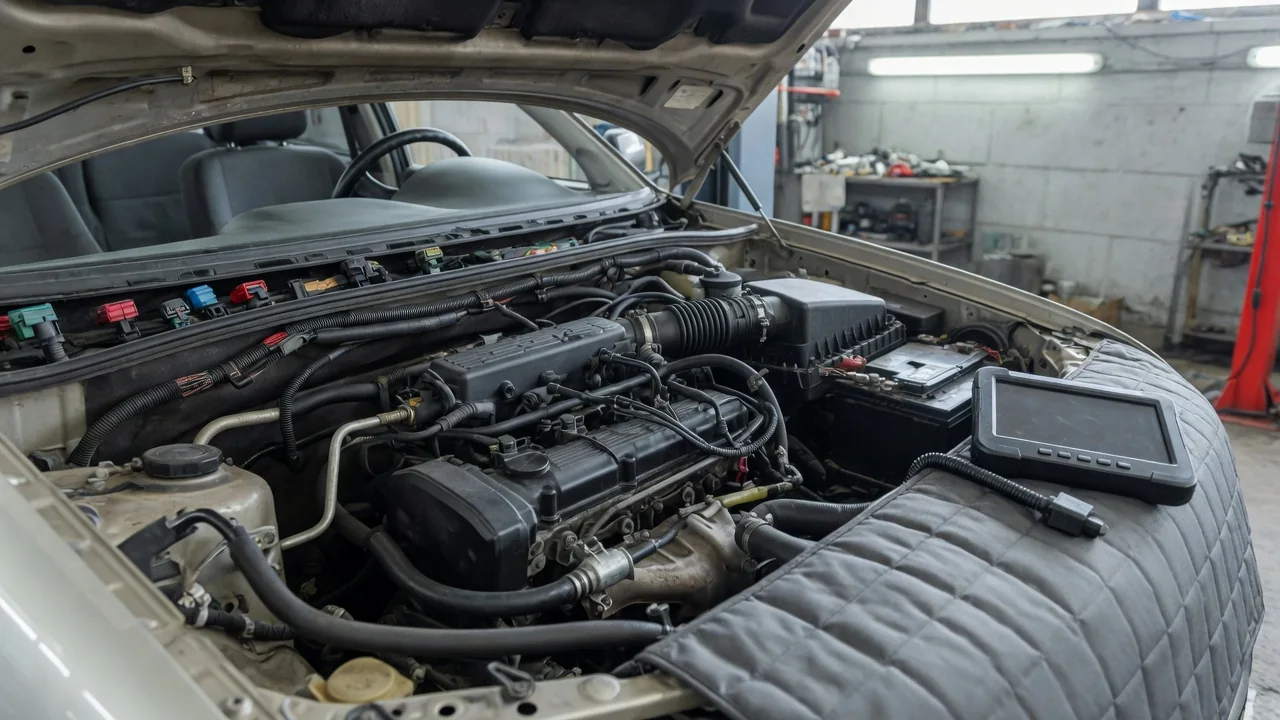
P0251 through P0258 belong to the diesel injection pump fuel metering control family. A P0251 code, P0252 code, or related P0253 through P0258 entry reports a detected condition in fuel metering control A or fuel metering control B. The stored number starts diagnosis and does not prove the pump has failed. Confirm the exact description for the year, make, model, engine, and fuel system first.
Verify the Code Meaning for the Vehicle First
Before treating a P0251 code or any related entry as a pump failure, match the exact description in service information for that vehicle's year, make, model, engine, and fuel system. This family concerns injection pump fuel metering control, but component names, circuit layouts, and diagnostic criteria change with the application. One diesel may monitor a metering actuator, while another uses a different arrangement and enabling conditions. Reading the number without that context can send testing toward the wrong circuit.
Fuel metering control A and fuel metering control B are controller designations, not universal part names. The hardware behind each letter must come from vehicle-specific documentation, including the applicable vehicle-specific wiring diagram. A stored P0251, P0256 code, or neighboring entry records that the controller detected a fault condition under its programmed rules. That evidence supports further testing; it does not establish that the injection pump needs replacement or that a metering device has already failed.
P0251 and P0252: Fuel Metering Control A Faults
After the description is confirmed for the vehicle, a P0251 code is the usual general malfunction entry for fuel metering control A, and a P0252 code is the usual range/performance fault for the same channel. Those labels are starting points, not interchangeable diagnoses. P0251 typically means the controller saw a control A malfunction, while P0252 means the monitored value stayed outside the expected window. Confirm both against service information before treating them as the same problem.
A range/performance fault asks whether monitored behavior met the controller's expected operating criteria, not whether fuel volume was already measured at the injectors. Enabling conditions, associated codes, and each entry's status change how either result should be read. A P0252 stored with other fuel or circuit codes points to a different test path than P0251 stored alone. Identify the actual monitored components for control A before assigning a likely location in the pump, actuator, sensor, or wiring.
P0253, P0254, and P0255: Control A Signal Conditions
Once the vehicle-specific definitions apply, a P0253 code is the standard control A circuit low descriptor, a P0254 code is the circuit high descriptor, and a P0255 code is the intermittent signal descriptor. Low and high describe the monitored circuit or signal condition as the controller saw it. They do not independently establish low or high fuel pressure, or a quantity of fuel at the pump. A P0254 or P0253 result remains electrical evidence that still needs the application's test steps.
An intermittent signal can set a stored P0255 even when the engine currently starts and runs without an obvious complaint. The monitor may have seen a brief drop-out or an unstable reading that later returned to the expected range. Wiring, connectors, power supply, grounds, and the relevant control A components then become testing candidates, without any one being the proven cause. Freeze-frame data captured when the fault set helps reconstruct load, temperature, and speed at that moment.
P0256, P0257, and P0258: Fuel Metering Control B Faults
Vehicle-specific definitions still come first for the second channel. A P0256 code is the usual malfunction entry for fuel metering control B, P0257 is the usual range/performance entry, and P0258 is the usual circuit low entry. Control B is not a universal hardware name. Service documentation for the affected engine must establish what that designation represents, which circuit it uses, and which components the monitor watches. Treating P0256 as an automatic duplicate of P0251 skips that identification step.
A P0258 result alone does not establish inadequate fuel delivery, a fuel supply restriction, or a failed injection pump. Circuit low describes the monitored signal or circuit condition, not a measured shortage of fuel at the rail or injectors. Control B diagnosis depends on the applicable vehicle-specific wiring diagram, the fault-setting conditions, and recorded operating data from the same event. Associated codes and whether control A was also flagged change which tests are reasonable next.
Possible Symptoms and When to Stop Driving
Drivers may notice hard starting, extended cranking, rough running, reduced power, stalling, or a warning lamp when a P0251 through P0258 condition is present. Not every code produces every symptom, and the same number can appear with a mild complaint on one trip and a more severe one on another. A stored or intermittent fault may also exist with no obvious drivability issue if the monitor tripped during a brief event. Symptom pattern still helps match operating conditions to the stored data.
If the engine stalls, power loss makes traffic or grades unsafe, or a fuel leak is suspected, stop in a safe location and arrange assistance. The code number by itself cannot establish whether continued driving is safe, because P0251, P0256, or a neighboring entry can represent a brief electrical glitch or a condition that already affects fuel metering. Fuel odor, visible wetness around lines or the pump area, and sudden loss of power are reasons to shut the engine down and wait for professional help.
Possible Causes and Safe Owner Observations
Possible causes fall into electrical faults, fuel supply problems, and faults in the applicable metering or feedback components, always subject to that vehicle's diagnostic procedure. Connector corrosion, open or shorted wiring, a weak supply, and a poor ground can disturb fuel metering control A or B. Fuel supply issues, including restriction or contamination, remain possible only with supporting evidence. Record whether symptoms appear on cold starts, during warm operation, under acceleration, or after recent service or refueling.
Owner inspection should stay at accessible visual observations with the engine off and cool: damaged harness covering, loose connectors, chafed wires near the pump, or signs of leakage on nearby surfaces. Do not infer a fuel supply restriction or contamination solely from these codes. Do not loosen fuel lines, open high-pressure components, probe running equipment, or search for leaks by hand. High-pressure diesel systems can inject fuel through skin, and moving belts add injury risk while the engine is running.
Professional Testing Before Authorizing Parts
Preserve every stored and pending code, its status, and the freeze-frame data before clearing faults or disconnecting power. That snapshot shows the operating conditions when the monitor ran and can be lost if the battery is disconnected or codes are erased too soon. A technician then uses the published diagnostic procedures, the vehicle-specific wiring diagram, and live scan data to choose tests that match control A or control B on that engine. Guessing a pump or controller from the number alone skips those selection steps.
Professional work may include circuit continuity and voltage checks, fuel supply inspection for restriction or contamination with supporting measurements, and metering-system evaluation according to the published procedure. Pump, actuator, sensor, or controller replacement still needs evidence tying that component to the fault, rather than replacement based on P0251 or P0256 alone. After a repair, verification should include operation under the conditions that originally set the code, a scan for returning codes, and confirmation that the original complaint is gone.