P0220 to P0224: Throttle/Pedal Position Sensor B Circuit Codes
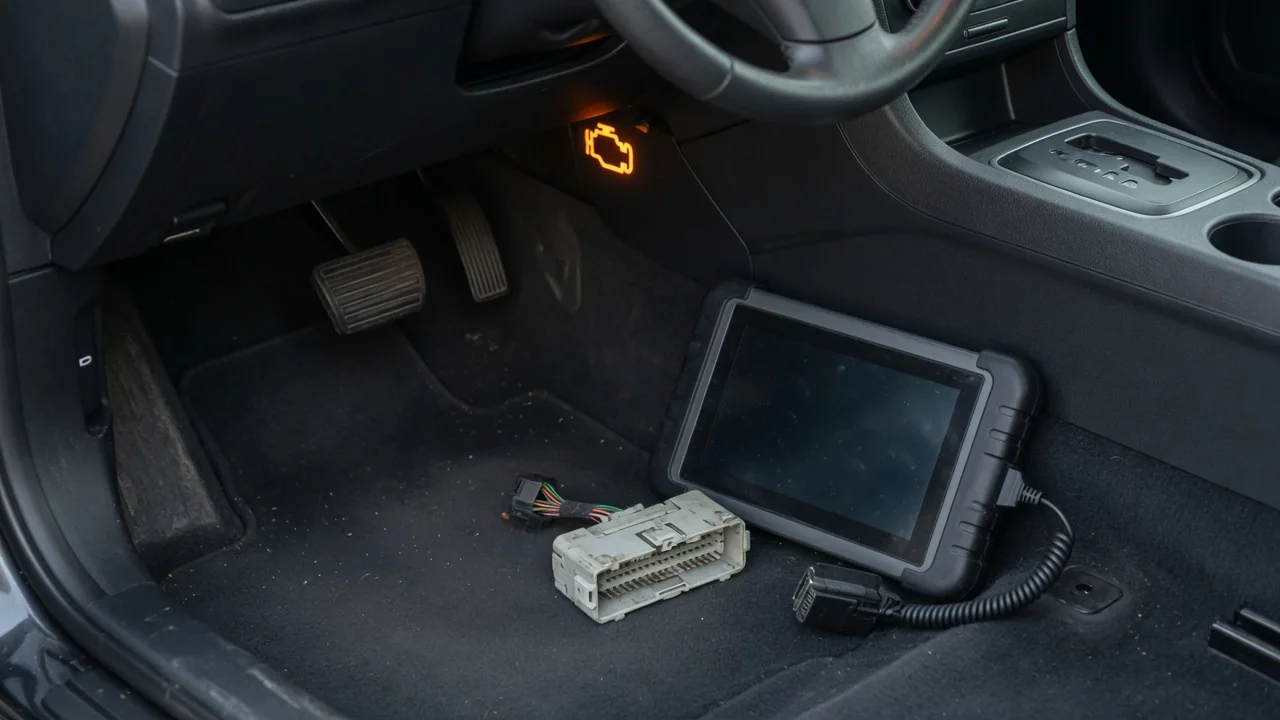
P0220 through P0224 describe throttle or accelerator pedal position sensor B circuit problems the control module recorded, not a confirmed failed part. A P0222 code, P0223 code, P0221 code, or P0224 code reports how that channel behaved: circuit, range or performance, low or high input, or intermittent. Nearby P0225 through P0229 codes belong to sensor C. Reduced engine power or limp mode may appear, but vehicle service information still governs interpretation.
P0220: Identify the Sensor B Circuit Before Interpreting the Fault
A P0220 code identifies a throttle position sensor or accelerator pedal position sensor or switch B circuit malfunction. That report is a monitored electrical problem, not proof of which part failed. Sensor B names a circuit or signal channel the control module watches and does not reliably identify a separately replaceable sensor. The exact vehicle's service information must supply the definition, sensor location, circuit identification, and setting criteria before the fault is interpreted.
The complete scan report matters because accompanying codes about reference voltage, sensor ground, or another position signal show whether the module saw a shared supply issue or a single signal-voltage path. Freeze-frame data records operating conditions when the P0220 code set. Those details help a technician choose which circuit to verify first instead of treating the throttle body or pedal assembly as already failed.
P0221: What a Range or Performance Fault Establishes
A P0221 code concerns the sensor B circuit's range or performance under the vehicle's specified monitoring conditions. A signal voltage can still be electrically present while the reading fails expected behavior or plausibility checks against another position signal. P0221 therefore shows that the monitored B channel did not behave as the strategy requires. It does not, by itself, prove a failed throttle position sensor or accelerator pedal position sensor.
Possible contributors include a sensor fault, poor contact at connector terminals, a wiring harness problem, or a mechanical concern at the pedal or throttle where the vehicle's diagnostic procedure supports that check. Vehicle-specific test criteria must be applied before attributing P0221 to the pedal assembly or throttle body. Replacing either without that confirmation treats the code as a parts order instead of evidence still needing interpretation.
P0222 and P0223: Low and High Sensor B Circuit Inputs
Subject to confirmation in vehicle-specific service information, P0222 indicates a low circuit input on the sensor B channel, and P0223 indicates a high circuit input. A P0222 code and a P0223 code describe the monitored electrical input, not how far the driver pressed the pedal and not how much power the engine produced. Low and high refer to signal voltage relative to that circuit's strategy limits, not to pedal travel as a driving sensation.
A low or high input can come from a signal-wire fault, incorrect reference voltage, a problem on sensor ground, damaged connector terminals, or an internal sensor fault. None of those causes is certain from P0222 or P0223 alone. Voltage thresholds, pin assignments, and circuit measurements belong to the applicable service procedure and qualified testing, not to guesswork from the code number.
P0224: Documenting an Intermittent Sensor B Signal
P0224 identifies an intermittent sensor B circuit fault. A P0224 code can store after an intermittent signal that later looks normal during inspection, so a quiet live reading does not erase the earlier event. Record when symptoms occurred, including weather, engine temperature, and whether the vehicle was starting, idling, or accelerating. Those notes travel with the stored code and help later testing of the wiring harness and connector terminals.
Loose connections, damaged wiring, corrosion, or an internal sensor fault can produce intermittent behavior without confirming a diagnosis. Freeze-frame data shows conditions when the module captured the event, and professional signal capture can watch the B channel in a controlled shop setting. Deliberately reproducing a loss of throttle response on the road is unsafe. Document the concern and have the circuit evaluated with the correct procedure.
P0225–P0229: Recognizing the Adjacent Sensor C Code Family
P0225 denotes a throttle or pedal position sensor or switch C circuit malfunction, and a P0225 code should be read that way until service information confirms the wording. P0226 denotes range or performance, so a P0226 code is not a restatement of P0221. P0227 is low input, P0228 is high input, and P0229 is intermittent. A P0227 code, P0228 code, or P0229 code therefore belongs to sensor C, not sensor B.
Channel C identifies a monitored circuit or signal path and does not prove a third standalone sensor exists on every vehicle. Verify each definition and the meaning of C for the exact vehicle before interpretation. These codes require the vehicle's C-circuit diagnostic procedure and cannot establish a sensor B fault. Shared reference voltage or sensor ground problems can still set codes in both families together.
Reduced Power, Pedal Response, and When to Stop Driving
Symptoms vary by vehicle and may include an engine warning light, reduced-power operation, limited acceleration, or inconsistent pedal response. Some drivers notice limp mode; others feel only sluggish throttle. Those sensations do not map onto P0222, P0223, or any other single code in this group. Reduced engine power is a protective reaction when the module distrusts a position signal, and the warning light can also appear with little change in how the vehicle drives.
Limp mode is a protective operating strategy and does not identify the failed part. If pedal response becomes unpredictable or available power cannot support safe travel, move out of traffic when it is safe and arrange assistance. Limit owner observations to a safely parked vehicle, including warning lamps and notes about when the problem appeared. Road testing intended to trigger the fault, and any attempt to bypass reduced-power protection, should not be done.
What Testing Should Establish Before Parts Are Replaced
Save stored and pending codes, freeze-frame data, and symptom notes before clearing anything. Clearing a code does not repair its cause. With the ignition off, an accessible visual check may look for obvious wiring-harness damage or a loose connector. Do not probe terminals, disassemble components, or force a throttle plate. Further checks belong to a technician using the correct diagram.
A technician may check supply and ground integrity, circuit continuity, connector condition, and live position signals with the correct wiring diagram and test procedure. Evidence must isolate the fault before a sensor, pedal assembly, throttle body, wiring repair, or control-module work is recommended. Repair verification includes expected signal operation and watching for recurrence, and any calibration or relearn is performed only when the vehicle's service procedure requires it after the repair.