P0206–P0212 Injector Circuit Codes: Cylinders 6 Through 12
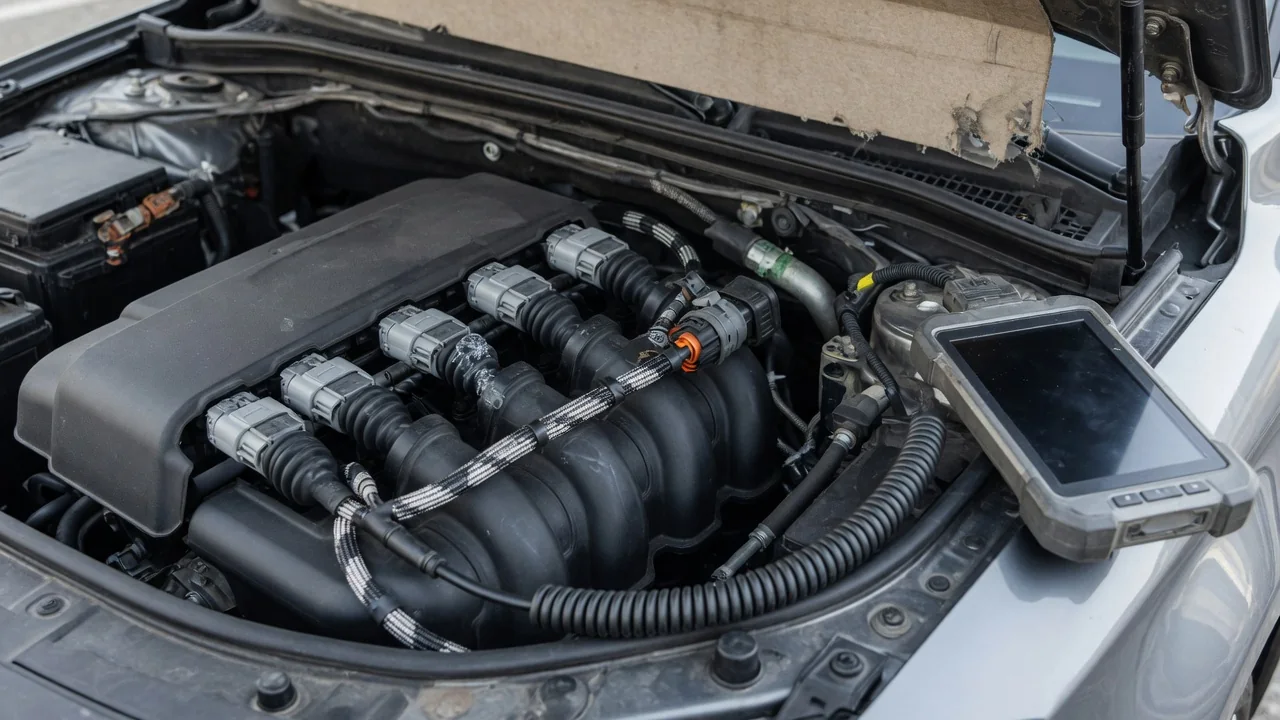
P0206, P0207, P0208, P0209, P0211, and P0212 belong to a family of injector circuit malfunction codes for higher-numbered cylinders. Each stored code reports that the control module saw electrical behavior outside expected conditions on the indicated injector circuit. The code is evidence to interpret, not proof that an injector, wiring harness, or injector driver has failed. Confirm cylinder identification and the exact description in vehicle-specific service information before locating components.
What P0206 Through P0212 Mean for Each Cylinder
P0206 identifies an injector circuit malfunction associated with cylinder 6, P0207 with cylinder 7, P0208 with cylinder 8, and P0209 with cylinder 9. P0210 maps to cylinder 10, P0211 to cylinder 11, and P0212 to cylinder 12. These codes do not name a failed part; they point to electrical behavior the control module associated with that cylinder's injector circuit. Bank layout, firing order, and physical injector location still depend on the engine configuration, so the displayed number is only a starting reference for cylinder identification.
Before locating an injector connector or tracing a wiring harness, read the exact code description, engine configuration, and cylinder numbering in vehicle-specific service information. Manufacturer-dependent numbering can place cylinder 6 or cylinder 8 on different banks, and V8, V10, and V12 layouts do not share the same physical map. If a scan tool reports P0211 or P0212 on an engine that has fewer than eleven or twelve cylinders, verify the vehicle identification, the reporting module, and the scan-tool interpretation rather than searching for a cylinder that does not exist.
What Causes the Control Module to Set an Injector Circuit Code
The control module monitors injector circuit electrical behavior while the engine runs under the enabling conditions defined for that injection system. When voltage, current, or the inferred circuit response falls outside expected conditions, it can store P0206, P0207, P0208, P0209, P0211, or P0212 for the affected cylinder. Open circuits, shorts to power or ground, and abnormal electrical resistance are typical electrical reasons a monitor can trip, but detection thresholds and sampling windows are not identical on every vehicle. Enabling conditions may include engine speed, battery voltage, and injector command state.
A stored injector circuit code does not establish injector clogging, fuel pressure loss, or a mechanically damaged cylinder. Those mechanical and hydraulic problems can cause an engine misfire, yet they do not by themselves prove the electrical circuit failed the monitor. The same caution applies in reverse: a circuit code can appear with little drivability complaint if the fault is brief or occurs only under a narrow set of conditions. Treat the code as an electrical-circuit flag and use freeze-frame data to see the operating point when the module set it.
Wiring, Connector, Injector Coil, and Driver Faults
Damaged wiring, a loose injector connector, corrosion, and poor terminal contact can interrupt current through the injector coil and produce an injector circuit malfunction on cylinder 6 through 12. Chafed insulation, a pinched harness, or a connector not fully seated after engine-bay work can create an open, a short, or high resistance the module sees as out of range. Heat, vibration, and oil around the injector connector often worsen terminal contact over time. Electrical continuity still has to be confirmed with vehicle-specific tests rather than assumed from appearance.
An internal injector electrical fault, such as an open or shorted injector coil, is a possible cause that requires testing. A shared power supply, ground, or fused feed can affect more than one injector, so P0208 with P0209 or P0211 with P0212 may indicate a common circuit rather than two independent coil failures. An injector driver inside the control module can fail, but that conclusion comes last. Check wiring, connector contact, and injector electrical behavior before condemning the module, since a shorted circuit can damage a driver and a driver fault can mimic a wiring fault.
Symptoms That Require Prompt Attention
An injector circuit malfunction on P0206, P0207, P0208, P0209, P0211, or P0212 may appear with a rough idle, engine misfire, hesitation, reduced power, hard starting, or an illuminated malfunction indicator lamp. Not every vehicle will show all of those signs, and a brief electrical fault can set a code with little more than a lamp. Intermittent wiring or connector problems may produce symptoms only under particular operating conditions, such as heat soak, a wet engine bay, or a specific engine speed where vibration moves a terminal. Freeze-frame data helps capture that operating point.
If the engine shakes severely, stalls, loses major power, or the malfunction indicator lamp flashes, stop safely and arrange assistance rather than continuing to drive. A flashing lamp is commonly associated with a misfire that can overheat a catalytic converter, and a cylinder that is not injecting as commanded can contribute to that condition. Visible fuel leakage or a strong raw-fuel odor is a different emergency: shut the engine off safely, avoid restarting it, and wait for professional assessment. Do not attempt to reseat connectors or inspect wiring while fuel is leaking or the engine is running.
Safe Observations to Record Before Diagnosis
Before any clearing or parts replacement, record all stored and pending codes, available freeze-frame data, and when the symptoms occur. Note whether P0206 appeared alone or with P0207, P0208, P0209, P0211, or P0212, because multiple injector circuit codes can change the diagnostic path toward a shared feed or a module issue. Capture engine speed, load, coolant temperature, and fuel-system status from freeze-frame if the scan tool provides them. That snapshot is often more useful than a later guess about whether the fault happened at idle or under load.
Also note recent repairs, engine-bay work, or the conditions around the first warning without assuming they caused the fault. With the engine off and cool, look at accessible wiring and injector connectors for obvious damage, oil intrusion, or a displaced connector, without unplugging terminals or probing pins. Do not open fuel lines, apply battery voltage to injectors, test energized connectors, or reach near moving or hot engine parts. Those actions can create a fire hazard, damage an injector driver, or cause injury, and they do not substitute for vehicle-specific electrical tests.
Professional Tests and Confirmation After Repair
Vehicle-specific wiring diagrams and diagnostic procedures guide checks of injector power, wiring integrity, terminal contact, and control signals for the cylinder named by P0206 through P0212. A technician may measure electrical continuity, resistance, and voltage under the conditions the procedure allows, then compare results with the specifications for that injection system. Waveform testing of injector current or voltage can show an open coil, a shorted winding, or a driver that is not switching, but only with appropriate equipment and the correct pinout. Guesswork at the connector without a diagram risks damaging terminals or misidentifying the circuit.
Select a repair only when evidence supports a wiring, injector, or injector driver fault. A code is not an automatic instruction to replace the injector on cylinder 6, 7, 8, 9, 11, or 12. After the repair, confirmation includes a rescan for stored and pending codes, an assessment of idle quality and misfire, and suitable operation under the original fault conditions when that is safe. Clearing P0206, P0207, P0208, P0209, P0211, or P0212 without that follow-up does not prove the circuit now meets expected conditions.