P0153 Code: Bank 2 Sensor 1 Slow Response Explained
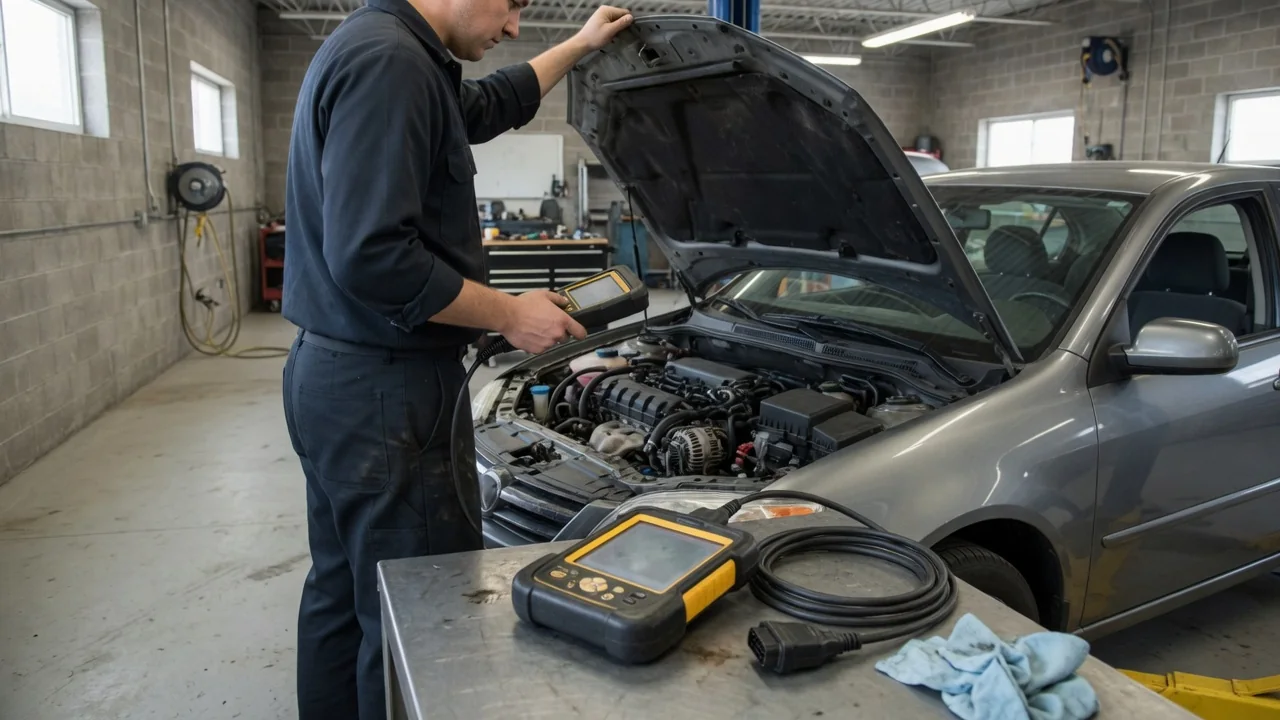
A P0153 code reports that Bank 2 Sensor 1, the upstream oxygen sensor on the bank that does not contain cylinder 1, responded too slowly for the control module's monitor. The code is a detected-condition flag, not proof that the sensor has failed. Related circuit codes such as P0150, P0151, P0152, and P0154 can appear in the same scan and change how diagnosis should proceed. Confirm the exact engine, then interpret freeze-frame data against that vehicle's service information.
What P0153 Means and What the Code Establishes
P0153 identifies an oxygen sensor circuit slow response for Bank 2 Sensor 1. During the applicable monitor, the control module compared the upstream oxygen sensor's switching or tracking behavior with expected oxygen sensor response time and judged the signal insufficiently responsive. That judgment is a circuit-condition result, not a parts verdict. Closed-loop fuel control uses this upstream reading to adjust injector pulse, so a sluggish signal can delay mixture trim. Sensor technology varies by powertrain, so do not assume a universal waveform when you first see the P0153 code.
Before treating scan data as diagnostic proof, open the service information for that engine and year. Monitor enable criteria and pass-fail limits are manufacturer-dependent, so a live reading that looks slow on one platform may be normal on another. Freeze-frame data shows the operating point when P0153 set, which helps recreate conditions rather than guess at a failed part. The code establishes only that the module saw a slow-response condition. Confirm wiring, exhaust integrity, and fueling before condemning Bank 2 Sensor 1.
Finding Bank 2 Sensor 1 on the Vehicle
Bank 2 is the cylinder bank that does not contain cylinder 1, and Sensor 1 is the upstream oxygen sensor mounted ahead of the catalytic converter serving that bank. That placement puts the sensor in the exhaust stream used for closed-loop fuel control on Bank 2. Cylinder numbering is engine-specific, so a diagram for the installed engine is required before labeling a bung as Bank 2 Sensor 1. Driver-side and passenger-side shortcuts fail on inline engines, transverse V layouts, and some longitudinal designs.
Engine layout and exhaust routing decide which pipe is Bank 2 and how hard that sensor is to see. A V engine may place upstream sensors on opposite manifolds, while an inline engine can still use Bank 2 labeling on dual-converter designs. Confirm the exact engine code before following access advice, because a related family can route the Bank 2 Sensor 1 bung differently. Limit owner checks to visible connectors and harness routing with the engine off and cool. Underbody work near hot exhaust belongs to a properly equipped professional.
Symptoms and Driving Decisions With P0153
A steady check-engine light is often the only change a driver notices with P0153. The module can set the code during a monitor even while drivability feels ordinary, because oxygen sensor response time is judged against internal timing rather than a stall or surge. Rough idle, hesitation, or higher fuel use can appear when mixture control is disrupted, yet those P0150 symptoms also arise from ignition, intake, or fuel-delivery problems. Treat the light as a request for diagnosis, not proof that Bank 2 Sensor 1 has failed.
How soon you need service depends on engine behavior and other warnings. If the vehicle otherwise runs normally with a steady lamp, continue with reasonable caution and schedule prompt diagnosis so fuel trim and catalyst monitoring are not left unexamined. Stop as soon as it is safe and arrange assistance if the check-engine light flashes, the engine misfires severely, power drops sharply, or exhaust fumes enter the cabin. Those conditions point past a slow-response report to a safety or damage concern that P0153 alone does not describe.
Conditions That Can Cause Slow Sensor Response
An aging or contaminated upstream oxygen sensor can slow its reaction to exhaust oxygen changes, which is one reason the module stores P0153. Silicone, coolant, oil, or fuel residue can coat the sensing element and stretch oxygen sensor response time without an obvious open circuit. That possibility is not a replacement order; the part remains a suspect until testing supports it. Damaged sensor wiring, a corroded connector, and heater-circuit faults that keep the element from reaching temperature can produce the same muted signal.
An exhaust leak at or ahead of Bank 2 Sensor 1 can pull outside air into the stream or disturb the pulse the sensor should read, so the module may see a delayed oxygen signal. Intake vacuum leaks, unbalanced fueling, and other operating faults can also move the mixture so the upstream reading looks sluggish during the monitor. Those problems change what the sensor reports rather than proving it is defective. Investigate leak and fueling evidence with the circuit so P0153 is not treated as an isolated sensor event.
Related Bank 2 Sensor 1 Codes in the Scan Report
P0150 is an oxygen sensor circuit malfunction for the same Bank 2 Sensor 1 position, often stored when the module cannot interpret the circuit as a whole. A P0150 code may bring a check-engine light and changes in running quality or fuel use, yet P0150 symptoms cannot name the failed part. P0151 is a low-voltage circuit code at that same sensor. Do not read a P0151 code as proof of a lean mixture or a dead sensor until vehicle-specific tests separate a genuine low signal from wiring, grounds, or exhaust-air dilution.
P0152 is a high-voltage circuit code for Bank 2 Sensor 1. A P0152 code does not by itself prove a rich condition or a failed sensor; confirm the reading against that vehicle's procedure, including sensor wiring. P0154, listed as a P0154 code for no activity detected, means the module did not see expected circuit activity from that upstream oxygen sensor. Record every companion code before focusing on P0153, because a P0154 result or a P0150 circuit malfunction can change the test order.
How to Diagnose P0153 and Confirm the Repair
Start by recording stored and pending codes, freeze-frame data, current symptoms, and any recent repairs before clearing memory. That snapshot preserves the operating point that produced P0153 and shows whether a P0150 code, P0151 code, P0152 code, or P0154 code is also present. With the engine off and cool, an owner can look for an unplugged connector, rubbed sensor wiring, or a damaged harness near Bank 2 Sensor 1. Do not probe circuits or remove exhaust parts; those steps need the correct pinout and heat protection.
Professional diagnosis may evaluate oxygen sensor response time, fuel trim during closed-loop fuel control, wiring continuity, heater operation, and intake or exhaust leaks using procedures published for that vehicle. Avoid a universal voltage or switching-time threshold, because those limits are not shared across sensor designs. After the verified cause is corrected, run the applicable monitors and confirm that Bank 2 Sensor 1 behaves within the specified window under the freeze-frame conditions. Clearing the check-engine light without those checks does not prove the P0153 repair.