Outer CV Joint Symptoms: Noise, Failure Signs and What to Check
Direct Answer
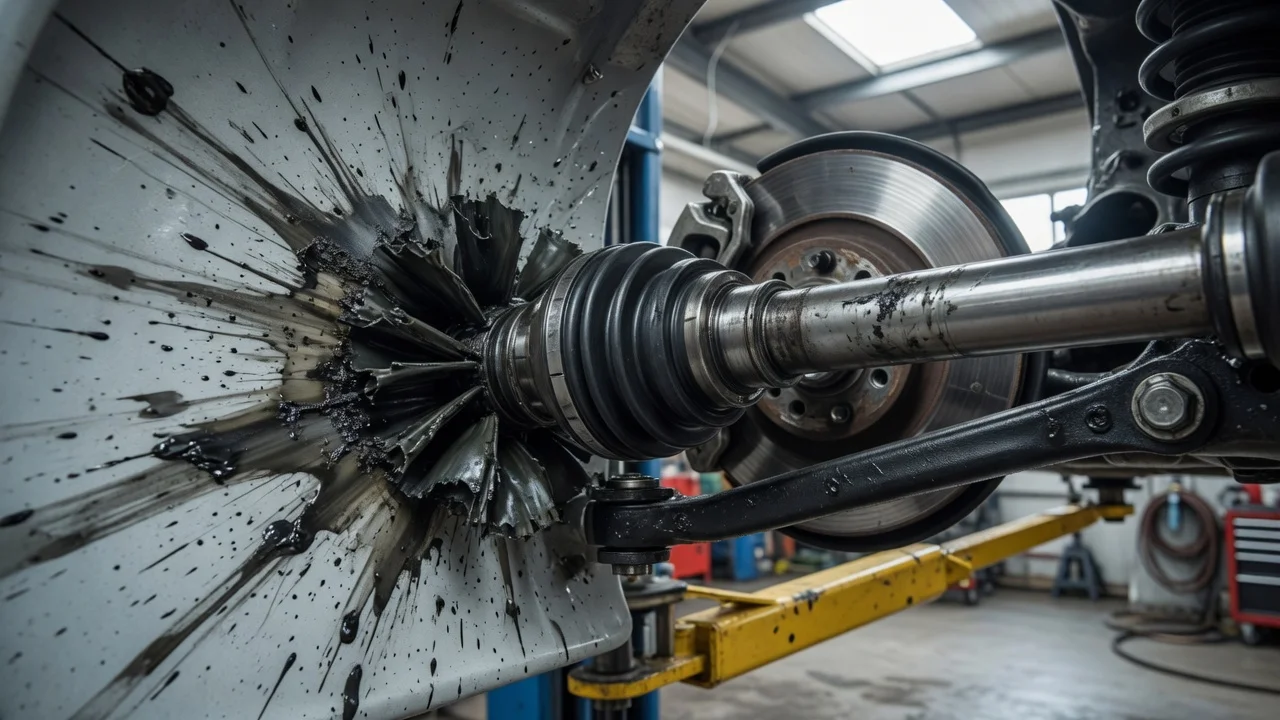
A defective outer constant velocity (CV) joint usually makes a rhythmic clicking, popping or snapping noise that is most obvious during sharp turns or when accelerating through a turn. This is because the outer joint operates at a sharper angle during cornering. A bad outer CV joint can also produce a steady knocking under acceleration, a cyclic vibration felt through the steering wheel or floor, and in some cases a tearing of the rubber boot that leads to grease splatter around the wheel.
Scope and Confusion Points
The outer CV joint is the flexible coupling at the wheel end of a front-wheel-drive or all-wheel-drive axle shaft. It allows the wheel to steer and move with the suspension while still receiving drive torque. A worn inner CV joint is typically farther inboard, near the transmission or differential, and tends to produce a shudder or vibration during acceleration rather than a clicking during turns. A worn wheel bearing can also make a rhythmic noise, but it usually changes with vehicle speed and may vary when steering weight is shifted from one side to the other.
Primary Outer CV Joint Symptoms
Clicking or popping noise during sharp turns, especially when accelerating; The sound is often loudest at full steering lock. It may repeat in time with wheel rotation. Grease visible around the inner wheel, suspension parts or the outside of the CV boot; A split or loose boot allows grease to escape and water and grit to enter the joint. Vibration or shaking during acceleration; A worn outer joint can create a cyclic vibration that speeds up with road speed. Knocking or clunking when transitioning from coasting to acceleration; Excess wear inside the joint creates lash that is felt when drive torque changes direction.
What Could Explain These Symptoms and How to Distinguish Causes
Clicking during turns can be caused by an outer CV joint with brinelled or pitted ball tracks, by a broken cage, or by contamination from a torn boot. It can also be caused by a damaged wheel bearing, a loose axle nut, or debris contacting the rotor shield. Because these causes overlap, observation should separate them before replacing parts.
A useful discriminating check is to drive slowly in a tight circle in both directions. Clean outer CV joint noise typically remains rhythmic and happens under load during the turn. A wheel bearing noise often changes or reduces when steering sharply shifts weight away from the affected side, meaning a left-hand turn loads the right bearing and may quiet the right side. If the clicking does not clearly follow one side or changes character with steering load, inspect the axle nut torque and driveshaft splines before condemning the outer joint.
If the rubber boot is torn, check how long the joint has run without grease. A fresh tear with grease still present may allow boot replacement and repacking. A dry, gritty or discolored joint with visible rust or pitting on the ball tracks usually requires joint or axle assembly replacement. Do not treat grease leakage alone as proof that the joint is worn; confirm noise or looseness by rotating the wheel with the steering turned and listening or feeling for notchiness.
Vehicle-dependent factors matter. Some platforms place the outer joint very close to the brake rotor heat shield, and a bent shield can produce a similar rhythmic scrape during turns. Some all-wheel-drive systems route the front axle through a support bearing that can fail and mimic outer joint symptoms. Check the relevant model year and drivetrain configuration before assuming a universal failure pattern.
What Is Missing from This Guide
This article does not provide torque specifications for the axle nut or suspension fasteners because they vary by vehicle. It also does not list specific part numbers, aftermarket brands or labor times. Confirm those values in the applicable service information for the vehicle.