OBD2 Scanner Live Data and Freeze Frames Explained
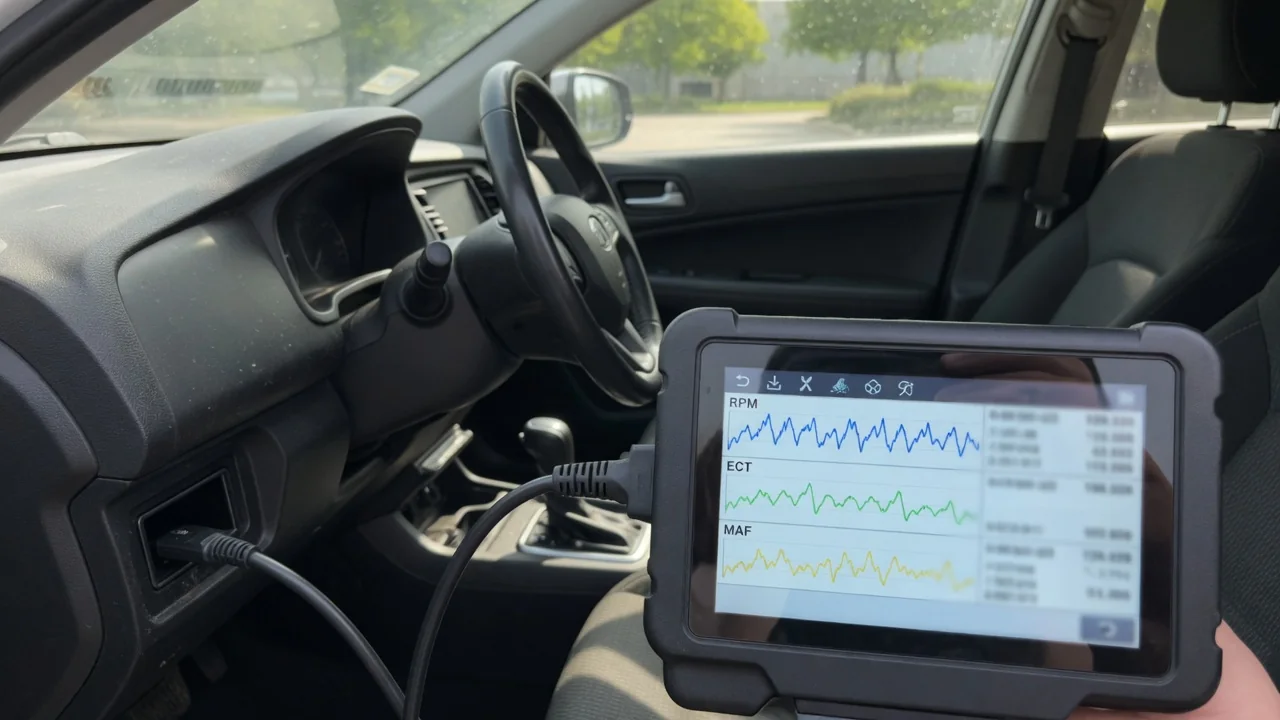
A check engine light tells you something was noticed, not what the engine was doing at the time. A live data OBD2 scanner fills that gap by showing sensor readings as they change, and freeze frame data preserves the conditions when a fault was stored. This guide explains what those readings mean, how to interpret them carefully, and where their usefulness ends.
What OBD2 Scanner Live Data Shows and How It Differs From Stored Codes
Live data is a stream of parameter IDs, or PIDs, reported by the engine control module through the OBD-II port while the engine is running or the ignition is on. Each PID is a single value, such as engine speed or coolant temperature, refreshed continuously. Diagnostic trouble codes work differently. A stored code records that a monitor failed, a pending code flags a fault seen but not yet confirmed, and a permanent code remains until the vehicle itself verifies the repair. A code names the circuit or system that failed a test, rarely the reason.
OBD2 scanner live data supplies that missing context. Generic PIDs commonly include engine speed, vehicle speed, coolant temperature, throttle position, calculated engine load, short-term and long-term fuel trim, and oxygen sensor signals. Watching them together shows how the engine is actually behaving around the fault. The list is not identical on every car, though. Which parameters appear depends on the vehicle, its model year and the control modules it supports, so a PID visible on one car may simply be absent on another without anything being wrong with the tool.
Features That Matter in an OBD2 Scanner With Live Data
When choosing an OBD2 scanner with live data, graphing mode deserves attention. A numeric list updates too quickly for the eye to catch a signal that drops out for a fraction of a second, whereas a plotted line shows the gap, and a sensor that responds sluggishly appears as a lazy slope rather than a crisp change. Custom PID selection matters as well. On many tools, the requested parameters are polled in turn, so displaying only the handful relevant to the problem can improve the refresh rate noticeably.
Data logging with playback lets readings captured during a drive be reviewed later while parked, which is both safer and more thorough than glancing at a screen. It is also worth understanding the two tiers of information. Generic OBD2 data covers emissions-related parameters defined by the standard, while enhanced manufacturer data reaches deeper into brand-specific parameters and other modules. Support for enhanced functions varies by tool, vehicle and model year, so confirm coverage for your exact car in the tool maker's own documentation before relying on them.
Reading Key Live Data PIDs Without Jumping to Conclusions
Fuel trims describe how much the control module is correcting fuel delivery. Short-term fuel trim reacts moment to moment, while long-term fuel trim reflects the learned correction over time. Consistently positive values mean fuel is being added, which may suggest the engine is running lean; consistently negative values suggest the opposite. These are clues, not verdicts. On many engines, upstream oxygen sensor voltage sits steady or inactive after a cold start and then begins switching actively once the engine is warm and running steadily, though wideband air-fuel sensors behave differently and report differently.
Coolant temperature sensor, intake air temperature and mass airflow reading values only mean something when checked against the manufacturer's specifications for that exact vehicle, because normal ranges differ between engines. Compare readings at warm idle and again at a steady higher engine speed, and note the conditions each time, since a trim problem that fades as revs rise points somewhere different from one that grows. A single odd value may come from the sensor, its wiring or connector, or from a fault elsewhere that the sensor is reporting accurately.
How Freeze Frame Data Captures the Moment a Code Set
Freeze frame data is a snapshot of selected parameters recorded at the moment an emissions-related fault was stored. Typical fields include calculated engine load, coolant temperature, engine speed, vehicle speed and fuel system status, often alongside fuel trims. Read together, they describe the situation: a low coolant temperature with little load suggests a cold start, steady speed with moderate load suggests highway cruising, and zero vehicle speed points to idle. Knowing that lets the same conditions be recreated so the symptom can be watched in live data, with safety kept in mind.
Clearing codes usually erases the freeze frame along with them, so write down, photograph or save the snapshot before any reset. Once gone, that record of the original conditions cannot be recovered until the fault returns. Interpretation also depends on knowing what the code actually means. Generic codes share standardized definitions, but manufacturer-specific codes can mean different things on different makes, so look up the definition for your particular vehicle before drawing conclusions from the freeze frame context rather than assuming a universal meaning applies.
Using an OBD2 Live Data Scanner Safely During Testing
An OBD2 live data scanner should never compete with the road for the driver's attention. View readings while parked, or have a passenger monitor the screen during a road test and call out anything notable; recording the drive for later playback achieves the same goal. Because the OBD-II port usually sits low in the driver's footwell area, route and secure the cable so it cannot snag the pedals, wrap around the steering wheel or restrict the driver's movement.
Stationary testing has its own hazards. Never run the engine in a closed garage or other enclosed space, because exhaust gases accumulate quickly and carbon monoxide gives no warning. If the hood is open with the engine running, keep hands, sleeves and tool leads away from belts, pulleys and hot components, and remember that electric cooling fans can start without notice. Wireless adapters deserve a mention too: left plugged in, some keep drawing power and may drain the battery on certain vehicles, so unplug them when testing is finished.
Limits of Live Data and When to Seek Professional Diagnosis
Live data shows what the control module reports, which is not the same as proof that a part has failed. A reading passes through a sensor, wiring and software before reaching the screen, and any of those can mislead. Replacing parts on the strength of one parameter often wastes money and leaves the fault in place. Some situations call for professional testing from the outset: intermittent faults, several related codes, misfires, overheating, brake or airbag warnings, and a flashing check engine light, which generally signals a misfire severe enough to risk catalytic converter damage.
Technicians have methods that go beyond a typical consumer scanner. Manufacturer-level scan tools reach modules and tests that generic tools cannot, oscilloscopes show a signal's actual shape, smoke testing reveals intake and evaporative leaks, and pinpoint tests verify a circuit step by step. Your own groundwork still helps. Bring saved recordings, the freeze frame snapshot and notes on when the symptom appears, such as temperature, speed and weather, so the shop can begin with evidence instead of trying to reproduce the problem from scratch.