Nissan Transmission Fluid Change: Choosing the Procedure for Your Model
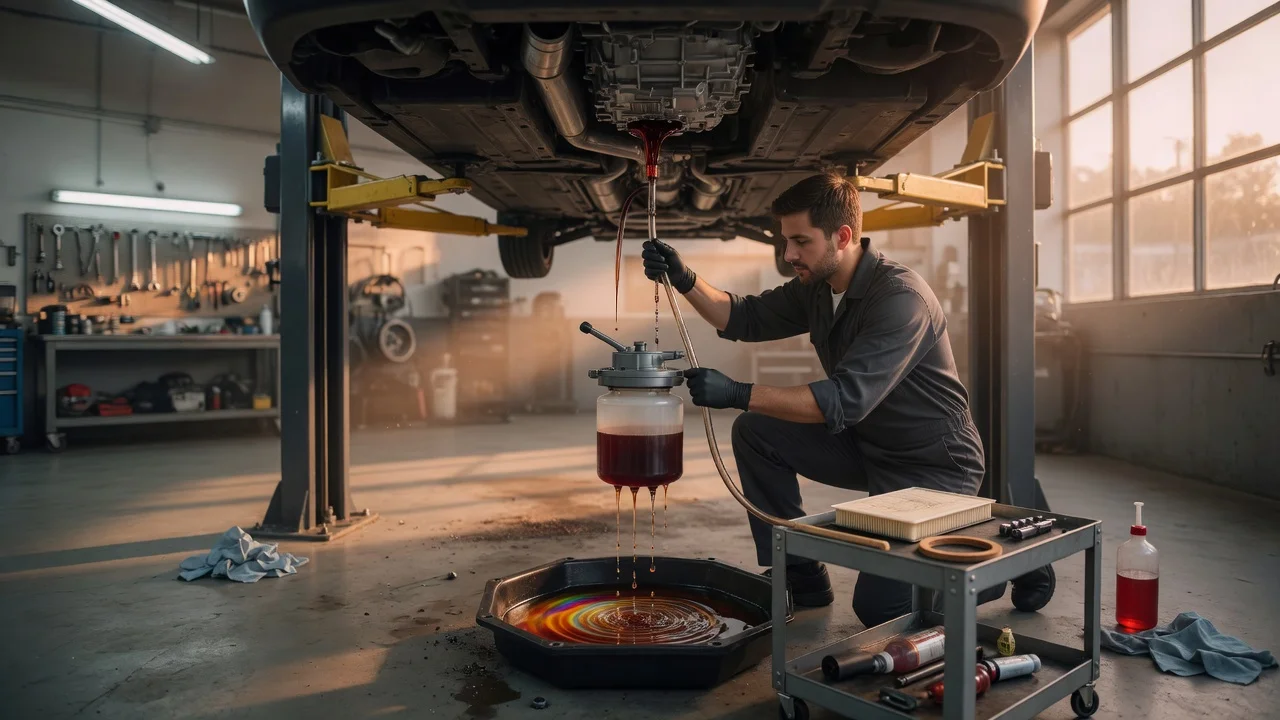
What the right Nissan fluid change actually is
A Nissan transmission fluid change is not a single recipe. The correct job is the one that matches the gearbox in that vehicle—an Xtronic continuously variable transmission (CVT), a conventional automatic, or a manual—and uses only the fluid Nissan specifies for that model year, engine, and transmission code. For most owner-level work, that means a drain-and-fill or a pan drop with a new gasket and, where the pan is designed for it, a new strainer, then a fill to the specified level using the method in the factory procedure.
A high-pressure machine flush is a poor default for Nissan CVTs and is often outside factory practice for those units. Fluid grade, fill quantity, drain-plug and pan-bolt torque, the temperature window for a level check, and the replacement interval all change by transmission family and market. Confirm those values in the owner's manual or factory service information for that vehicle before you buy fluid or loosen a plug. This guide explains how to choose among the usual methods and how a typical service is sequenced; it does not replace the figures printed for your VIN-level configuration.
Identify the gearbox before you pick a method
Nissan has used three owner-relevant gearbox families in recent decades, and a single model name can switch among them by year, engine, trim, and market. The fluid chemistry, pan design, and fill method follow the gearbox, not the badge on the trunk.
Xtronic CVT: used on a large share of passenger Nissans from the late 2000s onward in many markets, including numerous Altima, Sentra, Rogue, Murano, Maxima, Pathfinder, Juke, Kicks, and Versa configurations. Many of these units have no conventional dipstick and are filled through a plug, often to an overflow level at a specified fluid temperature. Conventional automatic: common on Frontier and Titan trucks, older passenger cars, and some sports models. These more often have a pan-mounted filter or strainer and, on many years, a dipstick. Manual: offered on selected Sentra, Versa, Z, and truck configurations depending on year and market. These take a gear lubricant specified for that transaxle, which is not automatic transmission fluid and is not CVT fluid.
Confirm the type from the owner's manual, the marking on the dipstick handle or filler cap, and a dealer parts lookup by VIN. Do not copy a fluid name or fill quantity from a neighboring model year or from a different engine in the same nameplate. Nissan CVT fluids are typically labeled NS-2, NS-3, or NS-3E; conventional automatics have used various Nissan Matic grades. Those names are not interchangeable by color or by the word “CVT” or “ATF” on a bottle. Use the grade listed for that vehicle, including any official supersession the current Nissan parts system shows for that VIN.
Which service method fits the job
The practical choice is among a drain-and-fill, a pan drop, a full fluid exchange, and a shop service that follows the factory temperature and scan-tool steps. Compare them on how much fluid they actually replace, whether they let you inspect the pan, whether they need a dipstick or a temperature-controlled overflow fill, and whether they expose a CVT belt-and-pulley unit to pressures it was not designed for.
Drain-and-fill: you remove the drain plug, let the pan empty, reinstall the plug with a new washer if specified, and refill through the fill port or dipstick tube. This replaces only the fluid that was in the pan, which is a portion of the total capacity because a large volume remains in the torque converter, cooler, and valve body. Prefer this when the fluid is not badly degraded, the unit must stay sealed, you plan to repeat the service, or you need the lowest-mess owner job. It does not let you replace a strainer or inspect pan debris beyond what comes out the drain hole. Pan drop with strainer or filter service: you unbolt the pan, replace the strainer where the pan is designed for one, clean the magnet, install a new gasket, and refill. Prefer this when the interval has been long, the fluid is dark or has a burnt smell, you want to inspect clutch or metal debris, or the pan gasket is already weeping. It still leaves fluid in the converter and cooler, so it is more complete than a drain-and-fill of the pan only, not a 100 percent exchange. Machine flush or cooler-line exchange: a machine pushes new fluid through the cooler circuit and can replace a larger share of the fill. Consider this only for a conventional automatic, and only when a qualified shop using equipment and a process accepted for that Nissan unit specifies it. It is the wrong first choice for an Xtronic CVT, where factory practice centers on drain, pan service, and a controlled refill rather than a pressurized flush. Dealer or independent shop using the factory fill procedure: choose this when there is no dipstick, the level is set by overflow at a specified fluid temperature, a scan tool is required, the vehicle is under a warranty that demands documented OEM fluid, the history is unknown, or the fluid already shows metal, a burnt odor, or slipping. A shop can also run more than one drain-and-fill to raise the replacement percentage without a flush machine.
On shared criteria, drain-and-fill wins on cost, time, and simplicity when the fluid is still in reasonable condition and you can verify the level afterward. Pan drop wins when inspection and a new strainer matter more than speed. Shop temperature-controlled service wins on sealed CVTs and on any unit whose fill method you cannot complete with a dipstick. Flush wins only in the narrow case of a conventional automatic where the shop process is accepted for that gearbox. Generic “universal CVT” or multi-vehicle ATF that does not list the exact Nissan specification is not a fourth option; it is a mismatch.
Steps for a typical drain-and-fill or pan drop
The sequence below is the owner-level path for a unit you can drain and refill, with the factory level method available to you. It is not a substitute for the torque figures, temperature window, and fill quantity in the service information for that transmission code. If you cannot identify the fill point or cannot measure the level after filling, stop and use a shop that has the procedure and the scan tool.
Prerequisites: the specified Nissan fluid in enough volume for a pan fill plus a margin for topping to the final level; a drain pan large enough for the pan contents; the correct sockets or spline bit for the drain plug and, if used, pan bolts; a new drain-plug washer if the design uses one; a new pan gasket and strainer if you are dropping the pan; a funnel; gloves and eye protection; a parking brake, wheel chocks, and rated jack stands or ramps so the vehicle sits level. Work on level ground. Do not support the vehicle on a jack alone.
Identify the drain plug and the fill point. On many CVTs the fill plug is separate from the drain, and some use an overflow filler that is valid only at a specified fluid temperature with the engine running. Bring the transmission only to the temperature the procedure calls for. Some Nissan CVT level checks are done in a narrow temperature band, with the selector cycled through the ranges while the brake is applied. Guessing a “hot” or “cold” fill on a sealed unit is how overfills and underfills happen. Raise and support the vehicle so the pan sits level. Place the drain pan. Remove the drain plug, or the pan bolts in the sequence given in the service information, and let the fluid drain fully. Note color, smell, and what is stuck to the magnet. Black fluid, a burnt odor, or a heavy load of metal or clutch material is a stop point for professional inspection, not a cue to keep filling. If you are dropping the pan, replace the strainer when the pan is designed for one, clean the pan and magnet, fit the new gasket, and tighten the pan bolts in a star pattern to the factory torque. Look that value up; do not reuse a figure from another Nissan gearbox. Reinstall the drain plug with a new washer if specified, again to the factory torque. Add the specified fluid, starting with the published drain-and-fill quantity for that transmission, then finish with the official level method: dipstick marks at the stated hot or cold condition, or overflow until a trickle at the specified temperature. With the brake applied, cycle the selector through the ranges, recheck the level, and inspect the plug, pan flange, and cooler lines for leaks. Record the date, mileage, and fluid used. Reset a maintenance reminder if the vehicle has one.
The job is complete when the level is correct by that gearbox’s method, there are no new leaks, engagement in every range is normal, and there is no new noise, flare, or delayed drive or reverse. The fluid in the unit must be the specified Nissan product, including any current supersession for that VIN, not a substitute chosen by color.
Professional boundaries sit at the steps they affect. Do not open a sealed CVT fill if you cannot hold the specified temperature and read it with a capable scan tool. Do not mix NS-2 with NS-3 or NS-3E unless the current Nissan parts guidance for that VIN says one grade supersedes the other. Do not use a pressurized flush on an Xtronic unit as a shortcut. Interval is not universal: use the maintenance schedule printed for that year and market, and use the severe-service column when the vehicle tows, idles in traffic for long periods, or runs in very hot conditions. Many Nissan CVT schedules call for inspection and, under severe use, earlier replacement than a casual reading of “lifetime fill” on a normal-service chart would suggest.
Material gaps remain on purpose. Quart or liter capacities, plug and pan-bolt torque in newton-metres, and the exact temperature window for overflow fills vary by transmission code and are not listed here. Whether a given CVT pan has a replaceable strainer is a design detail, not a rule for every Xtronic. If the manual, the filler marking, and the VIN parts record disagree, treat the VIN-level factory information as the authority and have a Nissan dealer or a shop with that information set the fill.