Nissan S13 Adjustable Control Arms: Fitment and Selection
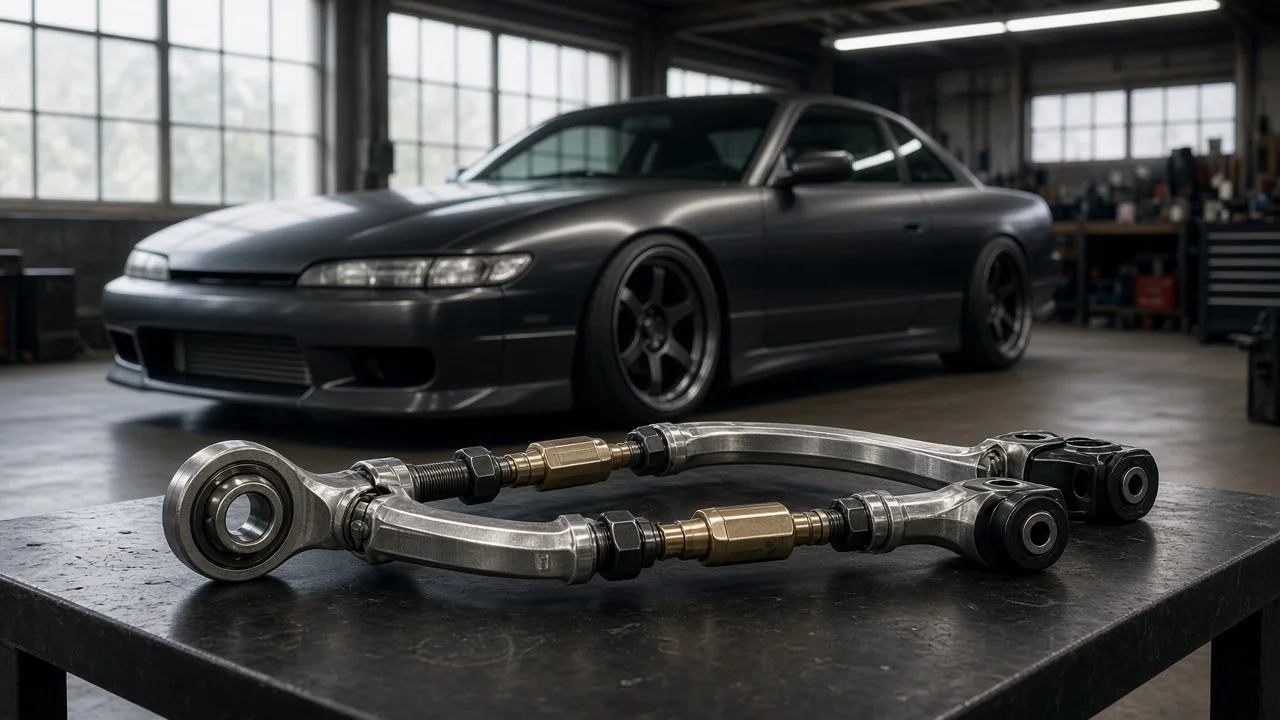
Adjustable control arms let an S13 owner set camber, toe and caster beyond what factory parts allow. That matters once the car is lowered, used on track or set up for drifting. They are also easy to buy wrong, because the S13 chassis has several distinct arms front and rear, each with its own job. This guide explains how to decide which arms you need, how to confirm fitment and which features justify the price.
Define the job the arms must do
Start with the symptom rather than the part. On a lowered S13, the most common complaint is wear on the inner edge of the rear tires from excessive negative camber. That is often combined with rear toe that moves out of range as the ride height drops. Other owners want more caster for steering feel, more front steering angle for drifting, or a way to replace tired factory bushings with something adjustable. Each goal points to a different arm, so a full kit is not automatically the right answer.
Be honest about how the car is used. A daily driver that sees potholes, winter roads and long highway runs has different priorities from a weekend track car or a dedicated drift chassis. Decide how much noise and vibration you will accept and whether you plan to change settings between events. Budget for a professional wheel alignment after installation, and check whether the suspension already has worn parts that should be addressed first.
Match each arm to the adjustment it controls
The S13 uses MacPherson struts up front, and each front wheel is located by a lower control arm and a tension rod. Adjustable tension rods change where the lower arm sits fore and aft, which is the usual way to add caster. Because they also move the wheel within the fender opening, check tire clearance afterward. Adjustable or extended front lower arms are aimed mainly at drift setups that want more steering angle and track width. They change scrub and steering behavior in ways a street car may not benefit from.
The rear suspension is a multilink design. Upper control arms, often called camber arms, set rear camber. Toe arms set rear toe and are worth considering whenever the car is lowered, because toe change through suspension travel becomes more noticeable. Traction arms locate the hub fore and aft and resist movement under acceleration and braking, and adjustable versions give one more way to fine-tune wheel position. For many street cars, rear camber and toe arms solve the actual problem without touching the front.
Check compatibility before you order
Confirm that the listing names the S13 chassis explicitly. The 240SX coupe, hatchback and convertible share the S13 platform with the Silvia and 180SX. However, some cars have been modified with parts from other chassis. Rear arms are often sold as fitting both S13 and S14 cars. Treat that as a claim to verify against your car rather than a guarantee, especially if the knuckles, subframe or hubs have been swapped. Cars with HICAS rear steering, or cars converted with a delete or lock-out kit, need toe arms that suit that configuration.
Then compare the interfaces. Check that the bushing or spherical joint sleeves match the width of the factory mounting points, that the bolt diameters are correct, and that each arm's end style suits the brackets on your car. Some tension rods replace the chassis-side bushing with a spherical joint and may need a different mount. Look at the published length range and make sure your target settings fall comfortably inside it, not at the limit of thread engagement. Finally, note whether new hardware is included and what fastener specification the maker requires. Reusing tired factory bolts on new arms is a false economy.
Features that affect the choice
Joint type is the biggest decision. Rubber bushings keep the car quiet and absorb road shock but allow deflection. Polyurethane bushings reduce deflection with a moderate increase in noise, and they may need periodic lubrication to avoid squeaks. Spherical rod ends, often called pillowballs or heim joints, remove almost all compliance and give the most precise wheel control. The trade-offs are transmitted vibration, more frequent inspection and faster wear on road-driven cars.
Adjustment design matters if you plan to change settings. A turnbuckle-style arm with left- and right-hand threads can usually be adjusted on the car, which simplifies alignment work. Single-ended designs generally require unbolting one end to change length. Look for secure jam nuts, accessible wrench flats and, where offered, boots over rod ends to keep grit out. Material and finish affect longevity. Steel tubing with forged ends is common. Aluminum saves weight but should come with clear guidance on inspection and service life. A durable plating or coating helps where roads are salted.
Separate evidence from labels. Terms like race spec, pro series or drift proven say little on their own. More useful signals are a stated adjustment range, clear installation instructions, replacement rod ends and bushings that are actually available, a defined warranty, and fitment notes written specifically for the S13 rather than a generic model list.
Limitations and ownership costs
Adjustable arms only give you the ability to correct geometry. The correction itself comes from a proper wheel alignment after installation, repeated whenever the ride height changes. The arms will not fix worn ball joints, tired struts, a bent subframe or damaged mounting points. They also cannot compensate for a ride height so low that suspension travel is used up. Before ordering, inspect the existing components for joint play and damage, because new arms on a worn chassis will not deliver predictable handling.
Installation requires safe vehicle support. Lift at the points listed in the factory service manual, place rated jack stands on solid structure, chock the wheels, and never work under a car held only by a jack. Use the torque values from the factory service manual or the arm manufacturer's instructions, not guesses. Where rubber or similar bushings are involved, follow the instructions for tightening pivot bolts with the suspension loaded at ride height. Otherwise the bushings can be locked in a twisted position. Set each arm to the maker's recommended starting length as a baseline before the alignment.
Budget for ongoing costs. Spherical joints and polyurethane bushings need periodic inspection, and rod ends wear faster on rough roads. Recheck fasteners and jam nuts after the first drives and as the maker directs. Watch for clunks or uneven tire wear, and expect to replace joints over time. Threads exposed to water and salt can seize, so clean and protect them according to the manufacturer's guidance if you plan to adjust them again.
Build a practical shortlist
Narrow the field with a few questions rather than a ranking. Which adjustment do you actually need: rear camber, rear toe, front caster or steering angle? Does each listing name the S13 explicitly and account for any swapped components or HICAS on your car? Do the sleeve widths, bolt sizes and end styles match your mounting points? Does the length range keep your target settings well within thread engagement limits?
Then compare ownership factors. Choose a joint type that matches the noise and maintenance you will accept, and prefer designs that adjust on the car if you will tune settings. Check for included hardware, a documented fastener specification, replacement parts and warranty terms. Include the cost of a professional alignment in the same budget. A set of arms that fits, suits your use and can be serviced will serve the car better than the most aggressive option on the shelf.