Nissan Note Supercharger Bypass Valve Location: Where to Look and What to Check
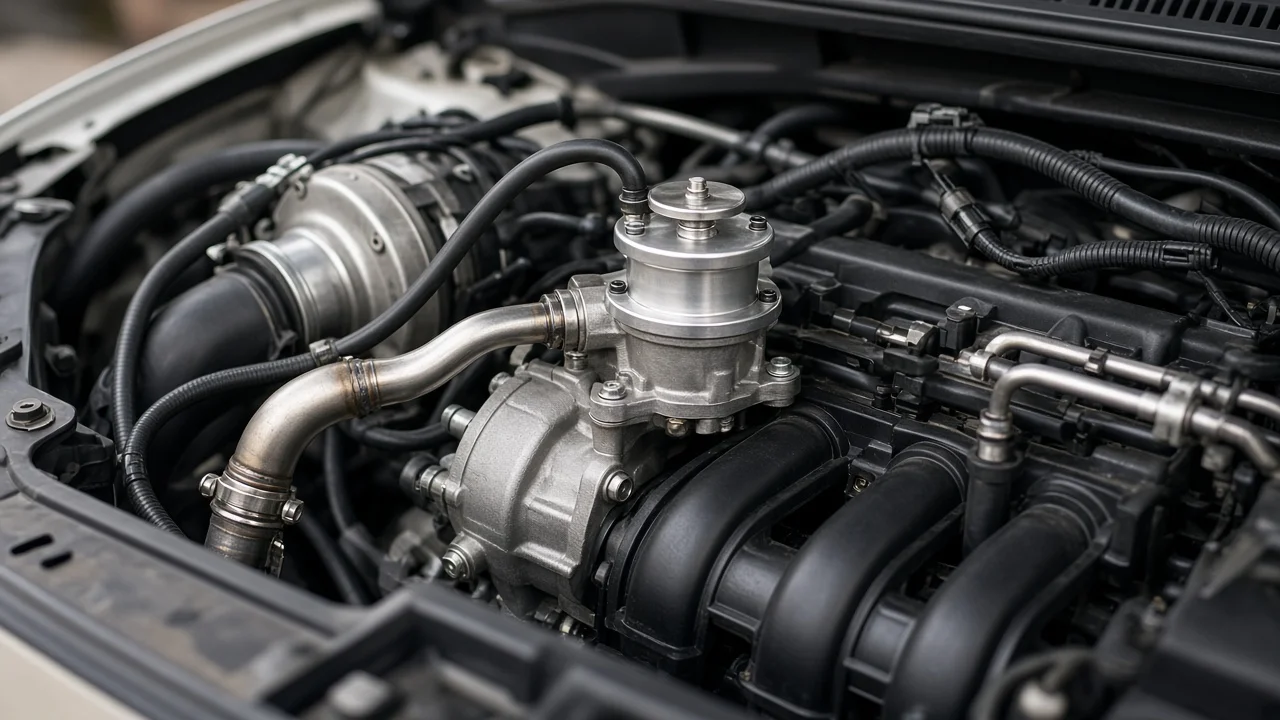
If you are looking for the supercharger bypass valve on a Nissan Note, first confirm that your car has a supercharger. Only certain Note versions use a supercharged engine. On those cars the bypass valve belongs to the supercharger and intake assembly; it is not a separate part hidden elsewhere in the engine bay. This guide covers where to look, what the valve does, which details depend on your exact vehicle configuration, and when you need the factory service information.
Where the bypass valve is located
On supercharged Notes, the bypass valve is on or directly next to the supercharger assembly. These cars use the 1.2-litre three-cylinder direct-injection engine, sold in Europe as the Note DIG-S and also offered in Japan. The valve sits in the air path between the intake side of the supercharger and the boosted side that feeds the intake manifold. To find it, start at the air filter housing and follow the intake ducting to the belt-driven supercharger. The valve and its electrical or vacuum control connection will be on that assembly or the ducting attached to it. You will usually need to remove the engine cover, and sometimes parts of the intake ducting, to see it clearly. The exact position, orientation and access route can vary by market and production period. Whether the valve is sold separately or only as part of a larger assembly also varies, so check the service manual and parts catalogue for your VIN before ordering anything or taking components apart.
Many Notes have no supercharger and therefore no supercharger bypass valve. The Versa Note sold in the United States used a naturally aspirated engine. Earlier Note generations and the e-POWER versions do not use a supercharger either. If no belt-driven compressor is visible in the intake path, the component you are searching for is probably not fitted to your car.
How the bypass valve works
A positive-displacement supercharger moves air whenever it turns, whether or not the engine needs extra air. The bypass valve lets the system control this. When boost is not needed, such as at light throttle, while cruising or with the throttle closed, the valve opens. Air can then circulate around the supercharger instead of being pressurised against a restriction, which reduces pumping losses and unnecessary pressure. When the driver asks for more power, the valve closes and the supercharger builds boost in the intake. On the supercharged Note, the supercharger is also driven through an electromagnetic clutch, so it can be disengaged completely when demand is low. The engine control system coordinates the clutch and the bypass valve so the change between boosted and non-boosted operation stays smooth.
A faulty bypass valve shows up under the operating conditions it controls. A valve stuck open can cause weak acceleration under load because boost is not building as it should. A valve that sticks closed or responds slowly can cause uneven behaviour during light-load driving or throttle changes, or unusual intake noise. These symptoms are not unique to the bypass valve, which is why diagnosis matters before replacing parts.
What changes the answer for your car
Several details affect where the valve sits and how it should be serviced: • Market of original sale: a European Note DIG-S and a Japanese-market supercharged Note may have different documentation, labelling and parts numbering. Imported vehicles may need Japanese-language service material. • Production period: mid-cycle updates can change ducting, connectors or how the supercharger assembly is supplied as a spare part. • Previous work: aftermarket intake parts, earlier repairs or replaced assemblies can move hoses and connectors from their factory positions. The service history is worth reading before you start.
Operating conditions also affect what you will observe. Because the valve's behaviour depends on load, throttle position and temperature, a fault may appear only during particular driving situations and not at idle in the driveway. Record when a symptom happens, such as cold or warm engine, light or heavy throttle, steady cruising or accelerating. That information helps link the problem to the bypass valve or rule it out.
What the owner can do
1) Confirm the engine. Check the VIN, the registration documents or the labels under the bonnet. Make sure the car has the supercharged 1.2-litre engine and not a naturally aspirated or hybrid-type powertrain. 2) Inspect visually with the engine off and cool. Remove the engine cover and follow the intake path from the air filter housing to the supercharger. Look for cracked or loose hoses, disconnected or damaged electrical connectors, split vacuum lines and signs of intake leaks around the ducting near the valve. 3) Check for stored fault codes. A basic OBD scan tool can read them, and a code pointing to the boost control or bypass circuit is a much stronger lead than symptoms alone.
Do not run the engine with intake components removed or the valve disconnected. Do not force the valve mechanism by hand. Both can cause further damage or admit debris into the intake. For routine care, use the maintenance schedule in your owner's handbook or official service booklet rather than a general rule of thumb. Supercharger belt condition, clutch operation and intake components should be checked as part of normal inspection when that schedule calls for it.
Limitations and next step
This article cannot replace the location diagrams, removal procedures, torque values and test specifications in the manufacturer specifications for your exact car. These details depend on market, production date and equipment, and they should come from the official service documentation for your VIN. Symptoms that resemble a bypass valve fault can also come from the supercharger clutch, the drive belt, the throttle body, intake leaks, sensors or fuelling issues. Replacing the valve on symptoms alone can waste money without fixing the cause.
If the visual inspection finds nothing obvious, or a fault code points to the boost control system, the next step is a workshop with Nissan-compatible diagnostic equipment. Such tools can read live data and, where supported, command the valve and clutch to confirm whether they respond correctly. Bring your service history and notes on when the symptoms occur. This helps the technician narrow the cause quickly and confirm the correct part for your vehicle before any repair.