Nissan Frontier Supercharger Bypass Valve: Identification and Checks
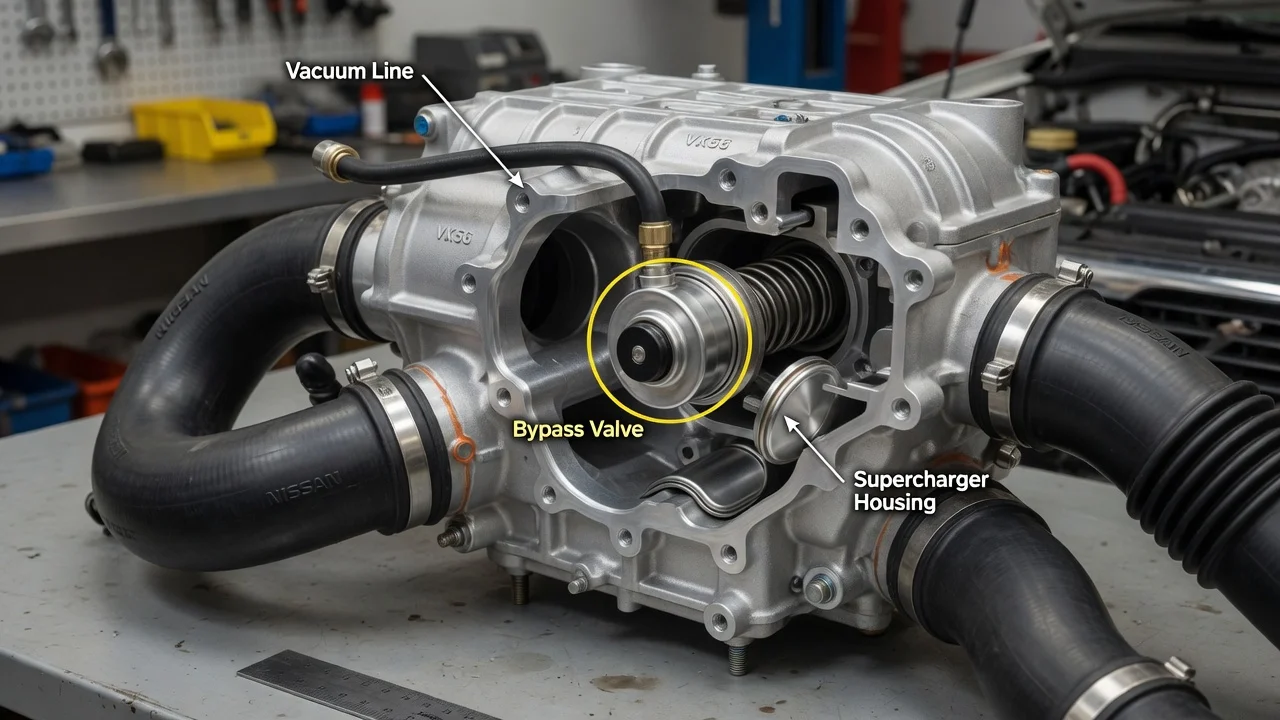
On a supercharged Nissan Frontier, the bypass valve lets intake air recirculate around the supercharger when the engine is at idle or light load. It closes when you ask for power so the blower can build boost. When the valve, its vacuum diaphragm or its hose fails, the truck can idle poorly, feel flat under load or set lean codes. This guide explains how to identify the problem and check the valve without guessing or replacing parts unnecessarily.
Establish the symptoms
Start by confirming the vehicle configuration. The factory supercharged Frontier used the 3.3-liter V6 in the early 2000s. If your truck is a later model with a supercharger, the system is an aftermarket kit, and its own documentation governs the bypass valve design and settings. Note the model year, engine, mileage and any service history involving the intake, supercharger, belts or vacuum lines.
Then record exactly when the problem appears. Useful details include whether it happens at a cold start, at warm idle, at steady cruise, under hard acceleration or when lifting off the throttle. Associated signs matter too: a hissing sound near the supercharger, a rough or hunting idle, a check engine light, weaker acceleration than usual, a change in supercharger whine, or worse fuel economy. Finally, list recent changes such as a belt replacement, intake cleaning, a new air filter or work near the top of the engine. A vacuum hose disturbed during unrelated work is a common starting point.
Distinguish plausible causes
A bypass valve can fail in several ways, and each produces a slightly different pattern. A torn diaphragm in the vacuum actuator acts as a vacuum leak. It tends to cause a rough idle, a hiss and lean fuel trims that are worst at idle and improve as engine speed rises. A valve stuck open lets boosted air escape back to the inlet, so the truck may idle normally but feel noticeably weak under load. A valve stuck closed or slow to open keeps the supercharger working against a closed path at light throttle. That can bring more noise, more heat in the intake and poorer economy, with little effect on full-throttle power.
Other faults produce similar complaints, so weigh them before blaming the valve. A cracked or disconnected vacuum hose to the actuator mimics a failed diaphragm. Intake leaks at couplers, the throttle body or the supercharger mounting can cause lean codes and hissing. A slipping or glazed supercharger belt reduces boost and often squeals. A dirty mass airflow sensor, a weak fuel supply or a PCV fault can also cause lean running or hesitation. Evidence that points toward the bypass valve includes symptoms that change sharply between idle and load, and a hiss located right at the actuator. Symptoms that are constant regardless of load, or that come with belt noise, weaken the case for the valve.
Checks in a useful order
Begin with safe visual checks while the engine is off and cool. Locate the bypass valve and its vacuum actuator on the supercharger inlet side. Inspect the vacuum hose for cracks, softness, splits at the ends and correct routing. Check that the actuator rod and linkage are intact and not bent or disconnected. Look for oil residue around the valve body, which can make it sticky. With the engine off, you can usually move the linkage by hand to feel whether it travels smoothly or binds.
Next, use a scan tool if you have one. Read stored and pending codes, freeze frame data and short- and long-term fuel trims at idle and at a steady higher engine speed. Lean trims that are high at idle and improve with rpm suggest unmetered air entering after the mass airflow sensor. A hand vacuum pump is the most direct test for the actuator. Apply vacuum to the actuator and watch whether the rod moves fully and whether the gauge holds steady. A reading that bleeds down indicates a leaking diaphragm. Compare the travel and behavior against the manufacturer specifications or the kit documentation rather than assuming a value.
Some tests require a qualified technician or specialist equipment. These include a smoke test of the intake system, monitoring boost with a gauge under real operating conditions, and observing the valve with the engine running. Be careful around the running engine, because the belts and pulleys sit close to the supercharger. If the vehicle has been modified, an inspection by someone familiar with that kit avoids misreading normal behavior as a fault.
Interpret the findings
A cracked or loose vacuum hose with a healthy actuator points to the hose, not the valve. Replace it and recheck the fuel trims and idle before going further. An actuator that will not hold vacuum during the hand pump test confirms a diaphragm leak. Whether the actuator is serviceable separately or comes only with the valve assembly depends on the part design, so confirm that with the parts catalog for your exact vehicle. A valve that binds by hand while the actuator holds vacuum suggests a sticking valve shaft or plate. Cleaning may help, but excessive play or damage usually means replacement.
Some results do not settle the question. Normal hand pump results with persistent lean trims mean the leak or fault is likely elsewhere, and a smoke test is the logical next step. Low power with a valve that tests correctly calls for checking belt condition and tension, boost under load, fuel delivery and the supercharger itself. Before ordering parts, confirm that the problem you can reproduce matches the fault you have found, and plan to verify the repair by repeating the same checks afterward.
Urgency and next action
A minor vacuum leak at the bypass valve is usually not an immediate emergency, but it should not be ignored. Persistent lean running can lead to misfires and drivability problems. Stop driving and arrange inspection if the check engine light flashes, if the engine misfires or hesitates badly enough to make merging or passing unsafe, or if you smell fuel. You should also stop if the temperature gauge climbs abnormally or if you hear grinding or rattling from the supercharger, or squealing and slapping from the belt. A flashing light usually indicates a misfire that can damage the catalytic converter, and supercharger or belt noises can signal mechanical failure.
Whether you repair it yourself or visit a shop, gather the information that shortens diagnosis. This includes the model year, engine, VIN, mileage and whether the supercharger is factory or aftermarket. Note any codes with freeze frame data, fuel trim readings, the conditions when the symptom appears and the results of any checks you have already done. Add relevant service history, especially recent belt, intake or vacuum line work. Follow the maintenance schedule and manufacturer specifications for your exact truck rather than general intervals, and confirm the repair by retesting under the same conditions that originally produced the symptom.