Nissan CVT Transmission Speed Sensor Location
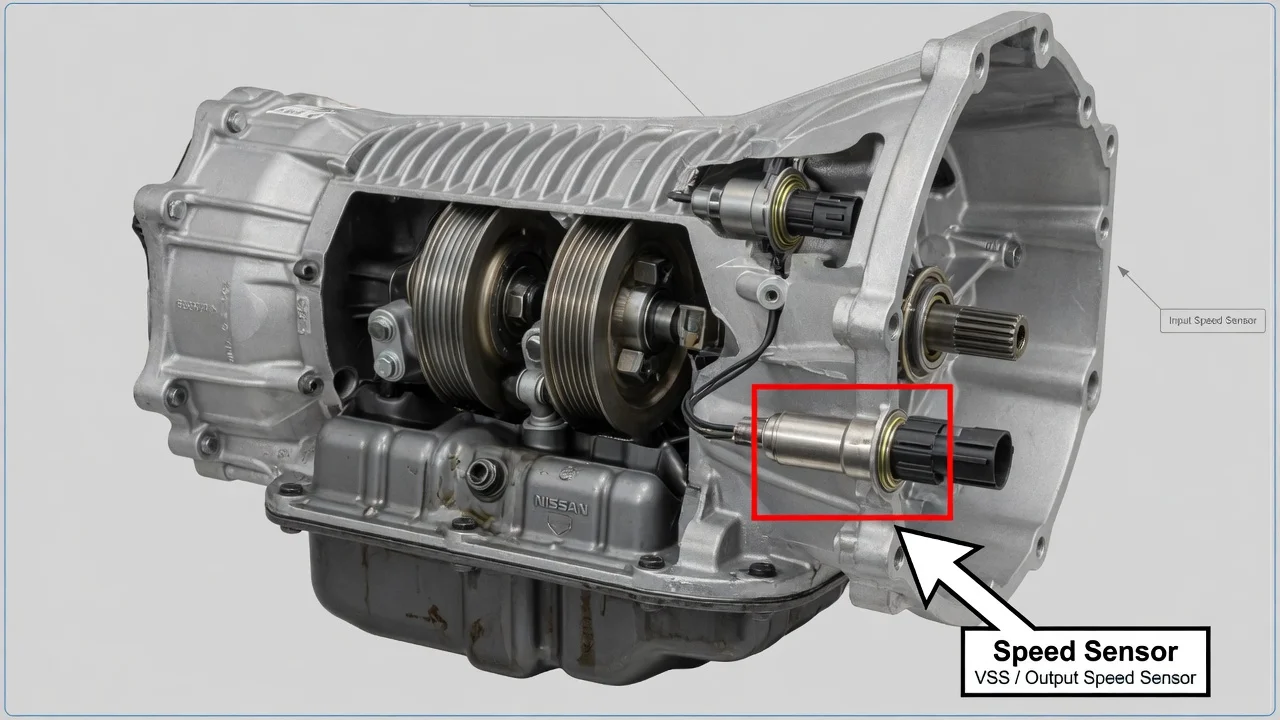
A Nissan with a continuously variable transmission rarely has just one speed sensor. Most Nissan CVTs use at least two: one reads the primary (input) pulley and one reads the secondary (output) pulley. The vehicle speed shown on the dashboard often comes from the ABS wheel speed sensors instead. Where each sensor sits depends on the exact transmission type, so identify your unit before you reach for tools.
Where the speed sensors are located
On most Nissan CVTs, the transmission speed sensors are mounted on the transaxle case. Each one sits in a bore so its tip is close to a rotating part inside. The primary speed sensor, sometimes called the input speed sensor, reads the primary pulley, which receives power from the engine and torque converter. The secondary speed sensor, often treated as the output speed sensor, reads the secondary pulley, which sends power toward the final drive and axles. Each sensor typically has a single retaining bolt and its own electrical connector, and an O-ring seals the sensor body to the case.
Because the transaxle sits sideways in the engine bay, you usually reach the sensors from above after removing the air intake ductwork or battery tray, or from below with the splash shield off. On some units, one or both sensors are part of the internal control valve assembly rather than externally replaceable parts, which changes the job entirely. Treat any general description as a starting point, and confirm it against the service information for your specific vehicle.
How CVT speed sensors work
A CVT changes ratio by moving the sheaves of two pulleys so the steel belt rides at different diameters. The transmission control module needs to know how fast each pulley is turning. It uses those speeds to calculate the actual ratio, compare it with the commanded ratio, and manage line pressure so the belt does not slip. The speed sensors supply those numbers. Most are magnetic or Hall-effect sensors that send a pulse each time a tooth or slot on a rotating target passes the sensor tip.
If a signal drops out, becomes erratic or disagrees with what the module expects, the transmission control module stores diagnostic codes. It often also switches to a protective fail-safe mode. Owners commonly notice limited acceleration, high engine speed with slow road speed, harsh or delayed engagement, or a speedometer that behaves strangely. On many modern Nissans, the ABS system shares vehicle speed with the instrument cluster over the vehicle network, so a speedometer fault can start outside the transmission.
What changes the answer for your vehicle
Nissan has used several Jatco CVT families across its lineup. Compact cars such as the Versa and Sentra, midsize models such as the Altima and Rogue, and larger V6 applications such as the Murano and Pathfinder use different units. Sensor count, mounting position and connector style vary between these families. So does whether the transmission control module is separate or built into the valve body. These details sometimes differ even between model years of the same nameplate.
Engine size, drive layout and production date also matter. An all-wheel-drive version may have less underbody clearance, a transfer unit that blocks access, or different wiring routes. A replacement or remanufactured transmission fitted during an earlier repair may not match the original build. That makes service history and the transmission identification label more reliable than the model name alone. Confirm replacement sensor fitment by part number from the vehicle identification number, not by appearance.
How to find and inspect the sensor
Start by confirming the transmission type. The model code is usually on a label or stamping on the transaxle case, and a parts counter or dealer can decode it from the VIN. With that code, the factory service manual or a reputable repair database will show the exact sensor location, connector pinout and removal steps. Then read the stored diagnostic codes with a scan tool that can access the transmission module, not only the engine module. Note any freeze-frame data.
With the engine off and the key removed, follow the transmission harness to the sensor and inspect it. Look for a loose or corroded connector, a damaged lock tab, chafed wiring near brackets or exhaust parts, and fluid inside the connector. Many sensor faults trace back to wiring rather than the sensor itself. If you remove a sensor, clean the area first so debris cannot fall into the bore, and expect a small amount of fluid to seep out. Check the tip for metallic debris, which can indicate internal wear worth investigating further.
If any fluid is lost, top up only with the CVT fluid specification Nissan lists for that unit, such as NS-2 or NS-3 depending on the transmission. A generic or incorrect fluid can change how the belt and pulleys grip. On many Nissan CVTs, checking the level requires a specific procedure at a set fluid temperature, so follow the service information rather than guessing.
Codes and symptoms do not confirm a failed part
Codes such as P0715 or P0720 point to a problem in a speed sensor circuit or signal, not necessarily a faulty sensor. The same codes can come from a damaged harness, a poor ground, a failing control module, or a mechanical problem that makes the sensed speed implausible. Likewise, shift complaints such as shudder, flare or a sudden loss of power can come from belt or pulley wear, low or degraded fluid, or software issues. Code descriptions can vary slightly by manufacturer, so confirm what each code means for your vehicle.
A technician will usually compare live data from the primary and secondary speed sensors against engine speed and wheel speed on a test drive. They may also check sensor resistance or signal output where specifications allow, and test wiring continuity back to the module. That evidence separates a bad sensor from a wiring or internal fault before you buy parts.
Repair options and when to get help
If testing confirms a failed external sensor with good wiring, replacing it is often a modest job for an owner with basic tools and the correct part. Afterward, clear the codes and take a test drive. Some Nissan CVTs may need a relearn or data procedure after certain repairs, which can require dealer-level software. If the sensor is internal to the valve body, the job means removing the oil pan and control valve assembly. That carries contamination and calibration risks, so it is best left to a transmission shop.
Seek professional help if codes return after a repair, several transmission codes appear together, the fluid is dark or contains debris, or the vehicle keeps entering fail-safe mode. Before paying for diagnosis or repairs, check whether an extended warranty or manufacturer campaign covers your CVT. The exact location and procedure for your car should always come from service information matched to its VIN and transmission type.