Nissan Altima 12V Battery Size and Replacement
The short answer
For a 2013 Nissan Altima sedan, BCI Group 35 is the battery size most commonly listed by parts catalogs. The same group generally carries through the generation that ran from the 2013 to the 2018 model years, which covers 2014 and 2016 cars. Two things can change the answer: which generation the car belongs to and which engine it has. For that reason, confirm the size on the car or through a VIN-based parts lookup before you buy.
A BCI group number is an industry code for a battery's case dimensions, terminal type and terminal layout. It does not describe capacity. Two Group 35 batteries will fit the same tray and reach the same cables, but they can still differ in cold-cranking amps and warranty.
How the answer varies by model year
Model years | Generation | Commonly listed group | What to check; 2013–2018 (includes 2013, 2014, 2016) | Fifth generation | Group 35 | Confirm on the existing battery label, especially on V6 cars; 2007–2012 (includes 2010, 2012) | Fourth generation | Group 35 is commonly listed for the 2.5-liter four-cylinder | V6, coupe and hybrid versions may list a different size and should be checked separately
The 2010 and 2012 Altima come from the earlier generation, so do not assume that a fitment listed for a 2013 or later car applies to them. Some catalogs list a different group size for the earlier 3.5-liter V6. This guide cannot settle that difference, so treat the earlier V6, the Altima Coupe and the Altima Hybrid as open cases and verify each one.
These notes apply to North American market cars. Altimas sold in other markets may have been fitted differently, and that is not covered here.
How to confirm the right battery for your car
Read the label on the battery currently in the car. Most show the group number, and if it is the original or a correct replacement, that number is your answer. Check the owner's manual for the battery specification. Use a parts lookup that takes your VIN or your exact year, trim and engine rather than the model name alone. Compare the replacement's cold-cranking amps (CCA) with the original. CCA measures how much current the battery can deliver for starting in cold weather. Matching or exceeding the original rating is the usual guidance. Check that the positive and negative terminals are on the same sides as the original, so the cables reach without strain.
Replacing the battery
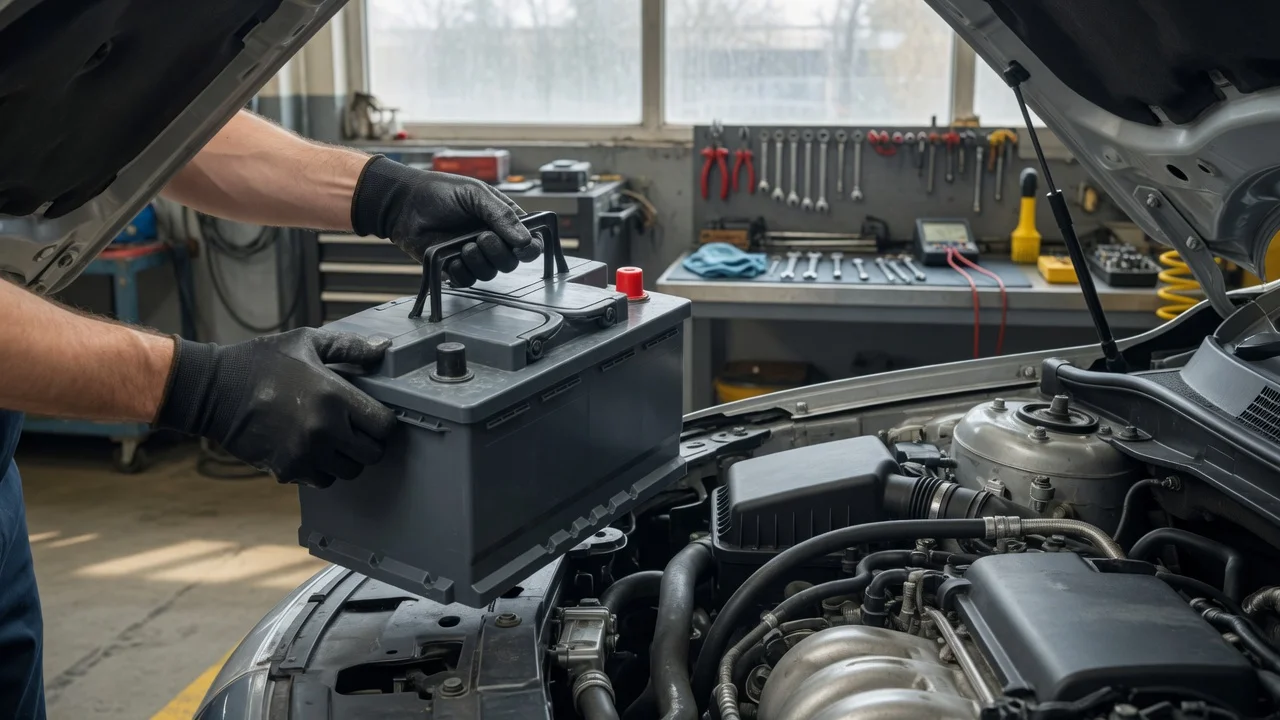
In most cases, swapping the battery on these cars is a bolt-in job. Before you start, switch the ignition off and remove the key or key fob from the car.
Disconnect the negative (black, minus) cable first, then the positive (red, plus) cable. This reduces the risk of a short if a tool touches the body. Remove the hold-down clamp or bracket and lift the battery out. Batteries are heavy and contain acid, so keep the battery upright. Clean any corrosion from the cable clamps and tray before you fit the new battery. Set the new battery in the same orientation and secure the hold-down so the battery cannot shift. Connect the positive cable first, then the negative, and tighten both clamps firmly. Start the car and check that it runs normally. Expect to reset items such as radio presets or the clock.
Old lead-acid batteries should not go in household trash. Retailers that sell batteries commonly accept used ones for recycling.
Gaps in this guide
This guide does not include verified cold-cranking amp ratings, battery dimensions, prices or warranty comparisons for specific products. It also does not resolve exact fitment for the earlier V6, coupe and hybrid versions, or for non-North American cars. For any of these, rely on the label on the original battery, the owner's manual or a VIN-based lookup.