Nissan 350Z and 370Z Differential Fluid: Type, Capacity and Care
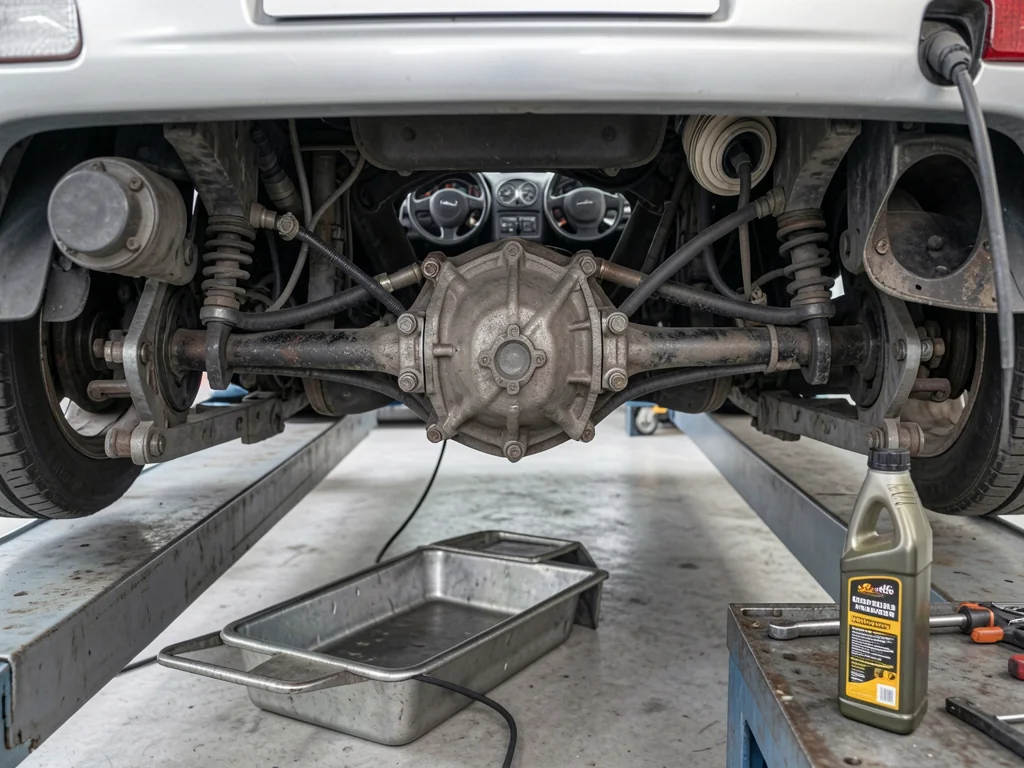
The rear differential in a Nissan 350Z or 370Z turns engine torque into rear-wheel motion through a ring gear, pinion, and bearings that run in a bath of hypoid gear oil. This fluid is separate from engine oil and transmission fluid, and its condition directly affects differential durability. Hard driving, especially track use, accelerates oil breakdown. Because the 350Z and 370Z have different differential options, including viscous limited-slip units, the correct fluid type and capacity depend on your specific model, trim, and year as detailed in the factory documentation.
What Rear Differential Fluid Does in a Front-Engine, Rear-Drive Z Car
Gear oil coats the spiral bevel ring and pinion teeth where they mesh, forming a load-carrying film that prevents metal-to-metal contact as torque is transferred. The oil also flows around the tapered roller bearings that support the carrier and pinion, carrying away heat generated by friction and sliding at the tooth contact. Without the right viscosity and additives, the film can break down under the extreme pressure of the hypoid gear set, leading to scuffing, pitting, and eventual whine or bearing noise from the rear differential.
Differential fluid works in a closed housing, so it does not share a sump with engine oil, which must handle combustion byproducts, or transmission fluid, which often has friction characteristics for synchronizers. The rear axle needs a dedicated hypoid gear lubricant with extreme-pressure additives and the proper grade for the differential's design. Regular driving warms the oil, but repeated hard launches, high-speed track sessions, and sustained load elevate temperatures beyond the normal operating range and shear the additive package faster than stop-and-go commuting.
Choosing the Correct Differential Fluid for a Nissan 350Z
Start with the owner's manual or factory service manual for your 350Z. The required gear oil will be listed by viscosity, such as 80W-90 or 75W-90, and by API service classification, often GL-5. These numbers are not interchangeable across all years: a 2003 model may call for a conventional GL-5 80W-90, while later years or limited-slip packages might specify a different viscosity or a synthetic base oil. Verify against your VIN or build sheet because a viscous limited-slip differential can require fluid with different friction characteristics than an open unit.
The differential fitted to a 350Z depends on trim and options. Base models often used an open differential, while the track and later models could have a viscous limited-slip rear end. A dealer VIN lookup or the model code on the chassis plate can confirm the original unit. When selecting an aftermarket fluid, compare the label's viscosity and GL classification against the Nissan specification, not just brand reputation. A fluid that meets the grade and viscosity is acceptable even if it is not marketed specifically for the 350Z differential fluid.
Differential Fluid Requirements for the Nissan 370Z
370Z owners should not assume that the fluid specified for a 350Z will suit their car. The 370Z generation, introduced for 2009, used updated differential assemblies, and trim packages such as the Sport or Nismo could include a viscous limited-slip differential while base models had an open unit. The factory service manual for each model year lists the approved gear oil viscosity and service rating. Check the section for rear final drive lubrication; the required fluid can differ between a base 370Z differential fluid and a limited-slip application.
Reading a gear oil label is straightforward: the first number with a 'W' is the winter viscosity, the second number is the high-temperature viscosity, and 'GL-5' or 'GL-4' indicates the API service rating for hypoid gears. A label may also state 'limited-slip compatible' or 'contains friction modifier.' If your documentation lists a Nissan part number or a specific additive requirement, confirm that the chosen oil meets it. When the manual is unclear or the car has been modified, ask a Nissan dealer parts desk to match the fluid to your VIN and the differential's exact build code.
350Z Differential Fluid Capacity and Confirming the Correct Fill Level
Do not rely on a single published capacity number. The factory service manual for your 350Z lists the differential fluid capacity for a dry fill, often near 1.5 liters or 2.7 to 3.1 pints, but after draining, some old fluid remains in the housing and axle tubes. Therefore, the refill amount may be slightly less than the dry capacity. The correct way to determine the fill level is to open the fill plug on a level surface and add gear oil until it just begins to trickle out; that is the full level regardless of how many bottles you used.
Underfilling starves the pinion bearings and ring gear teeth of cooling oil, leading to overheating and accelerated wear, while overfilling can cause churning, foaming, and pressure buildup that forces oil past the pinion seal or vent. Always support the car on jack stands or a lift, never on a floor jack alone, and set the rear axle level using a spirit level or by measuring the sill. If you do not have a fluid pump, a torque wrench for the plugs, and a safe workspace, have a qualified shop perform the 350Z differential fluid service.
Limited-Slip Differentials and Friction Modifier Considerations
A limited-slip differential biases torque to the wheel with more grip while allowing a speed difference in corners, improving traction without the harshness of a locked spool. The Nissan viscous limited-slip unit uses a silicone fluid inside a sealed case to resist slip, but the final drive gears still run in the main gear oil. Some limited-slip designs, particularly clutch-type units, require a friction modifier added to the gear oil to prevent chatter; the viscous unit usually does not, but Nissan's specification decides what is needed for your car.
Symptom clues such as chattering, shudder, or a low-speed clunk in tight parking-lot turns can point to limited-slip friction issues, but they are not proof that the fluid is wrong or that a friction modifier is missing. A worn viscous coupling, a failing differential bearing, or even a CV joint can mimic those sounds. If the limited-slip behavior changes after a fluid change, double-check that the replacement meets the factory spec. When in doubt, have a technician diagnose the unit; adding a friction modifier without documentation can cause more harm than good.
When to Change Z-Car Differential Fluid and Warning Signs to Watch
Check the maintenance schedule in your owner's manual for the differential oil change interval. Many street-driven Z cars can go 30,000 to 60,000 miles, but the severe-service schedule applies to repeated track days, autocross, or aggressive driving and may recommend changes every 15,000 to 30,000 miles. Observe the differential after a drive: a gear-oil smell yes, but new whine, howl, or clunk when loading and unloading the driveline, or seepage around the pinion seal, fill plug, or cover gasket, are signs to inspect the fluid level and condition.
These clues have limits. A whine at 45 mph could be a wheel bearing or tire noise rather than differential fluid breakdown, and a clunk might be a worn universal joint or subframe bushing. Do not assume new fluid will cure a noise or leak. During a fluid change, look for metallic particles on the magnetic drain plug: some fine gray paste is normal wear, but large chips or a silvery metallic sheen means internal damage. If you see a persistent leak, hear a steady whine that rises with speed, or find significant metal, stop driving hard and have a technician inspect the differential. Keep a record of the fluid type, amount, and date for every service.