Muffler Repair Options: Patching, Welding, and Professional Service
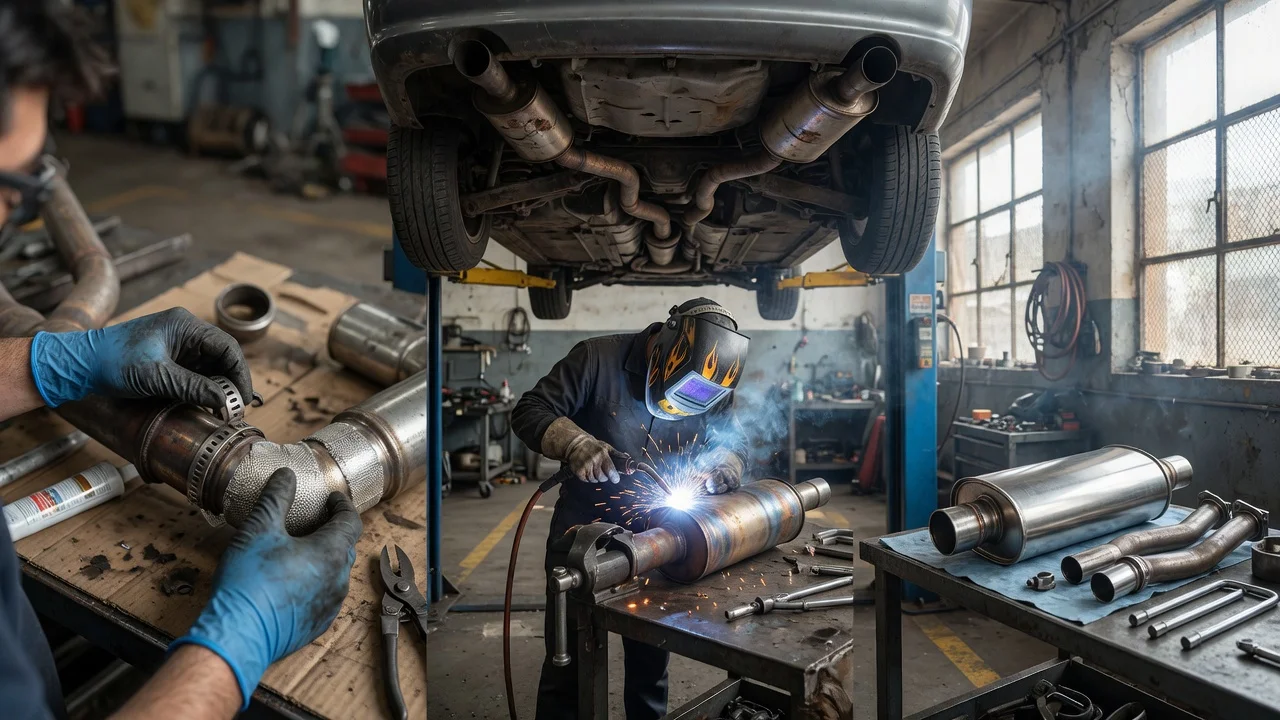
What Muffler Repair Can and Cannot Fix
Muffler repair addresses a defect in the exhaust muffler or its immediate connections. The essential answer depends on the condition of the metal. Small, isolated holes or cracks in otherwise sound material can sometimes be patched or welded. Larger rust-through areas frequently indicate that the surrounding metal is too thin to hold a patch, weld, or clamp. In that case, replacement of the affected component is the more reliable repair. Repair is also unsuitable when failure affects a catalytic converter, exhaust pipe, resonator, or mounting point rather than the muffler itself, although the symptoms may appear similar.
Repair Options Compared
The three common approaches are patching, welding, and professional service. They differ in durability, cost, required equipment, and how much diagnosis they include.
| Approach | Best for | Main limitation | Typical use |\n| --- | --- | --- | --- |\n| Epoxy or bandage patch | Small holes in accessible, sound metal | Surface rust or irregular shapes reduce adhesion | Temporary or low-cost repair |\n| Clamp or sleeve patch | A localized split or hole in a round pipe section | Needs a compatible diameter and straight section | Mechanical repair without welding |\n| Welding | Cracks or seams that can be cleaned to good metal | Nearby thin metal may burn through | Permanent repair when base material is thick enough |\n| Professional service | Uncertain diagnosis, multiple defects, or heavy rust | Higher direct cost | Inspection, repair, or replacement in one visit |
Patching is preferable when the goal is an inexpensive repair with basic tools and the damage is clearly limited to one small spot. Welding is preferable when the damage is a crack or split in metal that still has enough thickness to accept weld material. Professional service is preferable when the exhaust is heavily rusted, when the repair must last, or when the owner cannot safely access the underside and identify the failed part. Published prices and measured longevity are not supplied in this review, so the cost comparison should be confirmed locally before choosing.
Diagnosis Before a Repair
An exhaust symptom is worth localizing before buying repair parts. Observable checks can separate causes that sound similar. Increased exhaust noise that rises with engine speed is consistent with a leak, but it does not by itself identify whether the leak is in the muffler, a pipe, a joint, or the manifold. A rattle can come from a broken internal baffle in the muffler, but it can also come from a loose heat shield. A ticking noise near the engine is more often associated with an exhaust manifold leak than with a rear muffler.
Checks to perform: inspect the underside for visible holes, rust streaks, or black soot marks around a leak; check whether a mounting hanger has failed and left the exhaust contacting body or suspension parts; identify the noise location with the engine running while the vehicle is safely supported; tap or inspect a suspected heat shield separately from the muffler; confirm that the defect is in the muffler body and not at the pipe connection or another component.
A result that points to the muffler alone supports a local repair. A result that points to a pipe, joint, converter, or missing hanger indicates that a muffler patch would not address the cause. Exhaust gases entering the cabin, fuel odor, or a component that is loose enough to contact the exhaust system call for stopped use and professional diagnosis rather than continued driving.
Limits to Accept Before Repairing
A repair is only as strong as the metal around it. Epoxy, tape, and bandages depend on a clean surface and can fail when rust, moisture, or exhaust heat prevent adhesion. Welding requires access to the full seam and enough base thickness; an exhaust system weakened by internal and external corrosion may create new holes near the weld. Even a successful patch can leave a different aging section of the exhaust as the next failure point. When the surrounding material is too thin, repair becomes a temporary measure and component replacement is the supported long-term option. The absence of supplied model-specific rust and thickness data means the condition of the metal should be assessed directly before committing to a patch or weld.