Motorcraft 7.3 Glow Plug Relay Selection: Fitment, Features and Checks
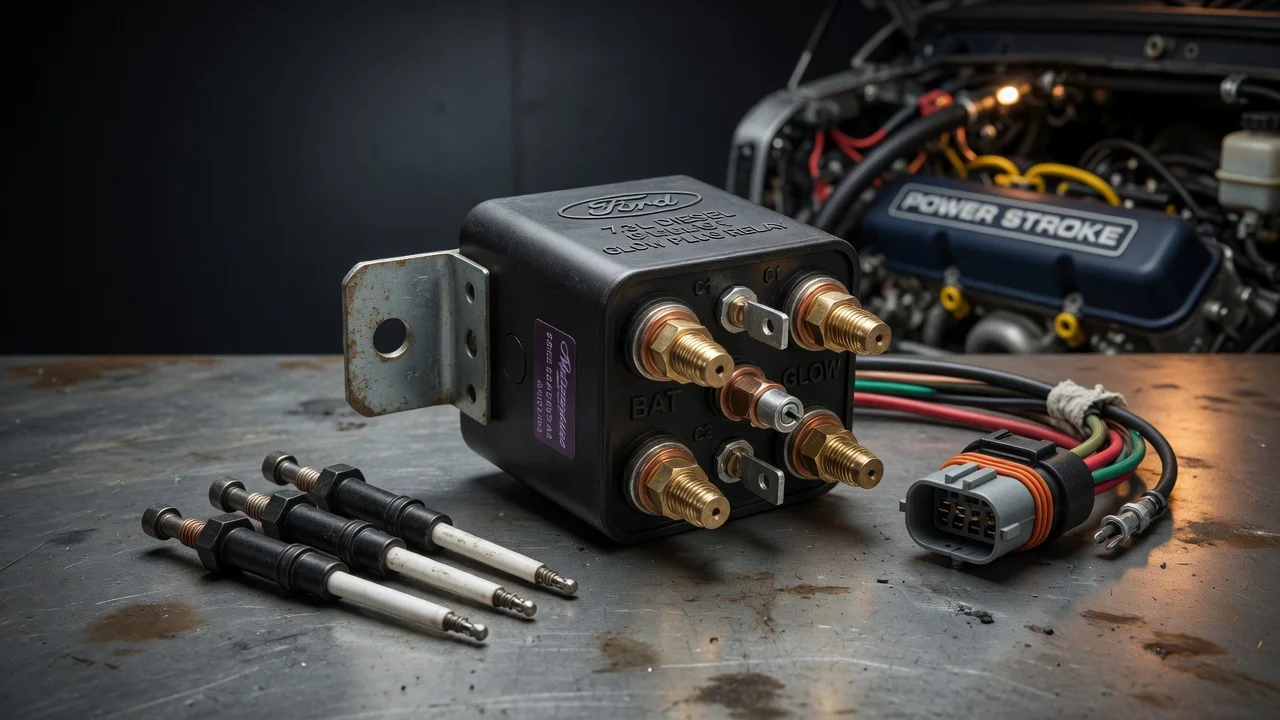
On a 7.3L Power Stroke, the glow plug relay is the heavy-duty switch that sends battery current to all eight glow plugs before and after a cold start. When it fails, the truck cranks longer, smokes white and idles rough until it warms up. Choosing a Motorcraft relay or an alternative is straightforward once you confirm the relay is really at fault, match the part to your truck and understand what a new relay can and cannot fix.
Define the job the relay must do
The 7.3 is a V8 diesel that relies on compression heat for ignition. There is no spark, so in cold weather the glow plugs preheat the combustion chambers until the engine can fire cleanly. The powertrain control module decides how long to glow, based mainly on engine oil temperature and barometric pressure, and it energizes the relay to do the actual switching. The relay closes a circuit that carries far more current than any ordinary relay, and on these trucks the glow cycle can continue after the wait-to-start lamp goes out. A relay that fails open leaves the plugs cold, which causes hard starts and white smoke. A relay that sticks closed keeps feeding the plugs, which can burn them out and drain the batteries. How much the relay matters depends on your climate, whether you use the block heater and how often the truck makes short cold-start trips.
Confirm the diagnosis before buying anything. On a cold engine, listen for the relay to click at key-on, then use a test light or voltmeter on the output stud to see whether voltage appears and later drops off. Measure each glow plug's resistance against the service specification, and on 1999 to 2003 trucks inspect the under-valve-cover harness connectors, a common source of dead plugs. Test both batteries, since one weak battery can imitate a glow problem. If the glow system checks out and the engine still starts poorly, look at the fuel side: low fuel pressure from a weak fuel pump or a restricted fuel filter, injector problems or low high-pressure oil pressure all cause similar symptoms. Check fuel pressure only with a gauge at the designated test point, following the service procedure, and never loosen fuel lines on a running engine. Fuel additives are not a repair for any of these faults.
Check compatibility
The 7.3L Power Stroke was used from the 1994.5 through 2003 model years in F-Series pickups, Super Duty trucks, the Excursion and E-Series vans. Displacement is shared, but relay mounting, terminal layout and harness connectors are not guaranteed to be identical across every generation and body. Look up the Motorcraft part number using your VIN or the exact model year, body style and build date, then compare the listing with the relay on your engine: number and size of studs, the shape of the control connector and the mounting hole pattern. Do not confuse this part with the glow plug control module used on the later 6.0L engine; that is a different design and does not interchange with the 7.3 relay.
Electrically, the relay has a constant battery feed stud, an output to the glow plug harness, a low-current control signal from the PCM and a ground path. Correct stud sizes and terminal fit matter because any loose high-current connection heats up and degrades. Check whether the replacement includes nuts, boots or a pigtail, or whether you must transfer them from the old unit. If the truck has a modified glow plug harness or an aftermarket controller, a stock catalog listing may not describe your setup, so trace the actual wiring before ordering.
Features that affect the choice
Motorcraft is Ford's own service parts brand, so its main advantage is that the relay follows the original design and its fitment comes from Ford's parts catalog. Aftermarket relays span a wide price range; some are perfectly serviceable, while others use lighter internals. The characteristics that actually matter are a contact rating suited to the repeated high-current load of eight glow plugs, solid terminal studs, a housing that resists water and road salt, and coil characteristics the PCM driver can operate reliably. Labels such as heavy duty or upgraded mean little unless the seller states real ratings you can compare.
Useful evidence includes a part number that matches the catalog lookup, intact original packaging, a traceable seller and clear warranty and return terms. Relabeled and counterfeit parts circulate for popular service items, so a price far below typical market rates deserves suspicion. When reading reviews, give weight to specific details such as time in service, climate and failure mode rather than star counts. Keep expectations realistic: the relay has no effect on fueling, so claims that a relay improves power or fuel economy are not credible, and fuel trim concepts from gasoline engines do not apply to this part.
Limitations and ownership costs
Installation is mostly simple, but the feed stud is live at all times, so disconnect the negative cables on both batteries before touching the relay. Clean corrosion from the cable eyelets, reinstall the protective boots and tighten the nuts securely without stripping the studs. Replacing the relay does not involve opening the fuel system, so there is no reason to disturb fuel lines or relieve any system pressure for this job. After installation, verify the glow cycle on a cold engine with a test light or meter rather than assuming the new part solved the problem.
Budget for related parts. If the old relay stuck closed, the glow plugs may already be damaged, and many owners replace plugs as a set once several have failed. The under-valve-cover harness, battery cables and the batteries themselves may also need attention. A relay cannot fix slow cranking from weak batteries, low fuel pressure, a clogged fuel filter, worn injectors, high-pressure oil leaks or contaminated fuel. If you suspect an oil or fuel leak, perform a proper leak check instead of continuing to replace electrical parts. In winter, use fuel suited to the temperature; additives may help prevent gelling but do not reverse an existing mechanical fault.
Build a practical shortlist
Run each candidate through the same checklist. First, the diagnosis is confirmed: no click or no output voltage during the glow cycle, or an output that never shuts off, with plugs, harness and batteries checked. Second, the part number matches a VIN or year, body and build date lookup. Third, the physical relay matches yours in studs, connector and mounting. Fourth, it is genuine Motorcraft from a traceable seller, or an aftermarket unit with stated ratings. Fifth, warranty and return terms are clear. Sixth, you know which hardware is included. Seventh, you have budgeted for glow plugs or harness work if testing points to them.
For an owner keeping a 7.3 close to stock, a genuine Motorcraft glow plug relay is the lower-risk default because the design and connectors match the original. A reputable aftermarket relay can be reasonable when its specifications and warranty are transparent and it physically matches your truck. Whichever you choose, test the glow cycle after installation and note the date and part number for future reference.