Mopar ATF+4 Explained: Transmission Fluid for Dodge, Ram, Jeep and Chrysler
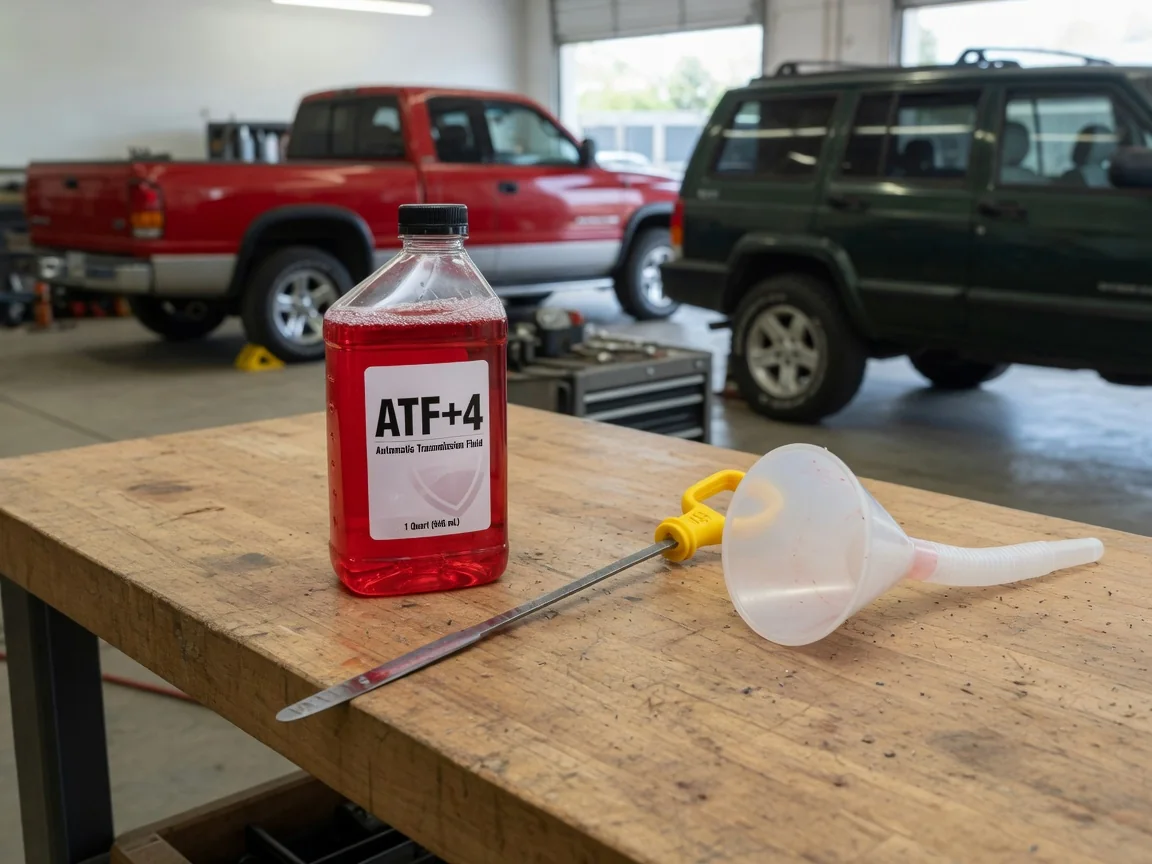
Few maintenance questions confuse Dodge, Ram, Jeep and Chrysler owners as often as choosing automatic transmission fluid. ATF+4 sits on countless store shelves, yet it is a precise specification rather than a generic product, and some newer vehicles don't use it at all. Knowing what the label means, how licensing works and how to identify your transmission helps you avoid shifting complaints that start with the wrong bottle.
What ATF+4 Actually Is and Why the Specification Matters
ATF+4 is an automatic transmission fluid specification developed by Chrysler. It is not a viscosity grade like the numbers on motor oil, and it is not a broad category that any red fluid can claim. The plus sign and the number together name the standard. That's why searches for ATF 4, ATF plus 4 or transmission fluid 4 all lead to the same product. On a legitimate container, look for the ATF+4 designation next to a Chrysler or Stellantis license reference, often alongside material standard MS-9602.
Inside a Chrysler-family automatic, the fluid carries the hydraulic pressure that applies the clutches. It also cools hardworking parts and lubricates gears and bearings. Its most demanding job is friction control. The clutch packs and the torque converter clutch are calibrated to grip and release in a particular way, and the transmission's control logic expects that behavior. ATF+4 is a full synthetic fluid that replaced ATF+3 and ATF+2 in most applications that once called for them. Still, your owner's manual has the final word for your vehicle.
Mopar-Branded ATF+4: What the Mopar Name Means on the Bottle
Mopar is the parts and service brand for Chrysler, Dodge, Jeep and Ram. Mopar ATF+4 is the factory-branded version of the fluid, not a separate or stronger specification. Its label usually shows the ATF+4 name prominently along with a material standard reference. It is commonly sold in quart bottles and in larger containers suited to shops and full fluid services. Prices vary by retailer and region, so when you compare products, compare them against the same specification rather than by brand name.
The catch is that Mopar sells several automatic transmission fluids, so asking for Mopar transmission fluid at a parts counter doesn't identify a single product. A late-model truck and an older minivan can both use Mopar parts and still need completely different fluids. Match the bottle to the specification printed in your owner's manual, on the dipstick handle, or on a label near the fill point if your vehicle has one. The brand tells you who packaged the fluid. The specification tells you whether it belongs in your transmission.
Licensed ATF+4 Alternatives and How to Verify a Genuine License
Because ATF+4 is a licensed specification, fluids from independent blenders can meet it if they carry an official license. Valvoline ATF+4 full synthetic is one widely sold example of a licensed product. Licensing matters because it shows the fluid was checked against the specification's requirements rather than simply described as similar. On the container, look for plain wording that says the product is licensed or approved to ATF+4. That statement often comes with a license number or reference.
Be cautious with softer wording such as suitable for, recommended for or for use in ATF+4 applications. Those phrases state the blender's opinion, not a license. Multi-vehicle and universal fluids often use this language to cover many specifications at once. Their friction behavior can differ from a dedicated ATF+4 fluid, which can change how smoothly the clutches engage. Don't rely on brand rankings. Read the claim on the container itself and choose a product whose label clearly states that it is licensed.
Which Dodge, Ram, Jeep and Chrysler Transmissions Call for ATF+4
Many Chrysler-family conventional automatics built over roughly two decades call for ATF+4, including Dodge and Ram pickups, Jeep SUVs, and Chrysler sedans and minivans. That pattern is a useful starting point but doesn't settle the question. Model year and transmission code decide the real answer, and a single model line can carry different transmissions. To confirm yours, check the owner's manual or the information labels under the hood or in the door jamb. A dealer parts department can also look up your VIN, which ties the vehicle to its original build.
Dodge and Ram truck owners who tow heavy trailers or drive in hot climates put extra heat stress on the fluid. For them, the correct specification and an accurate fill level matter even more. Follow the severe-service guidance in your manual instead of a generic interval. Jeep owners should take particular care. Many older Jeep automatics use ATF+4, but newer models may call for something else. No single guide can confirm every year and transmission combination, so the manual for your exact model year is the source to trust.
Dodge Caravan, Grand Caravan and Jeep Wrangler Fluid Questions
Caravan and Grand Caravan owners ask about fluid constantly because these minivans used Chrysler-built automatics for many years. Changes in shift quality are often the first thing drivers notice as the mileage climbs. Before you buy anything, check the specification listed for your minivan's model year instead of assuming every generation uses the same fluid. If your minivan has a dipstick, you can use it to check both the fluid level and its general condition between services.
Automatic Jeep Wranglers call for the same caution. Different generations have used different transmissions, and the correct fluid depends on which transmission is installed. On vehicles with a dipstick, a proper check is generally done with the engine running and fully warmed up, the vehicle on level ground and the shifter in park, and the level read against the hot marks. Some details, such as shifting through the gears before checking, vary by vehicle, so follow the exact procedure in your manual.
Mopar ASRC and Other Newer Fluids That Are Not ATF+4
Mopar ASRC is a separate automatic transmission fluid specification used in certain newer eight- and nine-speed automatics from Chrysler, Dodge, Jeep and Ram. It is not interchangeable with ATF+4. As transmissions gain more gears and more precise electronic control, manufacturers increasingly assign a fluid to each specific transmission design. That's why the habit of buying ATF+4 for every vehicle in the household can go wrong once a newer car or truck joins an older one in the driveway.
A simple rule prevents the mistake. Identify the transmission first, then find the fluid specification listed for it, and never choose fluid based only on the badge on the vehicle. Some newer transmissions also have no traditional dipstick. Checking the level on these units requires a specific procedure that may depend on fluid temperature and a check or fill plug. Guessing can leave the level wrong in a way that's hard to spot, so it makes sense to have a qualified shop handle it.
Symptoms of the Wrong Fluid and Common ATF+4 Mistakes
After the wrong fluid or an unlicensed one goes in, owners often report harsh or delayed engagement into drive or reverse. Other common complaints are shudder under light acceleration, which often involves the torque converter clutch, slipping between gears, and erratic shift timing. Worn clutches, valve body problems and software faults can cause the same symptoms. Common mistakes include topping off with a universal fluid, mixing fluid types, overfilling or underfilling, checking a cold transmission when the manual says to check it warm, and assuming ATF+4 can't be used where ATF+3 was originally specified.
Fluid color and smell give useful clues. Dark fluid that smells burnt suggests overheating or age, and milky fluid can point to contamination. Neither sign proves which fluid is in the transmission or confirms internal damage. See a professional if slipping persists, if warning lights or overheating messages appear, or if problems continue after a correct fluid service. A technician will verify the fluid type and level and scan for stored codes. Any code should be interpreted for your specific vehicle, not by a generic definition.