Mercedes Steering Angle Sensor (N49): Location and Models
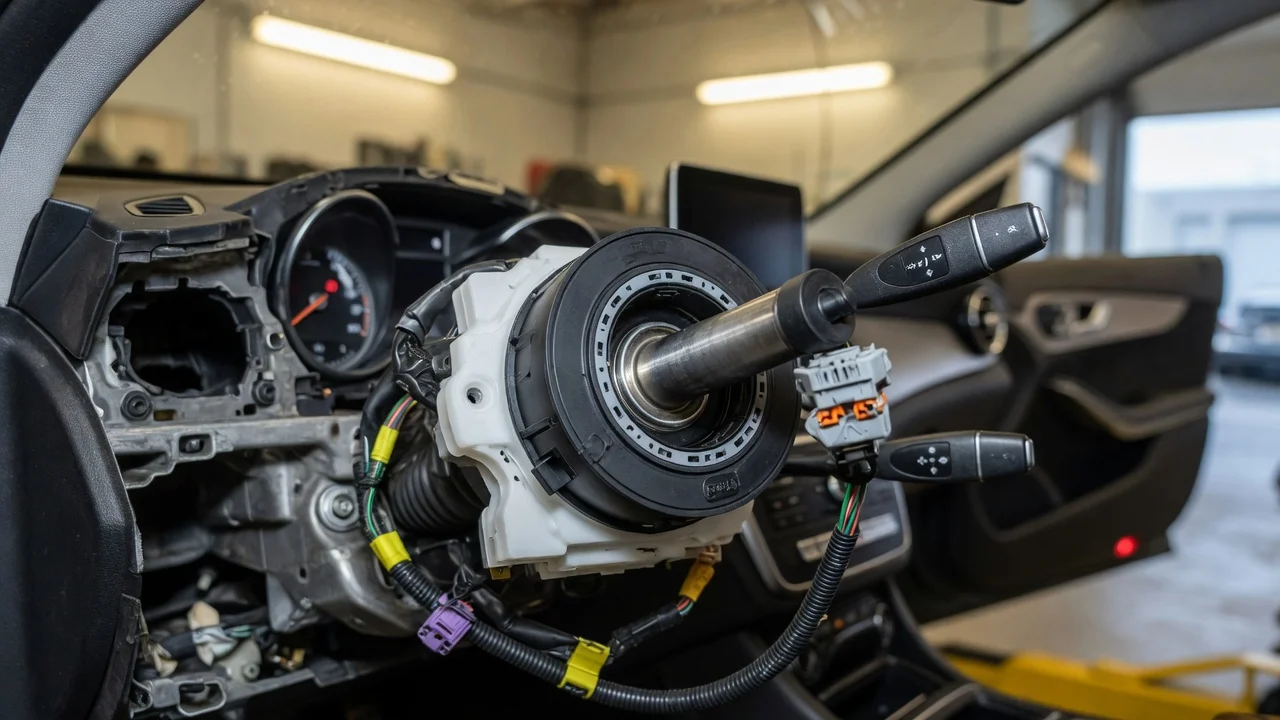
Direct answer and scope
The Mercedes-Benz steering angle sensor, commonly identified by its diagnostic code N49, measures the steering wheel position and rate of turn. In most Mercedes passenger cars and vans, it is integrated into the steering column assembly near the steering wheel, often as part of the steering column module or clock spring assembly rather than being mounted as a separate external part. The exact style and mounting vary by model generation. On many models, the N49 sensor is located behind the steering wheel, under the steering column shroud, or combined with the ESP yaw-rate sensor housing, depending on the vehicle platform.
Identifying and locating the sensor
The steering angle sensor is normally not visible without removing trim. It can be recognized as a flat, ring-shaped or cassette-style electronic unit fitted around the steering shaft, with an electrical connector and no mechanical linkage to the road wheels. On vehicles where it shares a housing with the clock spring, the combined assembly sits directly behind the steering wheel airbag and steering wheel hub. In separate sensor designs, the unit may be attached to the lower part of the steering column near the bulkhead or inside the column switch module.
Model-specific location notes
Location descriptions vary by chassis series. On the W203 C-Class, the steering angle sensor is generally located in the steering column module behind the steering wheel and requires removal of the steering wheel and airbag to access it. The W204 C-Class continues this arrangement, with the sensor typically integrated into the steering column switch cluster or the steering wheel electronics module. The W211 E-Class uses a similar steering column location, often as part of the N49 sensor integrated with the ESP system. On the W220 S-Class, the sensor is also mounted on the steering column, with access from behind the steering wheel trim.
The Mercedes A-Class differs by generation. On the W168, the steering angle sensor is installed on the steering column, behind the steering wheel, and is serviced with the column electronics. The W169 A-Class continues this placement, with the sensor generally integrated into the steering column module. The current A-Class platform keeps the measurement function inside the steering column or power steering control unit, so a separate N49 component is less commonly replaced as an individual part.
Older platforms show similar column-based placement. The W210 E-Class has the sensor on the steering column behind the steering wheel, often as part of the contact spiral or steering angle sensor cassette. The W163 M-Class and W164 M-Class place it in the steering column area or, on some configurations, near the ESP control module under the center console. On the Vito W447 van, the steering angle sensor is integrated into the steering column or electric power steering assembly, depending on equipment and model year.
Easily confused components
The N49 steering angle sensor should not be confused with the steering column switch module, the clock spring, or the ESP yaw and lateral acceleration sensor. Although some versions share a housing, the N49 function specifically measures steering wheel angle. A fault code referencing N49 does not automatically mean the clock spring or steering column module is defective. Some models use the same electrical path for the clock spring and sensor, but the diagnostic code identifies the angle measurement circuit.
Material uncertainty
Location and serviceability change with production dates, steering system type, and market specification. A vehicle with active steering, lane keeping assist, or an electric power steering rack may store the steering angle measurement in a different module than a base model. Because documentation is not consistent across all build variants, a direct visual check of the steering column area is the most reliable confirmation for a specific vehicle.