Luxury Convertibles: How to Choose the Right One and What to Check Before Buying

The short answer
A luxury convertible suits buyers who want open-air driving with premium comfort and are willing to accept trade-offs in cargo space, rear-seat room, cabin noise and roof upkeep. The right choice depends mostly on four things: the roof type, how many people you regularly carry, your climate and parking situation, and whether you are buying new or used. If you need a car for year-round daily use, regular rear passengers or frequent long trips with luggage, check closely before buying. Some convertibles handle those demands well, and many do not.
This guide does not include prices, performance figures, dimensions or model rankings, because no verified data for specific vehicles was available. Treat every specification as something to confirm for the exact model year, trim, powertrain and US-market version you are considering.
Conditions that change the answer
You carry adults in the back: many luxury convertibles are two-seaters or 2+2 layouts, meaning the rear seats are small and suited mainly to children or short trips. You need luggage space: on many convertibles the stowed roof occupies part of the trunk, so usable cargo space can shrink when the top is down. You park outdoors or in a high-crime area: roof material affects security and how well the car tolerates weather and long-term sun exposure. You live in a cold, wet or very hot climate: insulation, roof sealing and climate features matter more than they do in mild regions. You are buying used: the condition of the roof mechanism, seals and drains becomes a major part of the decision, not a minor detail.
Soft top or folding hard top
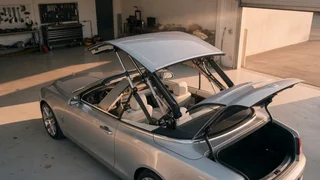
A soft top is a fabric roof, usually multi-layered and stretched over a folding frame. A folding hard top, sometimes called a retractable hard top, is made of rigid panels that fold into the body. The choice affects everyday comfort, security and maintenance more than most other features.
Soft tops generally weigh less and fold more compactly, which can leave more trunk space with the roof down and keep the car's styling cleaner. Their trade-offs are typically more wind and road noise at speed, less insulation in cold weather, and fabric that needs periodic cleaning and can wear, fade or be cut.
Folding hard tops usually behave more like a coupe with the roof up: quieter, better insulated and more resistant to break-ins. The trade-offs are typically more weight, a more complex folding mechanism with more parts that can fail, and a stowed roof that often takes up more trunk space. Which approach a given model uses, and how well it performs, varies by manufacturer and generation, so judge each car on its own terms.
Seating and cargo with the roof down
Check the trunk with the roof both up and down. Many convertibles have a movable divider or cargo cover that must be in place before the roof can fold, and that divider sets the real luggage limit for top-down driving. If you plan road trips, bring or measure the bags you actually use.
If you expect rear passengers, have an adult sit behind the front seats with the front seats set to your driving position. Also check whether a wind deflector, a mesh screen that reduces turbulence in the cabin, blocks the rear seats when installed. On some cars you cannot use the deflector and the rear seats at the same time.
Climate, comfort and daily use
Comfort with the top down depends on how well the car manages wind and temperature. Features to look for include a wind deflector, heated seats, a heated steering wheel and, on some models, neck-level heating vents built into the seatbacks. Availability differs by trim and option package, so confirm the exact equipment on the car rather than relying on general model descriptions.
Find out how the roof operates. Check whether it can be opened or closed while moving and up to what speed, how long a full cycle takes, and whether it can be operated from the key fob. These details decide how practical the car is when weather changes mid-drive, and they vary by model and year.
With the roof up, take a test drive at highway speed to judge noise. Cabin quietness is one of the biggest differences between luxury convertibles and their fixed-roof counterparts, and it is hard to assess from a spec sheet.
Ownership and maintenance considerations
To compensate for the missing fixed roof, manufacturers typically reinforce the body structure. This often makes a convertible heavier than the equivalent coupe or sedan, which can affect fuel economy and handling. Compare the convertible against its closed-roof sibling, if one exists, for the same model year and powertrain.
Roof systems use electric motors, hydraulic components or both, along with sensors, latches and weather seals. Repairs to these systems can be costly on luxury models. Before buying, ask what the warranty covers for the roof mechanism and seals, and for how long. If you are considering an extended warranty, read whether convertible-top components are included or excluded.
Convertibles have drain channels that route water away from the roof well and body. Clogged drains are a common cause of water leaks and interior damage, so they need occasional cleaning. Fabric tops also benefit from appropriate cleaners and protectants, and rubber seals may need conditioning. Check the owner's manual for the specific maintenance schedule.
Insurance premiums can differ between a convertible and a fixed-roof version of the same car. Get quotes for the specific vehicle before committing.
Checks for a used luxury convertible
Operate the roof through several full open and close cycles and listen for straining, grinding, hesitation or uneven movement. Watch for warning messages on the dashboard during roof operation. Inspect the fabric or panels for tears, cracks, shrinkage, fading, delamination or poorly matched repairs. Check all weather seals for cracking, flattening or gaps where the roof meets the windshield frame and side windows. Look under carpets, in the trunk and around the roof storage area for dampness, stains, corrosion or a musty smell that may indicate leaks. Check for hydraulic fluid residue around the roof well and trunk if the roof uses hydraulic components. Confirm that the side windows drop and rise correctly when the roof operates, since they often move automatically with the roof. Ask for service records showing roof maintenance, drain cleaning and any roof or seal repairs. Check that the wind deflector, roof cover and any tonneau cover that came with the car are present and undamaged. Have an independent pre-purchase inspection done by a technician familiar with the brand and its roof system.
Specifications to confirm for the exact vehicle
Convertible specifications often differ from the fixed-roof version of the same model, and they can change between model years, trims and powertrains. Confirm each of the following for the specific US-market car you are considering, using the manufacturer's documentation or the vehicle's window sticker:
Roof type, material and operating method; Maximum vehicle speed for roof operation, if any; Trunk capacity with the roof up and with the roof down; Seating capacity and rear-seat dimensions; Curb weight compared with the fixed-roof version; Fuel economy or electric range for the exact powertrain; Rollover protection design, such as fixed hoops or deployable bars; Included comfort features such as neck heating, heated seats and wind deflector; Warranty terms covering the roof mechanism
Gaps in this guide
No verified data on specific models, prices, reliability records, safety ratings or current availability was available for this guide, so it does not recommend particular cars or compare them. For those details, consult manufacturer specifications for the exact model year, official crash-test results where published, and recent owner or reliability data for the specific generation you are considering.
Next step
Decide on roof type and seating needs first, since those narrow the field fastest. Then shortlist models, confirm the specifications above for each exact version, and test drive with the roof both up and down, including at highway speed. If buying used, make the roof inspection and an independent pre-purchase check part of the deal before you agree on a price.