Low Transmission Fluid Symptoms: Jerking, Shaking, Stalling, No Movement
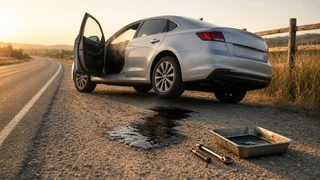
A low transmission fluid level can produce a wide range of alarming behavior, from jerking and shaking to stalling, overheating, and complete loss of drive. The exact result depends on how much fluid remains and which circuits lose hydraulic pressure first. In many automatic transmissions, the fluid is not just a lubricant; it is also the working medium that applies clutches, feeds the torque converter, and carries heat away. When that volume falls below a critical point, normal gear engagement becomes unstable and the vehicle may fail to move in one or more directions.
Direct answer
Yes, low transmission fluid can stop a vehicle from moving, and in some cases a nearly empty case can contribute to a no-start complaint. The transmission depends on pressurized fluid to engage drive or reverse. If the pump pulls air instead of fluid, hydraulic pressure collapses, clutches and bands cannot hold, and the gearbox behaves as if it is in neutral. A car may creep weakly, hesitate, or refuse to move until the engine revs rise enough to help the pump move aerated fluid.
A no-start condition is generally not caused directly by transmission fluid level unless the vehicle has a neutral safety or transmission range switch that is not receiving the expected state from a drivetrain that has lost line pressure. More often, a driver notices that the engine cranks strongly in park or neutral but the car will not move when shifted into gear. If the engine does not crank at all, the no-start concern is usually in the starting circuit, battery, ignition, or anti-theft system rather than the transmission fluid level.
Interpreting symptoms and test results
Jerking and shaking often appear before a complete loss of movement because air entering the valve body causes inconsistent line pressure. Gears may engage abruptly, slip, then grab again as the pump briefly picks up fluid. A shudder during light throttle or a banging downshift can also develop when the torque converter receives an unstable fluid supply. Drivers should notice whether the condition changes with temperature, because fluid expands as it warms and can temporarily mask a borderline low level.
Stalling and shutting off at stops may involve a torque converter clutch that drags or a transmission line pressure problem that overworks the engine at idle. With very low fluid, the converter can cavitate and overheat, transferring extra load that pulls engine speed down until the engine stalls. Overheating transmission fluid also loses its ability to protect gears and seals. If the vehicle stalls only in gear and restarts in neutral or park, the transmission hydraulic circuit should be checked before blaming the engine.