Low Coolant and Engine Overheating: What to Check
Direct answer
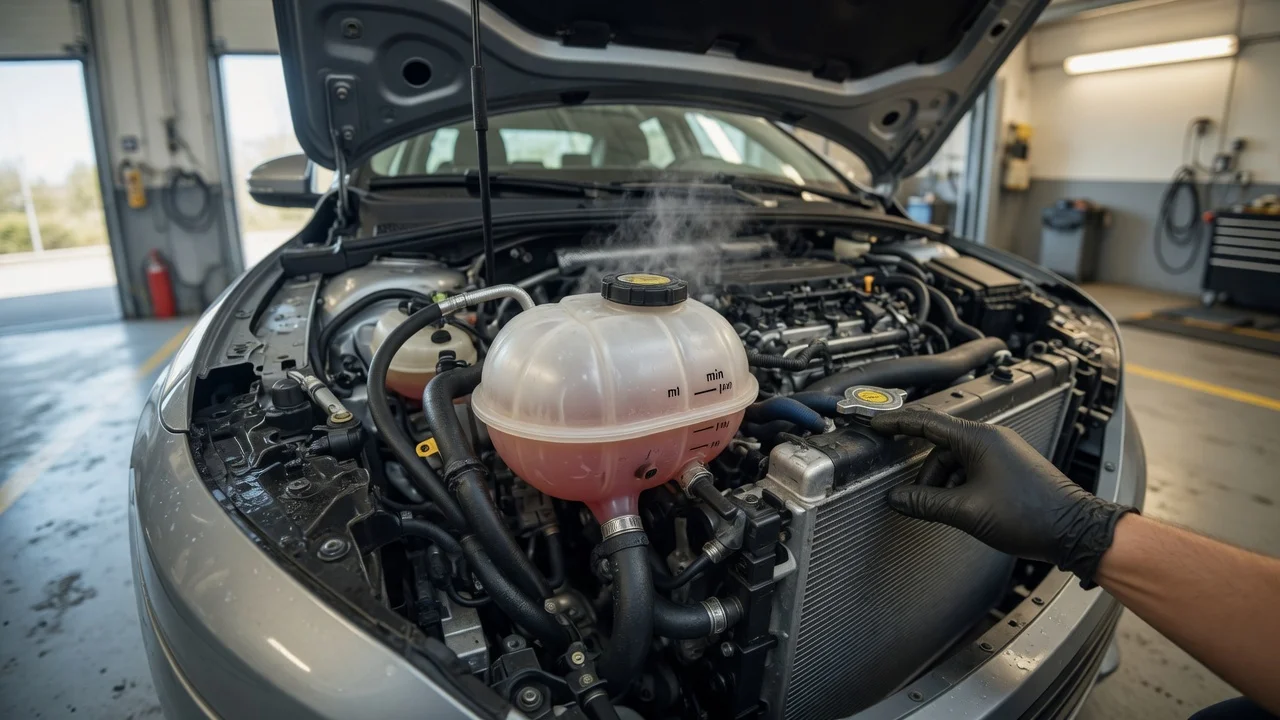
If the coolant level is low, stop driving the vehicle under load until you can inspect it. A low level may simply mean the system needs topping up, but it can also indicate a leak, a failing pressure cap, or coolant being lost internally. The safest first step is to let the engine cool completely, then check the level in the expansion tank or coolant reservoir rather than opening the radiator while it is hot.
What the coolant level tells you
The coolant system moves a mixture of antifreeze and water through the engine to absorb heat, then through the radiator to release that heat. The expansion tank, also called a coolant reservoir or overflow bottle, gives the heated coolant room to expand and provides a safe point for checking the level. A level at or near the minimum mark does not by itself identify the cause; it only confirms that fluid is missing from the system or that the level was last set too low.
Because coolant expands when hot, the reading changes with engine temperature. Check the level under the conditions specified by the vehicle manufacturer. On many cars the normal check is done with the engine cold, using the marks on the side of the translucent reservoir. Comparing a cold reading and a hot reading can help you avoid misreading normal expansion as a sudden gain or loss.
Why low coolant can cause overheating
If enough coolant is lost, air can enter the system and reduce the amount of liquid available to carry heat away from the engine. The result can be a temperature gauge that climbs above its normal range, a high engine temperature warning, or reduced cabin heat because less hot coolant reaches the heater core. The relationship is not always immediate: a small shortfall may not cause overheating until the engine is worked hard or the outside temperature is high.
Overheating with a low coolant level should still be investigated as a coolant loss problem, not treated as a simple top-up. Adding fluid may restore the level temporarily, but it will not correct whatever allowed the level to fall.
What to check first
Work through the following checks in order. Each one is useful only when the engine has cooled enough to make the inspection safe, and each result narrows the possible causes without proving a single component has failed.
Check the reservoir level and condition; Inspect the external coolant path; Check the pressure cap; Look for signs of internal coolant loss
Check the reservoir level and condition
Confirm whether the level is below the minimum mark, between the marks, or above the maximum mark. Note the appearance of the fluid. Oil floating in the coolant or a milky look can indicate contamination, while debris or discoloration may mean the coolant is old or contaminated. A low but clean reservoir with no obvious external leak leaves more possible explanations open.
Inspect the external coolant path
Look around the radiator, hoses, hose connections, water pump area, and heater hoses for wetness, staining, or crusty residue. Coolant can leave white, green, pink, orange, or blue deposits as it dries. A visible drip or a wet lower hose connection strongly suggests an external leak, while a dry engine bay does not rule one out because coolant can evaporate or leak only under pressure.
Check the pressure cap
The radiator or reservoir cap helps maintain system pressure and allows excess coolant to move into the expansion tank. A cap that no longer seals correctly can let coolant escape as vapor or liquid without leaving an obvious puddle. A damaged seal, a weak spring, or a cap that does not tighten properly is a possible cause of gradual coolant loss. Replacement is inexpensive, but only after a visual inspection supports the cap as a likely source.
Look for signs of internal coolant loss
Coolant can disappear into the engine through a failed head gasket, a cracked cylinder head, or another internal path. Signs include white exhaust smoke that persists after warm-up, a sweet smell from the exhaust, chocolate-milk-colored engine oil, or repeated loss of coolant with no external evidence. These observations support further diagnosis; they do not identify the exact failed part.
How to narrow the cause
Use the observations from the checks to separate likely causes. A visible external leak points away from internal consumption, but the vehicle can still have more than one problem. A clean, dry system that repeatedly loses coolant and occasionally overheats points toward an internal leak or a cap that allows coolant to escape under pressure. Overheating that occurs only with a full system points toward a different problem, such as poor airflow through the radiator, a thermostat that is not opening, or a cooling fan issue.
A temperature warning or diagnostic trouble code is not proof that a specific part needs replacement. For example, a code related to engine coolant temperature only says that the engine control module saw a temperature reading outside the expected range; it does not identify whether the cause is low coolant, a faulty sensor, a wiring problem, or a mechanical cooling fault.
Safe topping up and next steps
If the level is low and you need to move the vehicle, add the correct coolant type specified for the vehicle and bring the level to the marked range. Do not open a hot radiator or reservoir cap. A temporary top-up is not a repair: record the level, drive only as necessary, and recheck it after the engine has cooled. If the level falls again or overheating returns, have the cooling system pressure-tested and inspected.
Some vehicles use a sealed or pressurized reservoir, and others use a conventional overflow system; the exact cap location, fill procedure, and coolant specification vary by model year, engine, and market. Follow the manufacturer's instructions for your specific vehicle.
What the evidence does not tell you
A single low reading does not reveal how fast coolant is being lost or where it is going. Without a pressure test of the cooling system, a cylinder leak test, or another applicable check, internal loss and intermittent external leaks can remain visually invisible. Treat the checks above as a way to form the next diagnostic step rather than as a final answer.