Lost Communication Codes U0102–U0120 and U0136
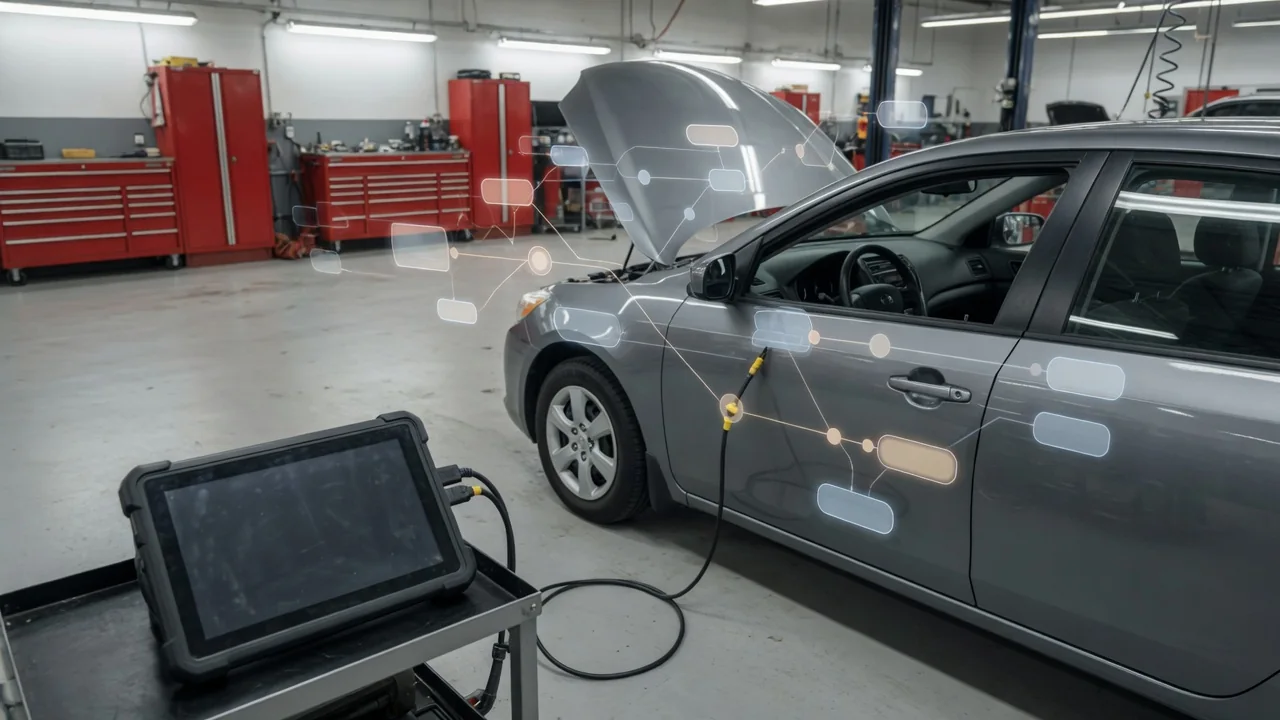
A U0103 code indicates lost communication with the gear shift control module, but similar U0102 through U0120 and U0136 codes point to many modules on a vehicle's communication network. These fault codes mean a reporting module stopped receiving expected messages, often due to low-voltage supply problems, wiring faults, or a module that is offline. Understanding what a lost-communication code does and does not prove helps focus diagnosis without assuming the named part has failed.
What a Lost-Communication Code Can Establish
Every lost-communication code must be confirmed against service information for the specific year, make, model, and powertrain, including any suffix that changes its meaning. A generic U0103 definition is only a starting point because the same code can have a different module association on another vehicle. Full scan-tool text, freeze-frame data, and the reporting module identify why the code was set and whether the fault is active or stored from a past event.
A lost-communication code is evidence that a reporting module recorded missing expected messages on the CAN bus or another vehicle communication network. It does not establish that the named module has failed. Interrupted module power or ground, connector damage, network wiring faults, or a discharged low-voltage battery can all create the same symptom. The reporting module, code status, accompanying codes, and installed equipment matter because they reveal whether the fault is isolated or part of a broader electrical issue.
U0102, U0114, and U0136: Transfer Case, 4WD Clutch, and Differential Communication
U0102 is usually associated with the transfer case control module, and U0114 with the four-wheel-drive clutch control module, but this must be verified for the specific vehicle. U0136 sits outside the U0102–U0120 range and often relates to a differential control module, but its axle application requires confirmation. On vehicles with these systems, a communication fault may trigger drivetrain warnings, unavailable drive modes, or restricted operation depending on the manufacturer’s fail-safe strategy.
A lost-communication code cannot establish internal mechanical damage to a transfer case, clutch, or differential. The code only indicates that the reporting module lost the ability to exchange messages with the drivetrain controller. Gear grinding, binding, or noise would be separate mechanical observations. Since lost module communication can stem from a loose connector, corroded terminal, or power interruption, the network and power supply must be tested before suspecting the drivetrain component itself.
U0103, U0104, and U0107: Gear Shift, Cruise, and Throttle Control
U0103 is normally mapped to the gear shift control module, U0104 to the cruise control module, and U0107 to the throttle actuator control module, though exact definitions vary by vehicle architecture. These modules may be integrated into larger control units, so the scan tool description is important. Possible symptoms include selector warnings, unavailable cruise control, or reduced throttle response, but no single symptom is guaranteed. Some vehicles default to a limp mode while others continue operating with a warning light.
Stop-driving guidance applies when throttle response becomes unpredictable, the driver cannot select or confirm a gear, or safe vehicle control is lost. A gear selector that does not communicate may leave the transmission in an unsafe state or prevent the vehicle from moving. Intermittent throttle communication can cause surging or a sudden loss of power. If the vehicle cannot be operated predictably, pull over in a safe location and arrange assistance rather than continuing to drive.
U0105, U0106, and U0115: Injector, Glow Plug, and ECM/PCM B Communication
U0105 is usually associated with the injector control module, and U0106 with the glow plug control module, but applicability depends on the installed engine. U0115 requires verification of the ECM/PCM B designation because the letter does not identify a universally interchangeable module. On a diesel, lost glow plug communication may cause hard starting when cold, while a lost injector module may produce rough running or reduced power. Engine warnings are common, but they cannot pinpoint the failed circuit or component.
Module supply and network testing are needed before condemning injectors, glow plugs, or an engine controller. A low-voltage battery, poor ground, or damaged CAN bus wiring can cause the engine controller to lose communication with a subordinate module and set one of these codes. Since the reporting module may be the ECM/PCM, the fault could lie in the injector module, its power feed, or the wiring between them. Replacing expensive fuel or ignition components without confirming network integrity is not a valid repair.
U0110, U0111, and U0112: Drive Motor and Battery Energy Control
U0110 typically designates drive motor control module A, while U0111 and U0112 are associated with battery energy control module A and B, but vehicle-specific service information is mandatory. The A and B letters describe the manufacturer’s control architecture and do not independently identify a battery location or replacement part. Possible observations include propulsion warnings, inability to enter the ready state, charging restrictions, or reduced power, but not every affected vehicle shows all of them.
A low-voltage supply or communication fault can interrupt hybrid or EV operation without proving traction-battery or drive-motor failure. The high-voltage system may remain fully functional while a 12-volt battery issue prevents the control modules from waking up and exchanging messages. Qualified professional diagnosis is required where high-voltage systems are involved. Do not open battery enclosures, disconnect orange cables, probe high-voltage circuits, or bypass interlocks; these actions require specialized training, tools, and safety procedures.
U0120: Starter-Generator Control Communication
U0120’s starter-generator control module designation must be verified against the vehicle’s installed starting and generation architecture. This code is used on vehicles with a belt-driven starter-generator or integrated starter-generator, but the exact system varies. Possible symptoms include start failure, unavailable automatic stop-start, or electrical-system warnings, depending on the vehicle. A stored U0120 does not independently establish failure of the starter-generator assembly or its energy-storage system.
Professional testing must establish module power, ground, network availability, and applicable voltage-system precautions before component replacement. The starter-generator may operate at 48 volts or higher on mild-hybrid systems, so additional safety procedures apply. A communication fault may be caused by a damaged connector, a break in the CAN bus wiring, or a low battery that prevents the module from responding. Replacing the starter-generator without confirming the communication path is a misdiagnosis.
Safe Observations and the Diagnostic Information a Shop Needs
Record exact codes, code status, dashboard messages, operating symptoms, and whether the fault followed a discharged battery, jump-start, or recent service. Multiple lost-communication codes that appear together often share a common power or ground problem. A vehicle that needed a jump-start may have a weak battery that dropped voltage enough to disrupt module communication. Recent service could have left a connector loose or a ground strap off, so this history is valuable to the diagnosing technician.
A full vehicle scan and professional power, ground, and network tests help determine whether multiple codes share an electrical cause. Preserve scan results before clearing codes, and explain that erasing a code does not confirm a repair. The fault may return after a drive cycle if the underlying problem remains. Driving advice should be based on symptoms and manufacturer warnings: stop safely and arrange assistance for stalling, unreliable propulsion, unsafe shifting, or instructions to stop the vehicle.