LB7 Wastegate Actuator: Identification and Checks
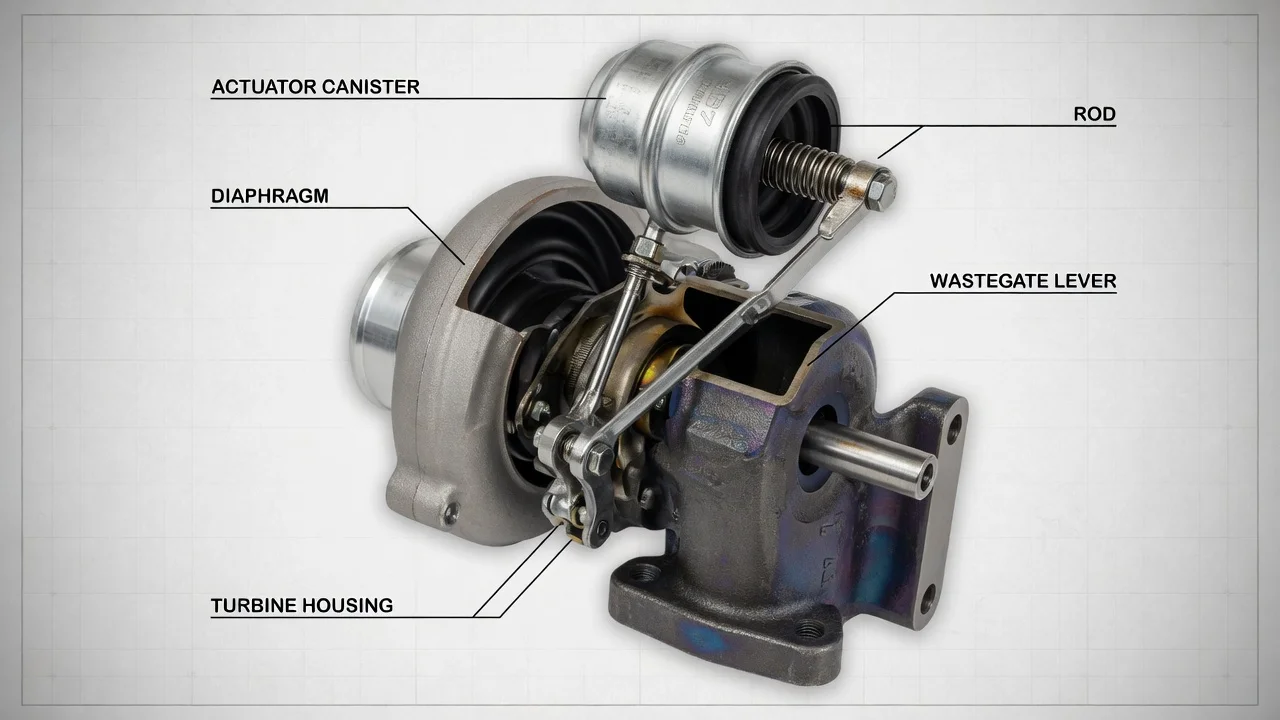
The wastegate actuator on an LB7 Duramax controls how much exhaust bypasses the turbine, which limits boost. When it sticks, leaks or loses its signal, the truck can feel flat, overboost or make new noises. Several other faults cause the same complaints. This guide shows how to identify the actuator on your vehicle configuration, record the symptoms, and work through checks in a sensible order so you can confirm the cause before buying parts.
Establish the symptoms
Start by confirming what you are looking at. On the LB7 the turbocharger is a fixed-geometry unit with a wastegate. The actuator is the round diaphragm canister mounted on the turbo. A short rod links it to the wastegate arm, and a small signal hose feeds it. Confirm the exact layout for your truck in the service information, because replacement turbochargers and modified trucks may not match the original setup. Typical complaints fall into two groups. Too little boost shows up as weak acceleration, slow response under load and sometimes more smoke than usual. Too much boost, or erratic boost, can feel like surging or a sudden power cut, or show as a boost reading higher than the truck normally gives.
Write down when the problem appears. Note whether the engine is cold or fully warm, whether you are cruising lightly or on heavy throttle, whether the truck is empty or towing, and whether the fault is constant or intermittent. Also record any warning lights, stored trouble codes, and whistles, hisses or rattles from the turbo area. If you have a boost gauge or scan tool, note what it shows. Recent changes matter just as much. Check the service history for intake or intercooler work, a turbo replacement, injector service, engine tuning or exhaust modifications. Any of these can change boost behavior and point the diagnosis in a different direction.
Distinguish plausible causes
A wastegate that stays open, or opens too early, lets exhaust bypass the turbine and limits boost. Possible causes are a ruptured actuator diaphragm, a cracked, collapsed or disconnected signal hose, a missing retaining clip on the rod, or a rod that has been adjusted incorrectly. A wastegate that stays closed causes overboost. The usual suspects here are a flapper or pivot seized by heat and carbon buildup, a blocked signal hose or a jammed linkage. A rattle at idle that changes with engine speed often points to worn wastegate linkage rather than the actuator itself.
Several faults outside the wastegate feel the same. A leaking intercooler boot, loose clamp or split intercooler causes low boost and often a hiss under load, even though the actuator tests fine. Fuel delivery and injector problems are a known concern on this engine and can cause low power and smoke even when boost is normal. A faulty boost or MAP sensor can trigger codes or reduced power without any real boost problem. A restricted exhaust, or a worn turbocharger with damaged wheels or excessive shaft play, can also mimic wastegate faults. Normal logged boost, an audible leak elsewhere, or codes pointing to fueling all weaken the actuator theory.
Checks in a useful order
Begin with checks any owner can do safely with the engine off and cool, since the turbo and exhaust get hot enough to cause serious burns. Inspect the signal hose along its full length for cracks, softening, oil saturation and loose ends. Confirm the rod is attached to the wastegate arm with its clip in place. Look for bends, heavy corrosion or signs that the adjustment has been disturbed. Check intercooler boots and clamps for oil residue or looseness, and read any stored codes with a scan tool. If the scan tool shows live data, have a helper watch boost and related readings during a careful, legal road test.
The next tests need tools and the manufacturer specifications for your exact vehicle. A hand pressure pump applied to the actuator shows whether the diaphragm holds pressure and whether the rod moves smoothly. The pressure at which the rod should start to move, and where it should reach full travel, must come from the service information, not guesswork. Where access allows, disconnect the rod and move the wastegate arm by hand to feel for binding. A boost leak test pressurizes the intake side to locate leaks. Leave rod adjustment, turbo removal, shaft play checks and fueling diagnosis to a qualified technician, because incorrect settings can cause overboost and engine damage.
Interpret the findings
If the diaphragm holds pressure and the rod travels smoothly within specification, the actuator itself is probably working. Attention then moves to the signal hose, the wastegate valve, boost leaks or fueling. If the actuator will not hold pressure or the rod does not move, the diaphragm or internal spring has likely failed. If the actuator moves freely but the wastegate arm binds or will not close fully, the problem is the valve or pivot inside the turbine housing. A new actuator alone will not fix that. A cracked or loose hose is a cheap, likely culprit, but replacing it only counts as a fix once logged boost returns to normal.
Before replacing parts, confirm the result under the same operating conditions that produced the complaint. If boost is normal but low power or smoke persists, suspect fueling, sensors or exhaust restriction rather than the turbo. Check whether the actuator is sold separately for your turbocharger or only as part of an assembly. Also check whether the replacement needs a set rod length. A repeat road test with logged data after the repair is the only reliable proof that the wastegate is controlling boost correctly.
Urgency and next action
Stop driving and arrange an inspection if any of these occur: boost climbs well above what the truck normally shows, the engine suddenly loses power under load, a new grinding or screeching comes from the turbo, or you see heavy blue or black smoke or oil in the intake tract. Overboost and a failing turbocharger can damage the engine quickly, especially when towing. Low boost with no other warning signs is less urgent, but it can still hide a developing fault, so avoid heavy loads until the cause is known. There is no safe mileage figure for driving with an unconfirmed wastegate problem.
When you book the repair, give the technician the model year, engine and VIN, a summary of the service history and any modifications, and the exact conditions in which the symptom occurs. Include stored codes and any logged boost data. Share the results of any inspection and pressure tests you have already done so they are not repeated. If the truck follows a maintenance schedule, mention when the intake, intercooler and turbo were last checked. This helps the shop confirm the cause and quote the correct parts the first time.