L5P Duramax Glow Plug Control Module Selection Guide
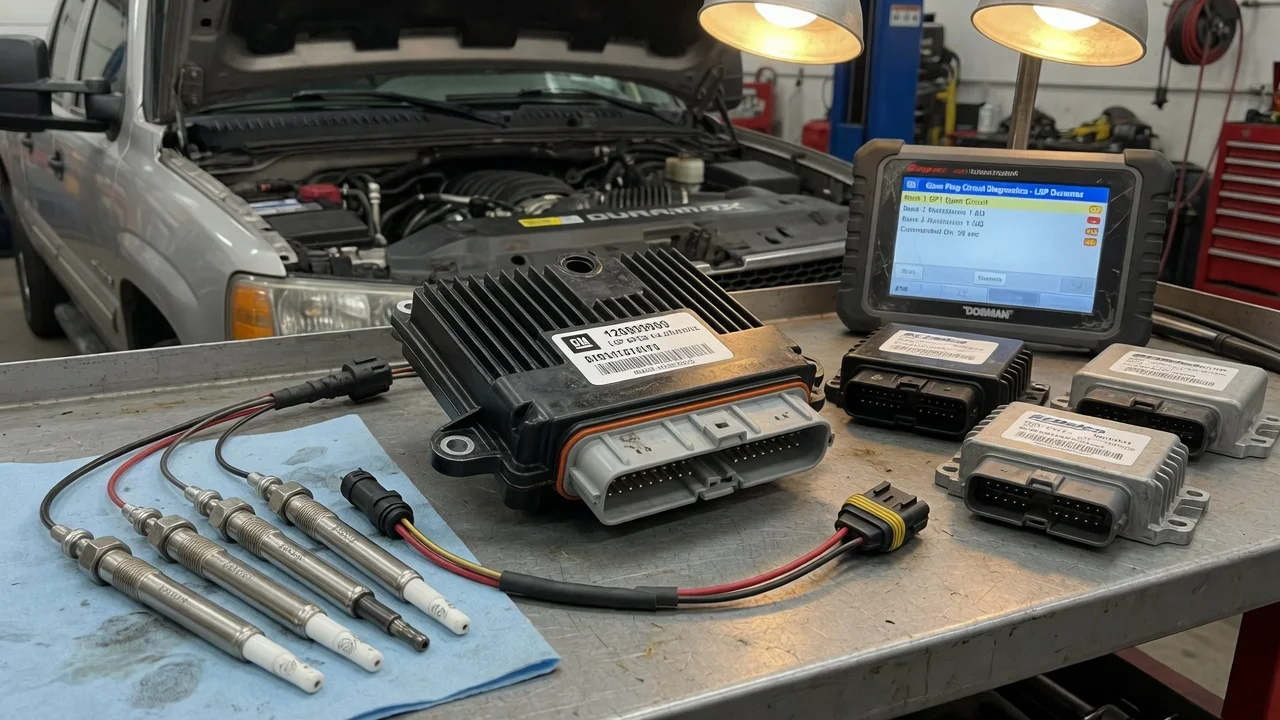
On a 2017 or newer Duramax with the L5P engine, the glow plug control module decides when each glow plug heats and for how long, then reports circuit problems to the engine computer. When it fails, cold starts get harder, white smoke lingers and diagnostic codes stack up. Choosing a replacement comes down to three things: confirming the module is really at fault, matching the exact part, and judging quality honestly. This guide covers each step from a fuel-system mechanic's point of view.
Define the job the product must do
The module takes commands from the engine control module, which weighs inputs such as coolant and intake air temperature. It switches power to the eight glow plugs and monitors each circuit. It plays no part in fuel delivery. Many hard-start complaints blamed on glow plugs actually come from weak batteries, gelled or water-contaminated diesel, a restricted fuel filter, low supply pressure from the fuel pump, or an injector that is leaking or sticking. Before buying anything, pull the codes. Codes in the P0671 to P0678 range point to individual cylinder circuits. P0670 and communication codes such as P0683 involve the module circuit itself. A single cylinder code usually means a bad plug or damaged wiring, not a bad module. Several cylinder codes at once, or a communication fault with confirmed good power and ground at the module, make a stronger case for replacement.
Next, weigh your own constraints. Consider how cold your winters get, whether you have a scan tool that shows glow plug commands and circuit status, how long the truck can sit, and whether you will do the work yourself. If you are chasing a no-start that might be fuel-related, leave the high-pressure side alone. The L5P common rail runs at extremely high fuel pressure, and loosening an injector line or fitting to look for air or leaks can cause a serious fuel injection injury. Any leak check on that system should follow factory service procedures with the correct tools.
Check compatibility
Start by confirming the engine. The Service Parts Identification label, usually in the glove box, lists the engine RPO code. You want L5P, not the earlier LML or LBZ, whose modules differ. The L5P appears in Silverado and Sierra 2500HD and 3500HD pickups from 2017 onward. It is also used in some medium-duty chassis, which may not share the same module part number. A 2017 Duramax glow plug control module is a first-year L5P part, so check whether the original number has been superseded by a revised one. Later model-year updates can also change parts, so do not assume one module covers every L5P year.
The most reliable match is the part number printed on your original module, cross-checked against your VIN with a parts counter. Compare the connector shape, terminal count, keying and mounting points. Then ask the seller a direct question: does the replacement need programming or a setup procedure with a scan tool? Some GM modules must be configured to communicate correctly with the engine computer. A unit that is never configured can keep setting communication codes even though the hardware is fine. If programming requires dealer-level software, add that cost before you compare prices.
Features that affect the choice
Your realistic options are a new GM-branded module, a new aftermarket module or a remanufactured unit. Each trades price against certainty. A new GM part offers the most predictable fit and communication but costs more. Aftermarket and remanufactured units can save money, but quality varies more and the documentation is often thinner. Whichever you choose, the module has to report circuit status the way the engine computer expects. If it does not, the truck may set false codes or fail to flag a plug that has actually died.
Separate evidence from marketing. Labels like heavy duty, upgraded, plug and play or OEM quality tell you nothing measurable. Useful evidence includes an exact interchange part number, a stated model-year and engine configuration range, written warranty terms, a return policy that covers programming problems, and fresh connector seals. Also check whether a new pigtail is included. If the original connector shows corrosion, heat damage or loose terminals, a pigtail matters as much as the module. A clean new unit plugged into a damaged connector can fail the same way the old one did.
Limitations and ownership costs
A new module cannot fix a failed glow plug, a chafed harness, a poor ground or low battery voltage. Check those first. A shorted plug can also damage a module, so test the plugs and wiring before installing the new part, or the replacement may fail early. Nor can a module correct fuel problems. Plan for a restricted fuel filter, water in the fuel, weak supply from the fuel pump or uneven injector delivery separately. Cylinder balance or fuel trim data from a capable scan tool helps you tell an injector problem from a glow plug problem. Winter fuel additives can help prevent gelling when used as directed, but they do not repair a failed module, a sticking injector or a clogged filter.
Ownership costs go beyond the part price. Budget for any programming, the labor to reach the module and its connector, and possibly a pigtail or glow plugs found bad during diagnosis. Remanufactured units often carry a core charge that is refunded only when the old module is returned in acceptable condition. Ongoing care is simple. Keep the connector sealed and seated, look over the harness during routine fuel filter service, and keep the batteries healthy, because low voltage stresses the whole cold-start system. Keep the receipt and part number for warranty claims.
Build a practical shortlist
Begin by confirming the diagnosis. You should have stored codes that implicate the module or several circuits, verified power and ground at the module, and no obvious battery, wiring or fuel faults left unresolved. Next, confirm fitment: an L5P RPO code on the parts label, a part number that matches your original or its official supersession, and a connector and mounting that match. Then look for real evidence of quality, such as clear model-year coverage, written warranty terms and a return path if programming fails.
Narrow the field to two or three candidates that pass every one of those checks, then compare total cost rather than sticker price. Include programming, any core charge, a pigtail if your connector is damaged, and the labor you will pay or spend yourself. If two options come out close, choose the one with the stronger support for configuration problems. After installation, clear the codes, confirm that the glow plug command and circuit status read correctly on a scan tool, and verify a normal cold start before you consider the job finished.