Jeep Wrangler TCC Solenoid: How to Identify and Locate It
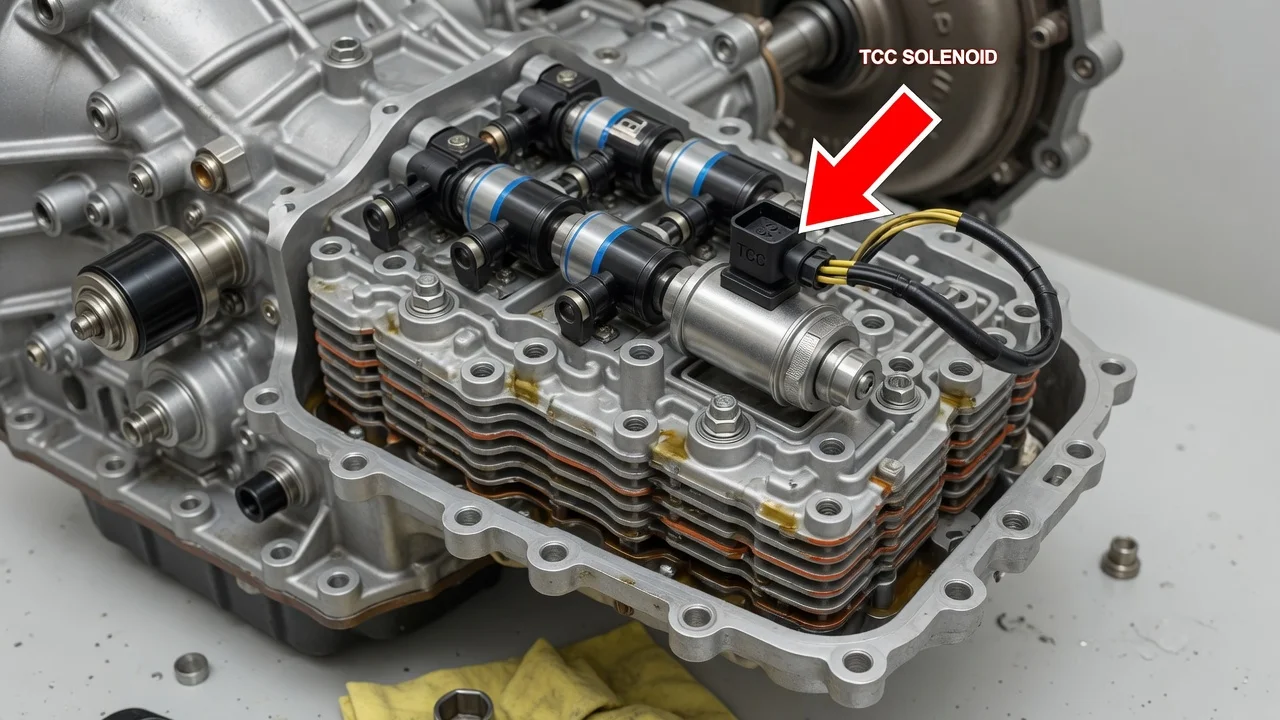
Owners looking for the torque converter clutch solenoid on a Jeep Wrangler usually want to know where the part sits and whether it can be replaced on its own. The answer depends on the transmission. Wranglers have used several automatic gearboxes over the years, and manual-transmission Jeeps have no torque converter at all. This guide covers how to identify your transmission type, where converter clutch control is generally located, and how to approach diagnosis without assuming a failed part.
Where the TCC Solenoid Is on a Wrangler
On automatic Wranglers, the converter clutch is controlled hydraulically through the valve body, which sits inside the transmission at the bottom of the case, under the oil pan. The solenoid that commands lockup is therefore internal. You will not find it under the hood or bolted to the engine. Reaching it typically means draining the fluid and removing the pan, and on later transmissions it often means removing the valve body or electronic control assembly as well.
Whether there is a separate, individually replaceable TCC solenoid depends on the transmission. On the 42RLE four-speed used in later TJ models and early JK models, converter clutch control shares a solenoid with the low/reverse circuit inside the solenoid assembly. There is no standalone part dedicated only to lockup. On the five-speed automatic in 2012–2018 JK models and the eight-speed in JL models, the solenoids are integrated into the valve body or transmission control assembly and are commonly serviced as a unit. Confirm the exact transmission before ordering anything labeled as a TCC solenoid.
How Converter Lockup Works
A torque converter couples the engine to the transmission through fluid, and some slip is built into that design. At steady cruising speeds, the control module commands the converter clutch solenoid to route fluid pressure to a clutch inside the converter. That clutch locks the engine mechanically to the transmission input. Lockup reduces slip, lowers engine speed and fluid heat, and improves fuel economy. The module decides when to apply or release the clutch using inputs such as vehicle speed, throttle position, engine load, fluid temperature and the brake switch. It normally releases lockup during braking, hard acceleration, or while the fluid is still cold.
The solenoid is only one link in this chain. A lockup complaint can come from wiring, a faulty input to the control module, degraded fluid, worn valve body passages, or the clutch inside the converter itself. A solenoid that passes an electrical test can still sit in a hydraulic circuit that leaks or sticks. For that reason, the part in the code description is not automatically the part that has failed.
What Changes the Answer
Generation and model year matter most. Older YJ and early TJ automatics were three-speed units with a simpler valve body arrangement. TJ models from 2003 to 2006 and JK models from 2007 to 2011 generally used the 42RLE four-speed. JK models from 2012 to 2018 used a five-speed automatic, and JL models use an eight-speed. Engine choices and variants such as diesel or plug-in hybrid JL models can change hardware details. If your Wrangler has a clutch pedal, it has no torque converter and no TCC solenoid, and lockup-related codes would point to a different issue.
To confirm fitment, check the build information for your VIN, the identification tag or markings on the transmission case, or a parts lookup by VIN. Parts listed only by model and year may not match your unit. Fluid specification also differs between these transmissions, and some later units have no conventional dipstick, so the level is checked through a fill plug at a specified fluid temperature. The wrong fluid or an incorrect level can affect shift behavior and lockup quality on its own.
What the Owner Can Do
Start with diagnostic codes. Use a scan tool that reads transmission codes, not just engine codes. Generic codes in the P0740 to P0743 range relate to the converter clutch circuit or its performance. Manufacturer-specific codes and freeze-frame data add detail about the conditions when the fault set. Treat a code as a pointer to a circuit or behavior, not as confirmation that the solenoid has failed.
Next, note the shift behavior and lockup symptoms. During a steady highway cruise with a warm transmission, a working converter clutch usually produces a small drop in engine speed after it applies. Watch for engine speed staying higher than normal at cruise, a shudder that feels like driving over rumble strips under light throttle, or the engine stalling as you come to a stop, which can indicate lockup that fails to release. Record the speed, temperature, load and whether you were towing, and note any changes to tire size or axle gearing. Then check the fluid level and condition using the correct procedure for your transmission. Look for a burnt smell, dark color or debris.
Review the service history for fluid changes, previous transmission work, and any service with a nonspecified fluid. Repair options range from fixing a damaged connector or wiring, through a fluid service, to replacing the solenoid assembly, valve body or control unit, or the torque converter. On later transmissions, replacing the valve body or control unit may require programming or an adaptation procedure with suitable equipment.
Limitations and Next Step
This guide is general. Exact component location, removal procedure, torque values and fill method vary by transmission and model year, so use factory service information for your specific VIN before taking anything apart. Several important tests require equipment most owners do not have: commanding lockup with a capable scan tool, checking solenoid resistance and circuit integrity at the case connector, and measuring hydraulic pressure.
If the engine stalls when stopping, or the transmission overheats or behaves unpredictably, limit driving until the cause is found, because a stall in traffic is a safety risk. A shop with automatic transmission experience and the correct scan software can confirm whether the problem is electrical, hydraulic or inside the converter, and can then recommend the appropriate repair.