Jeep Wrangler Front Axle Actuator Fitment: Matching the Right Part
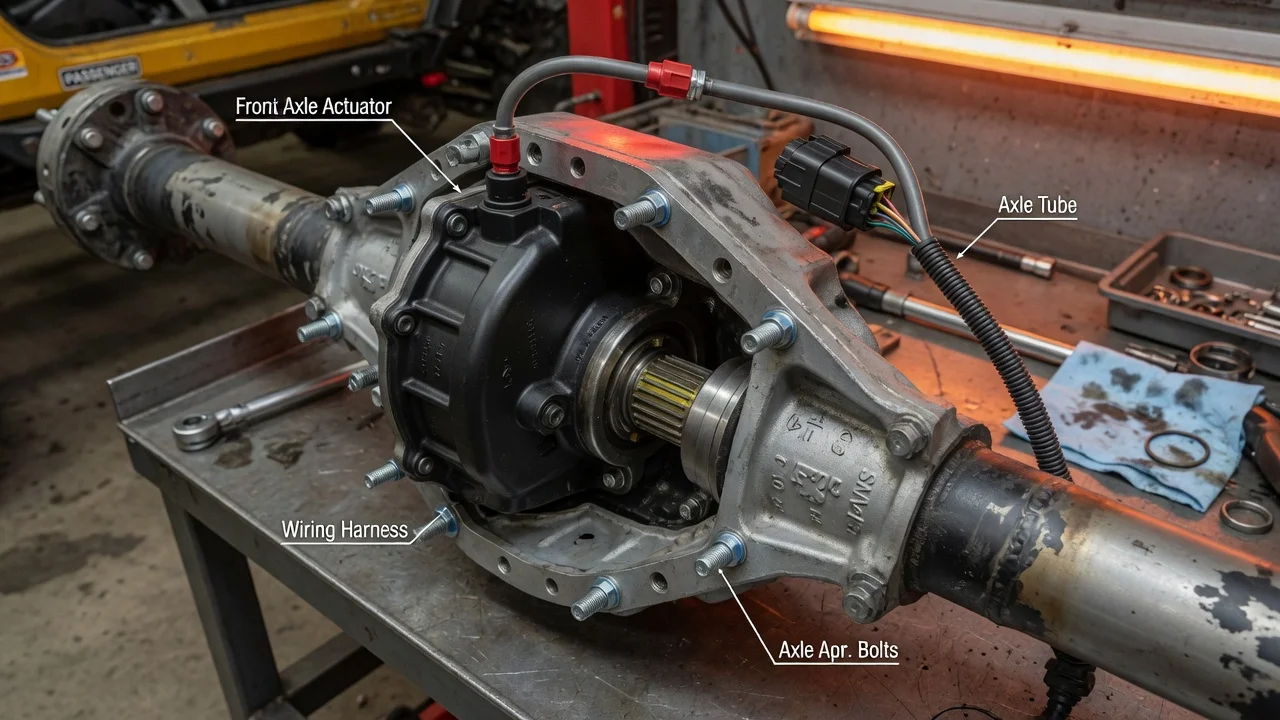
Buying a front axle actuator for a Jeep Wrangler looks simple until you notice that several different parts share the same name. Depending on the generation and trim, the actuator might engage a front axle disconnect, lock the front differential, or release the sway bar. Getting fitment right starts with identifying which system your Wrangler actually has, then matching the replacement to that exact vehicle configuration rather than to the model name alone.
Which front axle actuator fits your Wrangler
The correct actuator is the one specified for your Wrangler's generation, model year, trim, front axle and four-wheel-drive system. No single actuator fits every Wrangler. Not every Wrangler has an axle-mounted disconnect: on many generations the front axle shafts stay connected and the transfer case alone handles engagement. Before ordering, confirm which function has failed and physically locate the part on your vehicle.
The most reliable fitment check combines a VIN-based lookup, through a dealer parts counter or a catalog that decodes the VIN, with any number stamped or labeled on the original unit. Treat listings that claim to fit a Wrangler across a wide span of years with caution, and compare the stated years, trims and axle notes against your own vehicle.
How a front axle actuator works
In two-wheel drive, a disconnect system separates part of the front axle so the front shafts, differential and driveshaft are not turning with the wheels, which reduces drag and wear. When the driver selects four-wheel drive, the transfer case sends power forward and the actuator moves a shift fork or collar to reconnect the axle so torque reaches both front wheels. Older designs use engine vacuum to move a diaphragm. Newer designs use an electric motor or solenoid controlled by the vehicle's modules, often with a position sensor that reports whether engagement has actually happened.
The locker actuator on Rubicon trims does a different job: it locks both sides of the front differential together so both wheels turn at the same speed off-road. A sway bar disconnect actuator does not affect drive at all; it releases the front stabilizer bar for more articulation. All three are loosely called front axle actuators, which is why the function matters as much as the location.
Generation, trim and axle differences
Generation is the first filter. YJ-generation Wranglers commonly used a vacuum-operated center axle disconnect on the front axle. TJ and JK Wranglers generally do without an axle disconnect on their standard front axles, so an owner of one of those models searching for a disconnect actuator may actually need a locker or sway bar component, or may be dealing with a transfer case or wiring issue instead. Many non-Rubicon JL Wranglers use an electrically operated front axle disconnect mounted on the axle housing, and that part is not interchangeable with older vacuum units.
Trim and axle matter within a generation too. Rubicon models typically use a heavier front axle with an electric locker and an electronic sway bar disconnect, while other trims use a different front axle and may have the disconnect instead. Model-year changes, mid-year production updates, connector revisions and aftermarket axle swaps can all change what fits. A Jeep whose front axle has been replaced may no longer match its factory build, so check the service history before relying on the VIN alone.
Confirming fitment and diagnosing before you buy
Start with the symptom. A four-wheel-drive warning message, an indicator that flashes or never confirms engagement, grinding from the front axle during shifts, or front wheels that do not pull in 4WD all point toward the engagement system, but none of them proves the actuator itself has failed. Damaged wiring, corroded connectors, a blown fuse, a stuck shift fork, low or contaminated axle fluid, or a vacuum leak on older systems can produce similar complaints. Reading stored codes with a scan tool that can access the four-wheel-drive and body modules narrows the cause considerably.
Next, inspect the part. Locate the actuator on the axle, note its connector type or vacuum ports, and record any part number on the housing. Compare these with the replacement listing, including the connector, mounting pattern and any seal or gasket supplied. When installing, follow the manufacturer specifications for fastener torque and axle fluid, and check whether the service information calls for a relearn or calibration step with a scan tool. Afterward, test engagement at low speed on a loose surface and confirm that the indicator and the drive behavior agree.
Both original-equipment and aftermarket actuators are sold for common Wrangler applications. Whichever you choose, the deciding points are the same: the listing should name your generation, model years and axle, the connector or vacuum fitting should match yours, and the seller should state what is included. An exact match matters more than price, because a near miss usually means a second order and doing the job twice.
Limitations and when to get professional help
This guide explains how to narrow down fitment; it cannot confirm a specific part number for your vehicle, and it does not replace the factory service information for your Wrangler. Production changes and earlier repairs can mean two similar-looking Jeeps need different actuators. There is also no universal replacement interval for these parts. Their condition depends on operating conditions such as water crossings, mud, road salt and how often four-wheel drive is used, so inspection during scheduled maintenance tells you more than any fixed schedule.
Get professional help if codes point to a module or wiring fault, if the axle makes noise after engagement, or if the vehicle has a modified or swapped front axle. A shop with the correct service information can confirm which component failed, source the matching part by VIN and verify proper engagement afterward. Bringing the old actuator, its label and your repair records usually makes the parts match quick.