Jeep JK Transfer Case Linkage Bushing: How to Identify Wear and Fix Shifting Slop
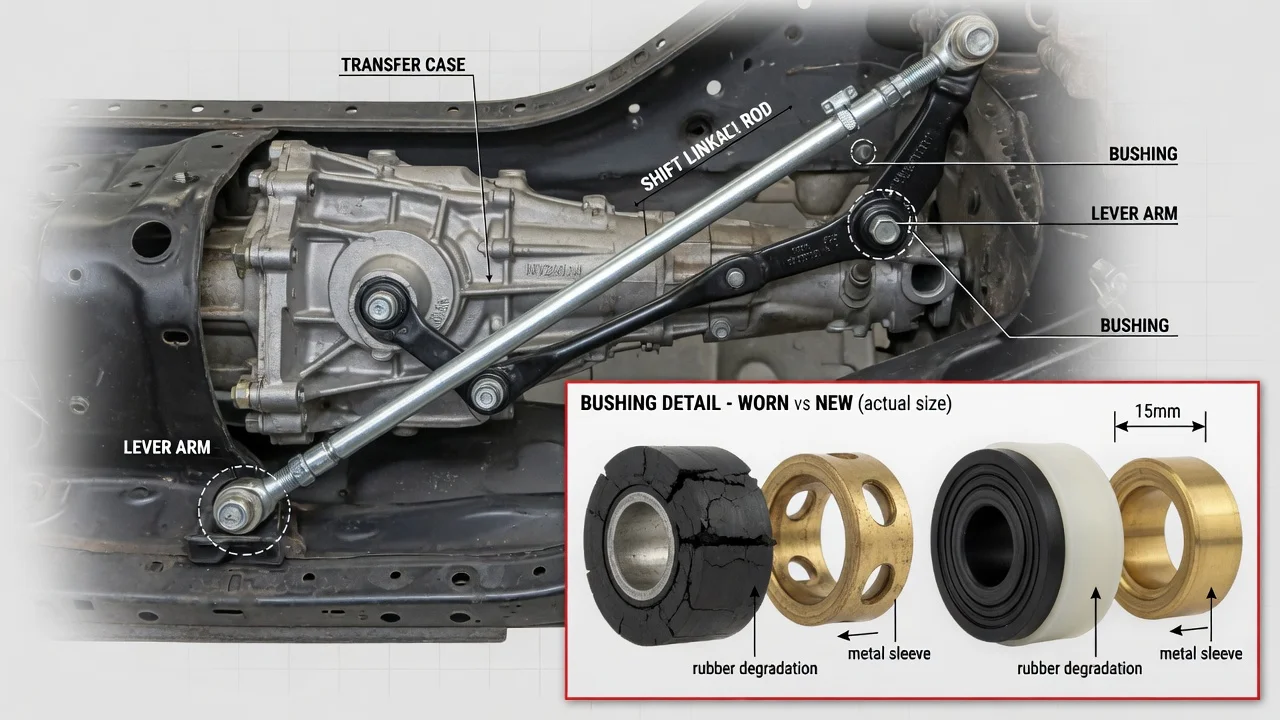
If the transfer case lever on your Jeep Wrangler JK feels loose, wanders between ranges, or will not seat fully in four-wheel drive, check the linkage bushing early. It is a small part, but when it wears out, the lever stops moving the transfer case accurately. This guide covers where the bushing sits, how to recognize wear, what about your vehicle can change the diagnosis, and when the problem is bigger than a worn piece of plastic.
Short answer: what the bushing is and where to find it
The JK uses a floor-mounted lever that shifts the transfer case through a linkage rod. The rod runs from the shifter down to a range lever on the side of the transfer case. Where the rod joins a lever arm, a small bushing lets the joint pivot without metal rubbing on metal. Over time that bushing can crack, wear an oval hole, harden, or fall out. Once that happens, the rod has free play, and part of each lever movement is lost before it reaches the transfer case.
Identifying the problem comes down to three steps: find the rod-to-lever joints, confirm a bushing is present and intact, and check for lost motion while someone moves the shifter. Inspect both ends of the rod, because wear can show up wherever the rod pivots. The exact bushing design and part number depend on your model year and drivetrain. Confirm them in a parts catalog using your VIN rather than assuming one part fits every JK.
How the transfer case shift linkage works
The JK transfer case lever selects 2WD High, 4WD High, Neutral and 4WD Low. When you move the shifter, the rod pushes or pulls the range lever on the transfer case. That lever moves the internal selector into the chosen range, and internal detents hold it there. The bushing keeps the rod connected snugly to the lever, so the rod moves exactly as far as the shifter does.
When the bushing is worn, the rod shifts inside the oversized hole before it moves the range lever. The shifter can then hit its stop while the internal selector has not fully dropped into its detent. That can feel like a mushy lever, a range that engages only partly, grinding, a lever that pops back, or a four-wheel-drive indicator that does not match the lever position. A hard shift can also come from technique or driveline windup on high-traction surfaces. Before blaming the bushing, make sure you are following the shifting procedure in your owner's manual, especially for shifts into and out of 4WD Low.
What changes the diagnosis
JK Wranglers were built from the 2007 through 2018 model years with different transfer cases. Rubicon models use the Rock-Trac version of the NV241 with a lower low-range ratio. Most other trims use the Command-Trac version. Both are shifted by a floor lever and rod, but brackets, levers and replacement parts can differ by model year, trim and transmission. Base your parts choice on your exact vehicle, not on a general description of the JK.
Modifications matter. Lift kits, body lifts, transmission skid plate changes, aftermarket shifters and sagging engine or transmission mounts can all change linkage geometry. When geometry changes, the linkage may need adjusting even if the bushing is new, or it may wear the bushing unevenly. Your operating conditions and service history also matter. Frequent off-road use, mud and water, and earlier repairs with polyurethane or other aftermarket bushings all affect how the joint looks and behaves. If someone has adjusted or replaced the linkage before, record that before assuming the original parts are still in place.
What the owner can check and do
Park on level ground with the engine off, set the parking brake, and chock the wheels. If you need more room underneath, lift the vehicle and support it properly on rated stands. Never work under a vehicle held up only by a jack. Find the linkage rod between the shifter area and the transfer case range lever. Have a helper move the shifter slowly through every range while you watch each joint. On a healthy linkage, the rod and lever arm move together. On a worn one, the rod moves or clicks before the lever arm follows. You may also see a cracked or missing bushing, an egg-shaped hole, or a loose retaining clip.
If the bushing is clearly worn, replacing it with a factory or aftermarket bushing is usually a simple, low-cost repair. Removing the old bushing may take some prying or cutting out of hardened remnants. After installation, confirm that the lever moves firmly into each range and that the four-wheel-drive indicator matches the selected position. If the lever still does not reach every range cleanly, the linkage may need adjusting. Follow the procedure in the factory service information for your model year rather than guessing. Note the repair in your service history so future inspections have a baseline.
If the bushing is intact and there is no lost motion at the joints, look elsewhere. Possible causes include bent or loose shifter brackets, worn mounts that let the drivetrain shift position, and problems inside the transfer case itself.
Limitations and when to get professional help
A visual check confirms obvious wear, but it cannot give you the correct part number or adjustment specification for your Jeep. Those come from your VIN, parts catalog and factory service information. There is no universal replacement interval for this bushing. A sensible approach is to inspect it whenever shifting feels wrong and during routine under-vehicle inspections on your maintenance schedule.
Treat certain symptoms as more than a linkage issue. A transfer case that jumps out of gear under load, grinds even when shifted correctly, leaks fluid, or makes new noises needs a diagnosis from a qualified technician. Also be aware of a safety risk: if a sloppy linkage lets the transfer case sit in or slip into Neutral, the vehicle can roll even with the transmission in Park. Until the linkage is repaired, always set the parking brake and confirm the selected range before leaving the vehicle.