Jeep JK Front Lower Adjustable Control Arms: Fitment and Selection
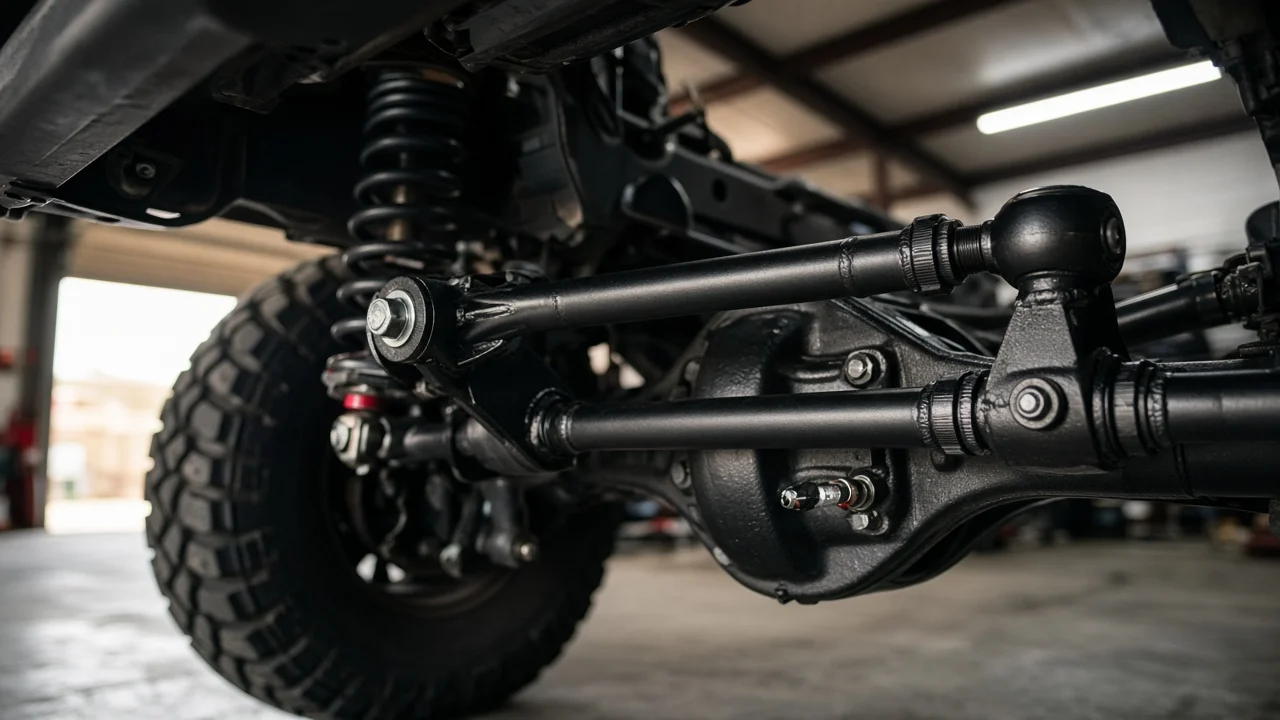
Front lower adjustable control arms help a lifted Jeep Wrangler JK owner set front axle position and recover suspension geometry after a ride height change. A good choice depends less on bold marketing claims than on how well the arms match your lift, your mounting points, your terrain and the maintenance you are willing to do. This guide explains what to check before you buy and what adjustable lowers can and cannot fix.
Define the job the product must do
The JK front axle is located by two upper arms, two lower arms and a track bar. When you raise ride height with taller springs, the axle moves down and swings around the arm pivots. That changes caster, pinion angle and fore-aft axle position. Factory-length arms cannot change length, so on many lifted Jeeps the only way to restore geometry is to change arm length. Lower arms mainly set where the axle sits front to back. The relationship between upper and lower arm lengths rotates the axle, which changes caster and pinion angle together.
Start by describing your own situation honestly. A mild lift on a daily driver may need little more than a careful alignment. A taller lift, larger tires or regular trail use usually justifies adjustable lowers, often paired with adjustable uppers or a geometry correction method from your lift maker. Note your priorities as well. Street drivers usually value quiet operation and stable steering. Rock crawlers care more about articulation, ground clearance and joint durability. Decide whether you will install the arms yourself, and budget for a professional wheel alignment either way.
Check compatibility
The JK generation covers the 2007 to 2018 Wrangler and Wrangler Unlimited. Arms built for the TJ, the JL or the rear of the vehicle are a different part, even if they look similar. Confirm that the listing names the JK front lower position specifically. Then check the interfaces at both ends: the bushing or joint width must fit the factory brackets, and the sleeve must accept the bolts used at the frame and axle mounting points. Many JKs use eccentric cam bolts at the axle-side lower mounts. Check whether the arms are designed to work with your cams or whether the kit expects a different setup.
Next, match the adjustment range to your lift. Manufacturers usually state the lift heights an arm is meant to suit. An arm that reaches the length you need only at the very end of its threads is a poor choice. If your Jeep has an aftermarket axle, relocation brackets, a skid system or a long-arm conversion, confirm fitment against that hardware rather than stock specifications. Long-arm systems use different mounts and are not compatible with short-arm replacement lowers.
Features that affect the choice
Adjustment style is the first real difference. A single-adjustable arm has one threaded end, so changing length usually means unbolting it. A double-adjustable arm uses opposite threads at each end and can often be turned while installed, which makes fine-tuning caster and axle centering much easier. Look for a sturdy jam nut design and threads that are protected or easy to clean. Exposed threads that corrode can make later adjustments difficult.
Joint type has the largest effect on ride quality. Rubber bushings are closest to factory feel and noise, but they flex less and cannot be serviced. Polyurethane bushings are firmer and may squeak without lubrication. Rebuildable flex joints rotate more freely for better articulation and can be serviced, but they need periodic attention. Rod ends offer the most movement, but on a street-driven JK they tend to transmit noise and wear faster, which makes them a poor fit for most daily drivers. Some arms mix joint types, with a softer bushing at one end and a flex joint at the other.
For construction, treat words like heavy-duty, extreme or bombproof as labels rather than evidence. More useful facts include the tube material, diameter and wall thickness, whether the arm is solid bar or tube, whether it has a bend for belly clearance, the coating quality, whether replacement joints are available and the warranty terms. A bent profile can help on rocks, but confirm that it suits your mounts and does not reduce clearance elsewhere.
Limitations and ownership costs
Installation requires proper vehicle support. Put the chassis on rated stands at the frame, support the axle so it cannot shift, and replace one arm at a time so the axle stays located. Use the fastener specification from the arm maker's instructions or the factory service information. Do not guess torque values. Many bushing-type arms must be tightened with the vehicle at normal ride height and resting on its wheels, so the bushings are not preloaded in a twisted position. Set both arms to the same starting length, measure carefully and expect some trial and adjustment.
After installation, a professional alignment is required. Toe and steering wheel centering must be checked, and caster should be confirmed against the settings your vehicle and lift call for. Remember that rotating the axle for caster also moves the pinion, so driveline angle may limit how far you can go. Adjustable lowers will not fix worn ball joints, tie rod ends, a loose track bar, a worn steering box, damaged mounts or the root causes of death wobble. Diagnose those issues separately.
Ongoing costs depend on joint type. Recheck jam nuts and fasteners after the first drives and after hard trail use. Inspect for joint play during routine service. Grease serviceable joints as the maker directs, and budget for replacement bushings or joint rebuild kits. Clean exposed threads and protect them from corrosion so the arms stay adjustable.
Build a practical shortlist
Narrow the field using facts you can verify. Each candidate should be listed for JK front lower use, fit your frame and axle brackets, and work with your cam bolts or replacement hardware. Its stated adjustment range should cover your lift without running out of thread. Choose the joint type to match your driving: rubber or mild flex joints for mostly street use, more articulating joints for frequent trail work. Prefer double adjustment if you expect to fine-tune often.
Then compare ownership factors. Check whether replacement joints are sold separately, how the threads and jam nuts are protected, what the coating is and what the warranty covers. Read the installation instructions before buying so you know the support, tightening and ride-height requirements. Finally, add the cost of an alignment and any upper arms or other geometry parts your lift needs. The right set of adjustable lowers is the one that fits your vehicle correctly and that you can realistically maintain.