Jeep Grand Cherokee EVAP System: Diagrams, Leak Detection Pump, ESIM and P0456
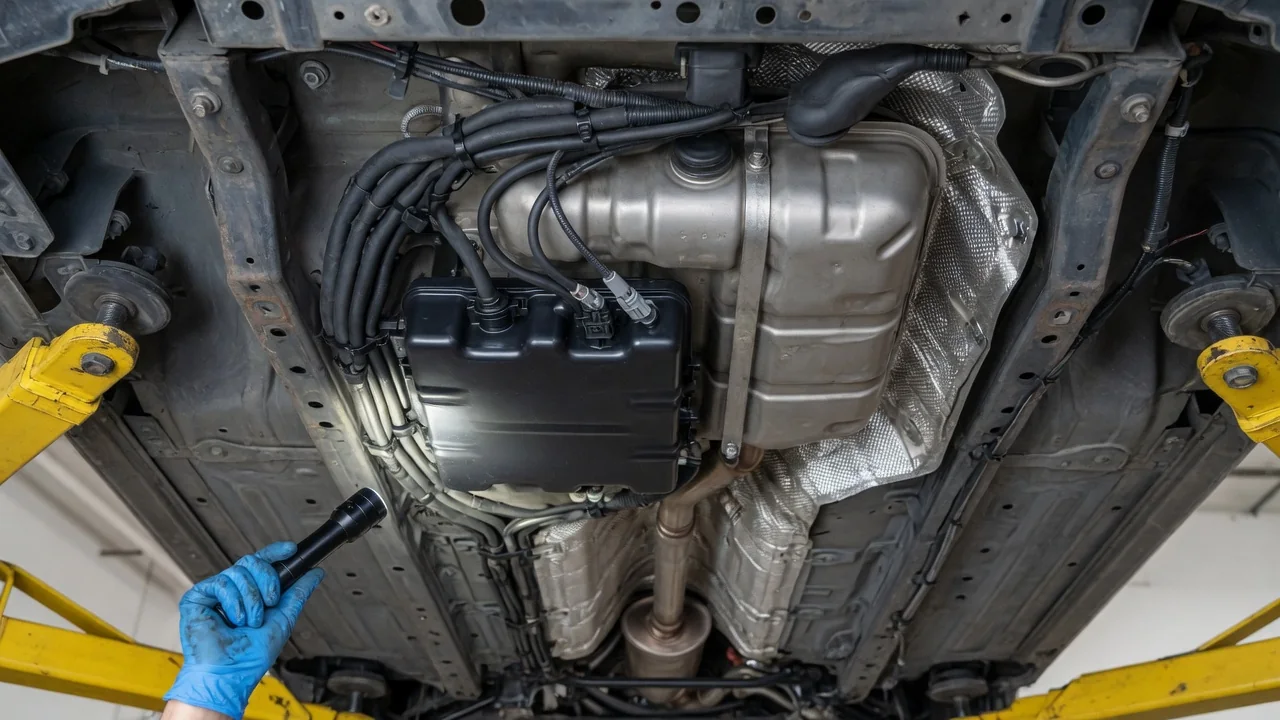
When a check engine light sets an EVAP code like P0456 on a Jeep Grand Cherokee, owners often search for a system diagram to start troubleshooting. The evaporative emission control system stops fuel tank vapor from escaping and exists on all years, from late-1990s models with leak detection pumps to newer ones with the Evaporative System Integrity Module. Understanding the vapor path, monitoring devices, and self-test logic helps determine if a small leak, vent fault, or purge problem is causing the code without needless part replacement.
How the Grand Cherokee EVAP System Captures and Purges Fuel Vapor
The evaporative emission system captures gasoline vapor that forms inside the fuel tank and stores it in a charcoal canister until the engine can safely burn it. This prevents hydrocarbons from venting to the atmosphere and helps a Grand Cherokee meet emissions standards. Major parts in most layouts include the fuel cap or capless filler neck, tank, vapor lines, charcoal canister, purge solenoid, a vent path that admits fresh air to the canister, and a leak-monitoring device, which may be a leak detection pump or an ESIM depending on model year.
The engine control module runs an EVAP self-test by sealing the system and watching how pressure or vacuum changes over a set period. This test only runs under specific conditions, such as a cold start, fuel level roughly between 15% and 85%, and stable speed for a defined drive cycle. A failed test sets a fault code but does not pinpoint the leaking component. Because production changes affect hose routing and component types, one generic EVAP diagram cannot cover every year; VIN-specific service data is necessary for accurate diagnosis.
Reading EVAP Diagrams for Earlier Grand Cherokees (Late 1990s to 2004)
Reading an older Grand Cherokee EVAP schematic starts with tracing the vapor path. Fuel tank vapor travels through a rollover valve and vapor lines to the charcoal canister, where hydrocarbons are absorbed by activated carbon. From there, a purge line runs forward to a purge solenoid on or near the engine, which opens under computer control to let intake vacuum draw the vapor into the intake manifold. A separate vent line on the canister lets atmospheric air enter during purging and closes during the leak test.
On late 1990s to 2004 body styles, the canister is typically mounted near the fuel tank or along a frame rail, vapor lines run along the underbody, and the purge solenoid is under the hood near the throttle body. The leak detection pump used in many Chrysler-group vehicles of this era is often near the canister or on the inner fender, but exact position varies. Aged rubber hoses at the filler neck, canister connections, and engine bay vacuum lines are sensible places to inspect visually, though a visible defect alone is not proof of the source of a small leak.
EVAP Layouts on 2005 and Newer Grand Cherokee Models
Later Grand Cherokee generations, beginning around 2005, changed EVAP hardware significantly. Many models adopted a more compact charcoal canister integrated with a combined vent valve or ESIM, and hose routing was simplified. Diagrams for 2005 through 2018 can show different line connections, canister placements, and monitor types even within the same year because engine displacement, fuel tank size, and market-specific emissions calibrations affect the parts used.
When using a diagram for model years like 2014, 2015, 2017, or 2018, first identify the canister, then follow the purge line to the engine bay and the vent line to the ESIM or vent valve. Note whether the filler is a traditional cap or a capless design, because the seal area differs. Confirm the diagram matches your engine option and emissions package; the Vehicle Emission Control Information label under the hood can help. VIN-specific service information is the only reliable way to verify exact hose connections and monitor device location before buying parts.
Leak Detection Pump vs. ESIM: What Each Device Does
A leak detection pump (LDP) is an active component used on many older Grand Cherokees. During the EVAP self-test, the computer commands the LDP to pressurize the sealed system using a diaphragm inside the pump. As the pump cycles, the computer monitors its movement or the rate of pressure decay. If the pump stops cycling sooner than expected, the system is considered leak-free; continued cycling indicates a leak large enough to prevent reaching a target pressure.
The Evaporative System Integrity Module (ESIM) used on newer Grand Cherokees is a passive monitor with no moving pump. It contains a weighted switch that reacts to the natural vacuum created as the fuel tank cools after the engine is shut off. When the EVAP monitor runs, the computer seals the system and watches for the ESIM switch to close, indicating that vacuum is holding. Safe visual checks include looking for cracked or disconnected hoses and damaged connectors, but a visual inspection cannot confirm every seam or o-ring.
P0456 Small Leak Code on a Grand Cherokee: What It Means and What It Doesn't
P0456 on a Grand Cherokee is generally defined as an EVAP system small leak detected, but exact criteria differ by model year. The code tells you the monitor saw pressure or vacuum decay beyond a threshold, implying a leak roughly 0.020 inches or smaller. It does not identify whether the leak is at the gas cap, a cracked hose, a canister seam, or a faulty purge valve. Because the leak is so small, it is rarely visible, and replacing parts based on the code alone frequently fails to correct the problem.
Safe first checks include confirming a traditional fuel cap is tight and its seal is clean, or that a capless filler door closes fully and the flapper seats without debris. Record freeze-frame data, such as engine coolant temperature and fuel level when the code set. After clearing the code, the EVAP monitor may require multiple drive cycles with a cold start and steady cruising before it completes. Jumping to replace the purge valve, canister, or ESIM without a smoke test often wastes money and leaves the same code to return.
EVAP Leak Symptoms and "General EVAP System Failure" Messages
Many EVAP faults on a Grand Cherokee produce no change in engine performance, acceleration, or fuel economy. The most common sign is simply a check engine light, although a faint fuel odor near the rear or difficulty refueling can occur. A message such as "general EVAP system failure" displayed on a dash or scan tool is an umbrella description, not a pinpoint diagnosis; it must be paired with the specific stored code and scan data to determine the actual fault type.
A strong, raw gasoline smell or a visible fuel leak is different from a normal EVAP small leak and indicates a safety hazard. Do not drive the vehicle; have it towed or repaired where fuel vapors cannot accumulate near ignition sources. Separating a small leak, a large leak, and a purge or vent fault requires reading the exact code. P0456 points to a small leak, P0455 to a large leak, and codes such as P0441 or P0443 relate to purge flow or circuit performance. Live data showing purge solenoid duty cycle and vent valve state helps distinguish an electrical failure from a physical leak.
When a Grand Cherokee EVAP Problem Needs Professional Testing
A smoke test is the standard professional method for finding EVAP leaks too small to see. A technician seals the system, introduces a low-pressure smoke vapor through a service port or the canister vent, and watches for smoke escaping at fittings, hoses, the filler neck, or component seams. Because the smoke is visible and non-pressurized enough to avoid damaging the system, it can reveal a pinhole in a vapor line or a leaking canister seal that would otherwise be undetectable.
Professional diagnostics add capabilities that a code reader cannot offer: bidirectional control of the purge solenoid and vent valve to confirm mechanical movement and seal function, monitor status checks, and electrical testing of the monitoring device. Before visiting a shop, write down the exact codes, freeze-frame data, and any fuel cap or EVAP part replacement history. Avoid improvised pressurizing of the fuel system, working near fuel with ignition sources, or disconnecting fuel-related components without proper training.