Jeep Gladiator Towing Capacity by Trim and Tow Package
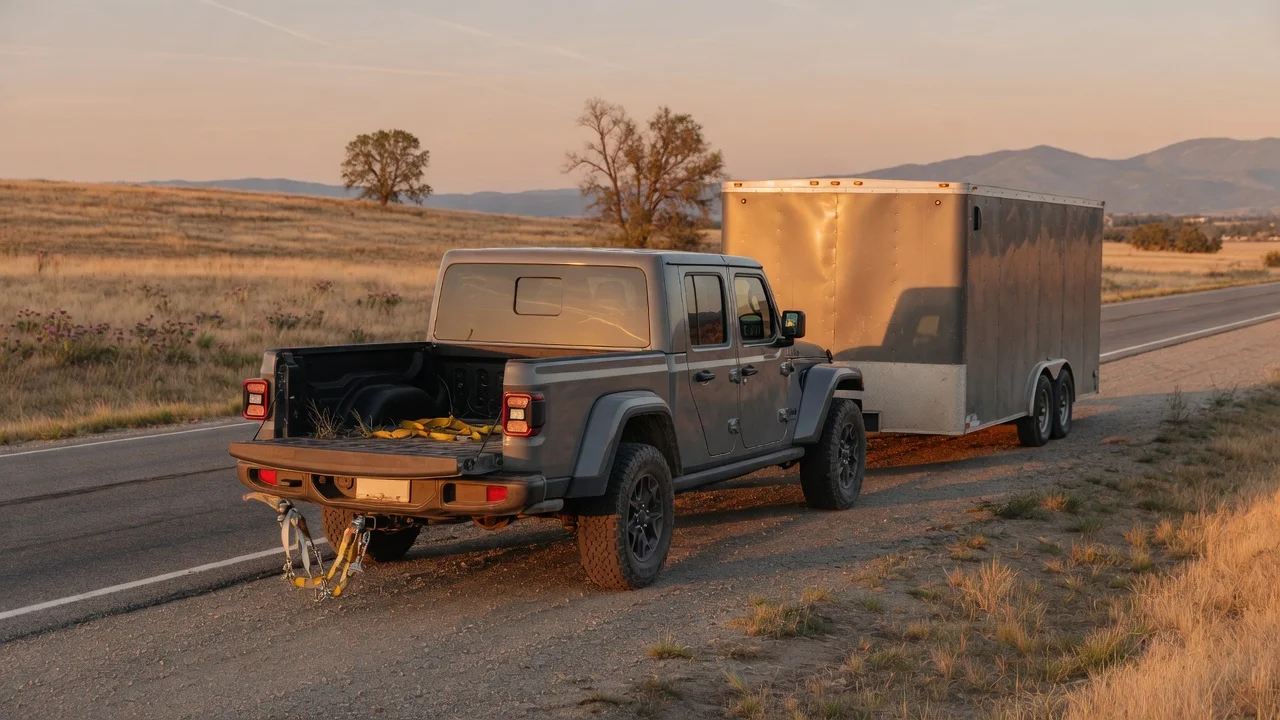
Essential answer
A Jeep Gladiator's published conventional towing capacity is not a single number. Across the JT generation (2020-present, midsize crew-cab pickup), factory ratings typically run from about 4,000 pounds on a lightly equipped truck to a commonly published maximum of 7,650 pounds when a gasoline 3.6-liter V6 Gladiator is fitted with the Max Tow package and the matching axle ratio, cooling, and hitch hardware. Exact figures change with model year, transmission, axle gearing, tire size, and options, so the rating on a given truck's certification label is the figure that applies.
Trim and tow package are the two factory choices that most often move the number. Sport and similar work-oriented trims can reach the highest published rating when Max Tow is selected. Rubicon and Mojave usually sit below that ceiling because of larger tires, added off-road equipment, and suspension hardware that raise curb weight and change gearing. A Trailer Tow package that is not Max Tow typically lands in a middle band, often around 6,000 pounds when Jeep lists it that way for that year.
How trim and the tow package change the rating
Jeep rates each build against gross combination weight rating (GCWR), axle ratio, cooling, and hitch class, then publishes a conventional trailer maximum for that configuration. The Gladiator is a four-door, 5-foot-bed, four-wheel-drive pickup in this generation; there is no two-door or long-bed split to track. What does change the rating is whether the truck has the 8-speed automatic or 6-speed manual, 3.73 or 4.10 axle gears, 32- versus 33-inch-class tires, and which tow group is on the window sticker.
On many gasoline V6 model years, Sport, Sport S, Willys, Overland, and High Altitude trucks with Max Tow, the automatic, and 4.10 axles are commonly published at up to 7,650 pounds. That is the highest factory combination of gears, cooling, and Class IV hitch. The same trims with Trailer Tow rather than Max Tow often sit near 6,000 pounds when Jeep publishes a mid-tier rating, limited by hitch, cooling, and axle ratio short of the Max Tow group. With no tow group and a standard hitch, the commonly cited figure is often about 4,000 pounds, limited by receiver class and cooling rather than GCWR headroom.
Rubicon is commonly below the line-topping Max Tow figure and is often cited near 6,000 to 7,000 pounds depending on year and options, limited by 33-inch tires, extra armor, sway-bar disconnect, and higher curb weight. Mojave typically sits in a mid band, often cited near 6,000 pounds, limited by desert-tuned suspension, 33-inch tires, and equipment weight. A 6-speed manual, where offered, is certified lower than the automatic Max Tow peak on the same trim. The 3.0-liter EcoDiesel, offered on some 2021-2023 trucks, sat below the gasoline Max Tow peak on published charts for those years.
Treat those bands as a map of how Jeep usually stacks the lineup, not as a substitute for a specific vehicle's rating. Jeep has restated year-by-year charts, and optional wheels, steel bumpers, winches, and aftermarket tires can move a truck off the brochure number even when the trim name matches.
What the Max Tow package typically adds
Max Tow is the factory group that unlocks the Gladiator's highest published conventional rating on eligible gasoline automatic trucks. Jeep's content list has varied by year, but the group is built around a numerically higher axle ratio, heavier cooling, and a Class IV receiver rather than around a different engine. On many model years that package has included 4.10 axle gears in place of 3.73, a Class IV hitch, a heavier-duty engine cooling module, a high-output alternator, an auxiliary transmission oil cooler, a larger or AGM battery, trailer-sway control, and provision for a trailer-brake controller. Some years also bundled a rear camera or an integrated brake controller; the window sticker for that truck is the source for the exact list.
A lesser Trailer Tow or hitch package generally supplies a receiver and wiring without the 4.10 gears and heavy-duty cooling that Max Tow uses to raise GCWR headroom. That is why two Gladiators in the same trim can be thousands of pounds apart on paper. Rubicon already uses 4.10 gears in many years, so adding a tow group there does not always reproduce the Sport Max Tow rating; tire diameter and extra weight still cap the certified number.
Powertrain and year qualifications
The volume engine across this generation is the 3.6-liter Pentastar V6. That is the powertrain tied to the 7,650-pound figure in Jeep's widely published gasoline charts when Max Tow, the 8-speed automatic, and the matching axle are present. The 6-speed manual, offered on some earlier trims, is certified to a lower trailer maximum. A 3.0-liter EcoDiesel V6 was available on selected 2021-2023 Gladiators; Jeep's published diesel towing figures for those years sat below the gasoline Max Tow peak, so a diesel badge is not a shortcut to the lineup's highest rating. Later hybrid or 4xe pickup variants, if present in a given market and year, must be read from that year's chart rather than from the gasoline Max Tow number.
Model-year charts also shift in small steps. Some recent marketing materials have used a rounded up to 7,650 pounds line while individual order guides list a slightly different figure for a given axle and tire combination. A 50- to 100-pound difference between brochure years is possible; a several-thousand-pound difference almost always traces to missing Max Tow, a manual gearbox, or a Rubicon or Mojave tire-and-weight package.
Payload, tongue weight, and the real limit on a given truck
Towing capacity is only usable if payload and tongue weight still fit. Tongue weight on a conventional bumper-pull trailer is typically about 10 to 15 percent of loaded trailer weight and counts against payload along with passengers, bed cargo, hitch hardware, and aftermarket accessories. A Gladiator that is brochure-rated to 7,650 pounds can still be payload-limited once a crew, a bed full of gear, and a weight-distributing hitch are on board. Gross axle weight ratings (GAWR) on the door-jamb label are the binding limits; exceeding rear GAWR with tongue weight is a common way a max-tow truck runs out of capacity before the trailer-weight number does.
Jeep generally requires a weight-distributing hitch and trailer brakes above specified tongue-weight and trailer-weight thresholds printed in the owner's manual for that year. Integrated or aftermarket brake controllers are part of using the higher ratings safely; the factory Max Tow path is designed around electric trailer brakes, not around an unbraked utility trailer at the maximum figure.
How to confirm the rating on one Gladiator
Read the Safety Certification and tire-and-loading label on the driver's door jamb for GVWR, GAWR, and payload. Subtract passengers, fluids, and cargo; remaining payload is the ceiling for tongue weight plus hitch. Use the window sticker or build sheet to see whether Max Tow, Trailer Tow, axle ratio (3.73 versus 4.10), and a trailer-brake controller are actually fitted. Match that build to the towing chart in the owner's manual for that model year, not to a different year's brochure. If the truck has larger tires, a bumper replacement, a winch, or a camper top, treat the factory number as a starting point and weigh the truck and trailer; those add-ons are the main reason two identical trims can tow differently in use.
For a buying decision: if the goal is the highest factory conventional rating, look for a gasoline automatic Sport, Sport S, Willys, Overland, or similar trim ordered with Max Tow and 4.10 gears, then confirm the 7,650-pound-class figure on that year's chart. If the goal is Rubicon or Mojave capability, plan around a lower certified trailer weight and a tighter payload margin. In every case the door-jamb label and the matching model-year towing chart override trim marketing.