IS38 Wastegate Actuator: Identification and Setup Requirements
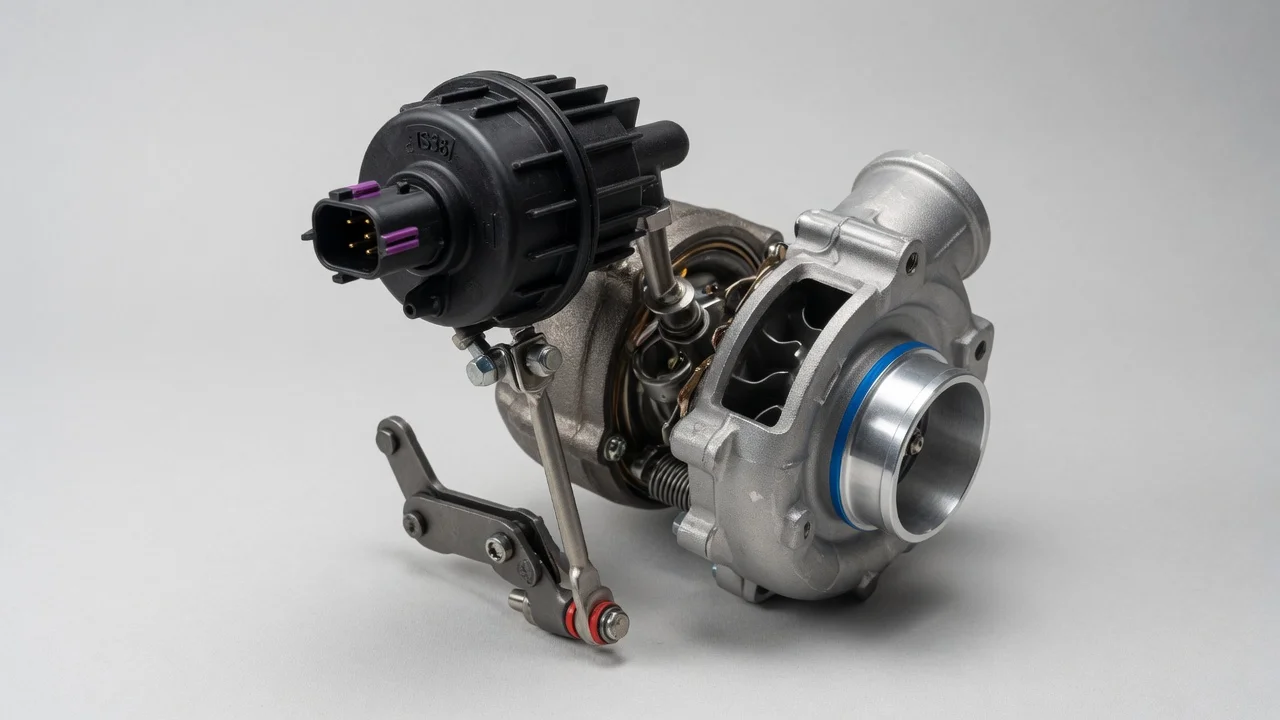
The IS38 wastegate actuator controls how much exhaust gas bypasses the turbine on the IS38 turbocharger, which is commonly associated with performance versions of the third-generation EA888 2.0-liter engine. Owners usually start looking into it after a boost-related fault, a rattle from the turbo area, or a turbo replacement. This guide explains how to identify the actuator on your car, why setup matters, and which steps depend on your exact vehicle configuration and the manufacturer's service information.
The short answer
On factory IS38 applications, the wastegate is moved by an electronically controlled actuator rather than a simple vacuum canister. It contains a small motor and a position sensor, and the engine control unit commands it based on the boost it wants at any moment. Identifying the correct actuator means reading the part number on the actuator or turbocharger label and checking it against a parts lookup tied to your VIN, because revisions and supersessions exist.
Setup has two parts. First, the mechanical connection between actuator and wastegate must be assembled and, where the linkage is adjustable, set exactly as the manufacturer specifications describe. Second, the control unit usually has to learn the actuator's travel through an adaptation or basic-setting routine run with a capable diagnostic tool. Skipping either step can leave the car with boost deviation faults, reduced power or a warning light, even when every part is new. Exact linkage dimensions and adaptation steps are vehicle-specific, so they should come from service information rather than guesswork.
How the actuator controls boost
Inside the turbine housing sits a wastegate flap. When it is closed, nearly all exhaust gas passes through the turbine wheel, spinning the compressor faster and raising boost. When it opens, part of the exhaust bypasses the turbine, which limits turbine speed and holds boost at the requested level. The actuator moves this flap through a linkage arm, and its built-in position sensor tells the control unit where the flap actually is.
The control unit compares requested boost with the pressure measured in the intake system and adjusts the actuator position continuously. To do that accurately, it relies on learned reference points, such as the fully closed position. If the stored values do not match the real mechanical position, for example after a turbo or actuator swap, the system may command the flap incorrectly or decide that the actuator is faulty. Wear in the flap pivot or linkage adds free play that the sensor cannot see directly, which is one reason a worn wastegate can rattle and still produce inconsistent boost.
What changes the answer
The vehicle configuration matters first. A car that left the factory with an IS38 has a matching calibration and actuator. A car that originally had a smaller turbo and was upgraded to an IS38 needs software that suits the new hardware, and the actuator learning procedure may behave differently. Remanufactured, hybrid and aftermarket turbochargers can arrive with the actuator already fitted and preset, or bare, and some aftermarket designs replace the electronic actuator altogether. In each case the supplier's instructions and the installed parts determine the correct setup, not the original factory procedure alone.
Service history also changes the picture. If the turbo or actuator has been replaced before, find out whether an adaptation was performed afterward and whether the linkage was disturbed. Engine tuning can raise boost targets and change how hard the actuator works. Operating conditions play a part as well: heavy heat cycles, sustained high load and altitude all affect how often and how far the wastegate moves, which can influence both wear and the fault codes that appear.
What the owner can check and do
Start with a scan for stored fault codes and note any that mention boost control, the wastegate actuator or its position sensor. Write down when symptoms happen: reduced power under load, a warning light after hard acceleration, or a metallic rattle from the turbo area at low load or idle. These details help separate an electrical or adaptation issue from mechanical wear in the wastegate itself.
A basic visual inspection can be done with the engine off and fully cooled. Check that the electrical connector is seated and undamaged, that the wiring is not melted or chafed near the exhaust, that the actuator mounting is secure, and that the linkage clip or retainer is in place. Record the part numbers on the actuator and turbo. Avoid forcing the actuator arm by hand or bending the linkage, since that can damage the internal gearing or upset the setting.
If a part is replaced, plan the full sequence: correct mechanical assembly per service information, an adaptation with a diagnostic tool that supports this procedure for your model, clearing codes, then a road test while monitoring requested versus actual boost and actuator position if your tool can display them. Keep notes and receipts with the service history so the next technician knows what was done. There is no universal replacement interval in a maintenance schedule for this actuator, so act on symptoms and findings rather than mileage alone.
Limitations and when to get help
General guidance cannot confirm which actuator revision your car needs, the exact linkage dimensions or the precise adaptation steps. Those depend on model year, market, installed software and any modifications, and they can change through part supersessions. A tuned car or a turbo upgrade adds further uncertainty, because the correct behavior then depends on the software and hardware supplier as much as on the original manufacturer.
Seek professional help if the adaptation fails or will not complete, if faults return shortly after clearing, or if a rattle persists after the actuator checks out. Those patterns can point to binding in the wastegate, wiring faults or a control issue that requires dealer-level diagnostics, and some repairs involve removing the turbocharger. The practical next step is to get a VIN-based parts lookup and the factory procedure for your vehicle, or to book a specialist familiar with this engine family who can verify the diagnosis before parts are ordered.