Installing EV Charging Stations: Site Requirements and Installation Steps
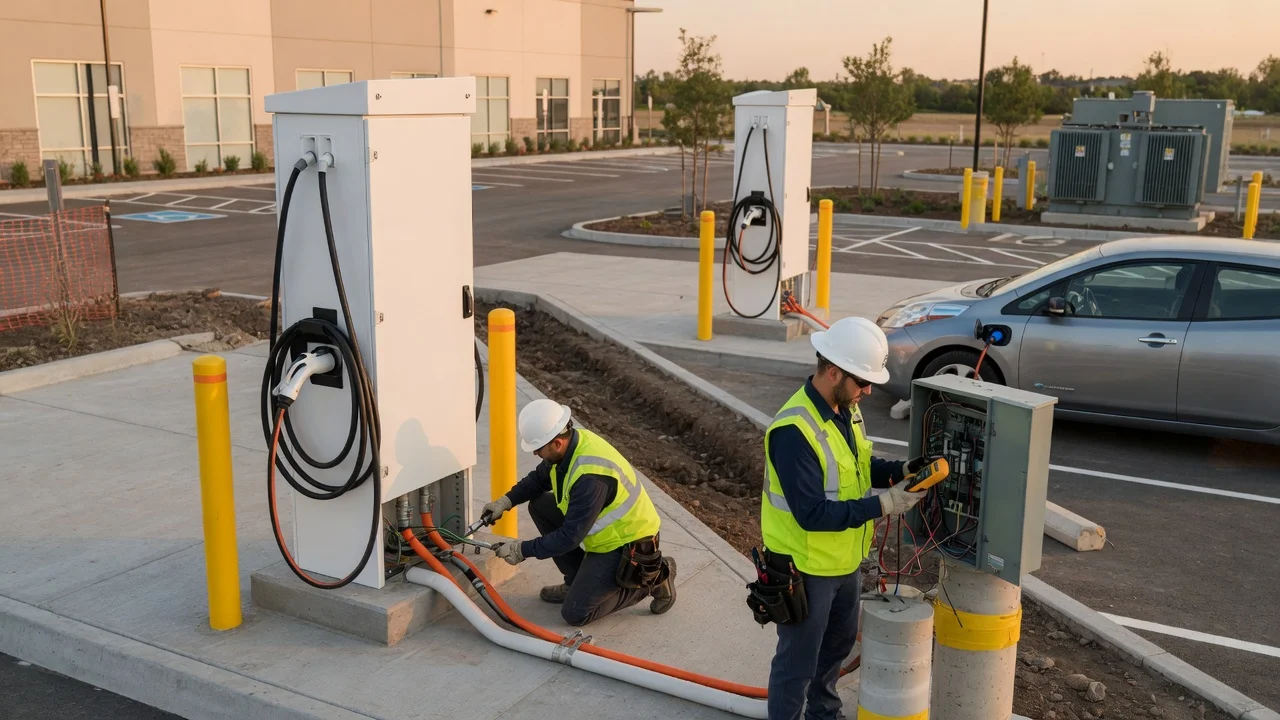
What you need in order to install a charging station
An electric vehicle charging station can be installed only where the electrical service, parking layout, and local rules can support electric vehicle supply equipment (EVSE): the wallbox, pedestal, or cabinet that delivers power to the car. For most homes and workplaces that means a Level 2 AC charger on a dedicated circuit, a mounting point within cable reach of the vehicle inlet, and a permit plus inspection where the authority having jurisdiction requires them. DC fast chargers and multi-stall commercial sites add utility coordination, larger service work, and civil construction. Circuit size, conductor rating, overcurrent protection, and fastener or torque values come from the charger’s listing and installation manual together with the electrical code adopted at the site; those figures are not interchangeable across models, model years, or markets.
This guide covers site requirements and the usual installation sequence for residential and light-commercial AC charging. It does not replace the EVSE manufacturer’s instructions, the vehicle owner’s manual, or a licensed electrician’s design for your panel and feeder. Specific breaker amperage, wire size, and tightening values are omitted here because they must be taken from the nameplate and the code in force, not from a generic article.
Match the charger to the vehicle and the site
Confirm the vehicle’s inlet type and the charge rate you actually need before you buy hardware. Level 1 uses a standard household receptacle and is slow. Level 2 is the usual home and workplace choice and uses a higher-voltage AC dedicated circuit. DC fast charging is a separate class of equipment, typically for corridors, fleets, and public hubs, and it is not a drop-in substitute for a home wallbox. Inlet standards, onboard charger limits, and available AC versus DC rates vary by vehicle make, model year, and market, so the car’s manual is the source for what the vehicle will accept.
Charging class Typical supply (qualification) Typical role; Level 1 AC Low-voltage household circuit; 120 V is typical in North America, with other voltages in other markets Slow charging when a dedicated Level 2 circuit is not available; Level 2 AC Dedicated higher-voltage AC circuit, often 240 V single-phase in North America or single- or three-phase equivalent elsewhere Primary home and workplace charging; DC fast charge High-power DC from dedicated utility service and listed DC EVSE Short-stop and fleet charging; extra utility and civil work
Site requirements
The stall must let the charge cable reach the vehicle inlet with the car parked as it will actually be charged, without stretching across walkways or adjacent spaces. Outdoor units need a weather rating and mounting method the manufacturer lists for wet or exposed locations. Indoor garages still need clearance for the enclosure, cable hang, and vehicle approach. Pedestal mounts need a foundation or pad that can take the unit’s weight and any vehicle-impact exposure the listing assumes.
Electrically, EVSE is treated as its own load. A dedicated branch circuit is the normal requirement so the charger does not share a breaker with lighting, tools, or other receptacles. The existing service and panel must have spare capacity after a load calculation of current demand; if they do not, a panel change, feeder upgrade, or service upgrade comes before the charger. Where the adopted code treats EVSE as a continuous load, the overcurrent device and conductors are sized with that continuous-load factor applied to the nameplate current. Grounding, an equipment-grounding conductor, and ground-fault protection must follow the EVSE listing and the local electrical code. A local disconnect may be required so the unit can be isolated for service.
Parking position within the listed cable length of the inlet, with the cable clear of pedestrian paths; Structure or pedestal able to carry the EVSE weight and outdoor exposure the listing covers; Dedicated circuit from a panel that still has capacity after a documented load calculation; Overcurrent protection, conductor ampacity, and continuous-load sizing taken from the nameplate and adopted code; Grounding and ground-fault protection as listed for that EVSE; Working space and ventilation clearances in the installation manual; Permits from the electrical, and if applicable building or zoning, authority before work starts; For public or workplace stalls, accessibility, lighting, and signage rules that apply to that occupancy
Hardwired EVSE and cord-and-plug EVSE (for example a listed plug on a matching receptacle) are both used in residences, but only if the combination is listed and the local code allows that method. Do not use unlisted adapters, household extension cords, or a receptacle that is not rated for the EVSE nameplate. Networked or metered stations add a data path and, for some commercial tariffs, utility metering provisions; those are extra site conditions, not substitutes for the power circuit.
Requirements that cannot be stated as a single number here include exact ampacity, conductor size, conduit fill, mounting-bolt torque, and ADA stall geometry for public sites. Those depend on the charger model, mounting kit, occupancy type, and the code edition the inspector enforces. Utility interconnection, demand charges, and make-ready conduit rules for DC fast charging are also utility- and program-specific and need the serving utility’s process, which is not detailed in this guide.
Installation steps
Treat this as an ordered field sequence, not a substitute for the manufacturer’s installation manual. Where local law classifies branch-circuit and service work as licensed electrical work, a qualified electrician must perform those steps. De-energize and lock out the circuit before any termination. Do not energize until the inspector has released the permit if an inspection is required.
Confirm the vehicle inlet, onboard AC limit, and whether you are installing Level 1, Level 2, or DC equipment. Order only EVSE listed for that use and for the supply voltage at the site. Pick the stall and the wall, pole, or pedestal location. With the vehicle parked in its normal charging position, check that the cable reaches the inlet without crossing a walkway. Note indoor versus outdoor exposure for the enclosure rating. Have a licensed electrician calculate existing electrical demand and remaining panel and service capacity. If capacity is short, plan the upgrade first; the charger cannot create capacity that the service does not have. Select the EVSE whose nameplate voltage and current match the circuit you can install. Size the breaker and conductors from that nameplate, the continuous-load rule in the adopted code, and the manual—not from another model. Submit permit drawings or a description of work as the authority having jurisdiction requires. Do not conceal or energize work that the permit says must be inspected. Notify the utility if the added load or a service change requires it. Install the dedicated circuit, overcurrent device, disconnect if required, raceway, and grounding with the panel de-energized and locked out. Use only listed fittings and the conductor type the manual and code allow. Mount the EVSE to a backing or foundation that meets the manufacturer’s weight, fastener, and sealing instructions. Apply only the tightening values in that manual; generic torque figures are not a substitute. Land line conductors, equipment grounding, and any communications or metering leads exactly as the wiring diagram shows. Do not share the EVSE circuit with other loads or insert unlisted plugs or pigtails. Request inspection if the permit requires it. Energize only after release, then restore covers and weather seals. Commission the unit: confirm status indicators, start a charge session on the intended vehicle, and verify any access control, app, or metering the owner expects to use. Keep the manual, permit, and inspection record with the property or vehicle file.
Professional boundaries and precautions
Service upgrades, panel changes, underground feeders, and DC fast-charge cabinets are electrician and, often, utility or civil-contractor work. Homeowners who are legally allowed to do their own electrical work still need the same load calculation, listing, and inspection as a contractor. Stop and hire a licensed electrician if the panel is full, the service rating is unknown, aluminum or deteriorated wiring is present, or the EVSE listing calls for a method you cannot execute. Indoor charging of a damaged inlet, a flooded enclosure, or a unit that has tripped ground-fault protection repeatedly is a service issue, not a reset-and-continue item.
Completion check
The installed EVSE matches the vehicle inlet class and the supply voltage at the site. The circuit is dedicated, protected at the nameplate-and-code size, and grounded as listed. Mounting, outdoor seals, and cable reach were verified with the vehicle in its charging stall. Required permits were closed and the inspector, if any, released the installation. A full charge session completed without nuisance trips, overheating at terminations, or error states on the EVSE or vehicle. The owner has the installation manual and knows how to stop a session and isolate the disconnect.
If any of those checks fail, leave the circuit off and return to the manufacturer’s troubleshooting steps or the installing electrician. Do not raise breaker size or bypass ground-fault protection to make a mismatched charger run.