Installing EV Charging in Apartments and Condominiums
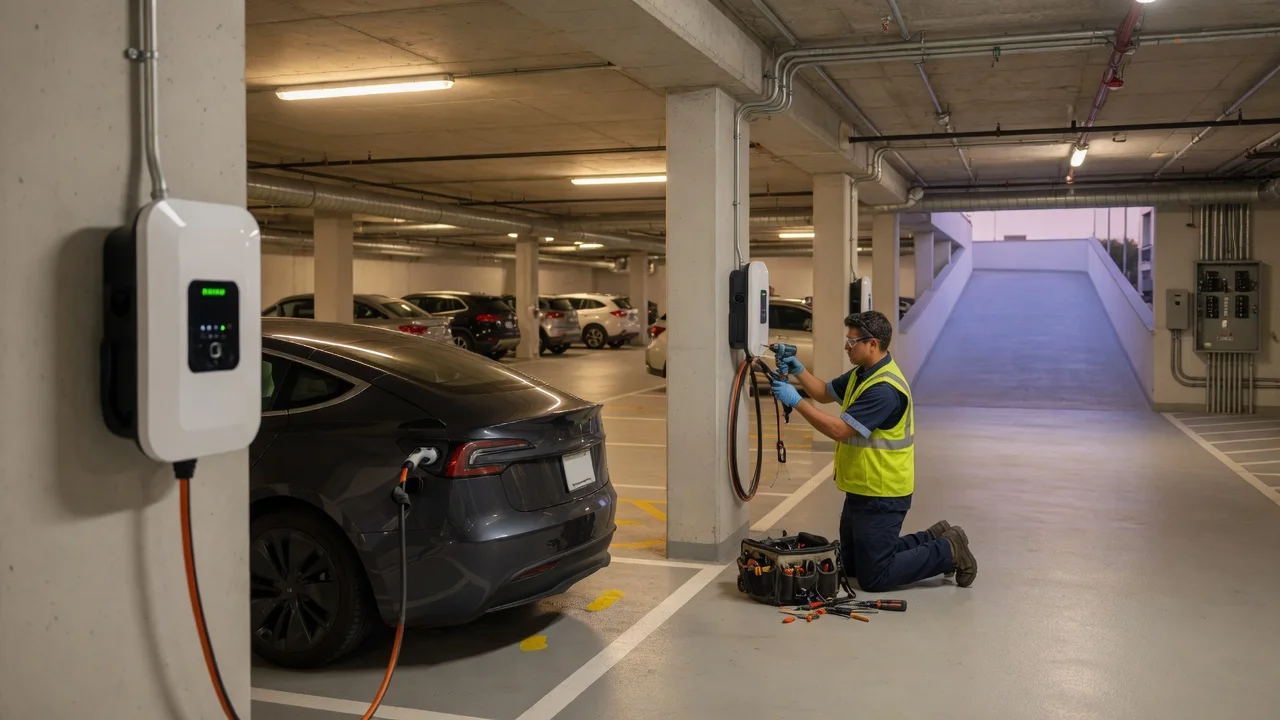
Can you install EV charging in an apartment or condo?
Yes, in many buildings, but the resident rarely has a free hand to add a dedicated charger the way a house owner does. Parking is often shared, electrical service is sized for the building rather than one stall, and a landlord, homeowners association, or condominium board must approve work that touches common property. The practical path is to match charging need to what the building will allow: overnight Level 1 from an existing outlet, a dedicated Level 2 circuit at an assigned stall, a shared building charger, or nearby public charging until a stall is wired.
Scope here is multi-unit housing: rented apartments, condominiums with deeded or assigned parking, and mixed buildings with both. It does not cover a detached house with a private garage, workplace charging, or highway DC fast charging except as a backup. Laws, utility programs, and building codes differ by country, state or province, and even by municipality; a right that exists in one market may not exist in another.
Why multi-unit charging is different from a house
A typical home Level 2 install uses a 240-volt circuit from a panel the owner controls. In an apartment or condo, the stall may sit on common property, the nearest panel may belong to the association, and adding load can require a building-wide electrical study. Insurance, fire-code clearances, metering, and who pays for electricity all have to be settled before a contractor pulls wire.
Assigned indoor or covered parking is the easiest physical case. Open lots, tandem stalls, and first-come parking make a dedicated cable run harder and raise theft and trip-hazard issues. Buildings constructed before widespread EV use often have panels that cannot add several 32- or 40-amp circuits without a service upgrade.
Charging levels that actually fit apartment living
Level 1 uses a standard 120-volt household outlet (or the local equivalent) and typically adds about 3 to 5 miles of range per hour, depending on the vehicle and the circuit. Overnight, that is often enough for commuting if daily miles are modest and the outlet is on a dedicated or lightly loaded circuit. Many garages already have an outlet near a stall; using it still needs permission if the receptacle is common property or billed to the building.
Level 2 uses 240-volt (or 230-volt) service and commonly delivers about 12 to 30-plus miles of range per hour, depending on the circuit rating and the car’s onboard charger. A 32-amp circuit on a 40-amp breaker is a frequent residential specification; 16-amp or 20-amp circuits are used when panel space is tight. Level 2 is the usual goal for assigned stalls because it covers longer trips overnight without relying on public chargers.
DC fast charging is almost never installed at a single apartment stall. It needs high-capacity service, specialized equipment, and utility coordination that buildings treat as a shared amenity, if they install it at all. Residents typically use public DC fast chargers for long trips and keep overnight charging at Level 1 or Level 2.
Level 1: lowest cost and least electrical work; slow; useful when daily driving is limited and an outlet already exists. Level 2 at an assigned stall: fastest practical home-style charging; needs panel capacity, a run to the stall, and a billing method. Shared building Level 2: several residents rotate or queue on one or more networked chargers; the association owns the equipment. Public or workplace charging: fills gaps when the building will not wire a stall or when travel exceeds overnight recovery.
Who must approve the work
In a rental apartment, the landlord or property manager controls alterations. A written request should describe the charger type, the stall, who pays for electricity, and a licensed electrician’s plan. Some leases treat any new circuit as a capital improvement that stays with the building; others require restoration at move-out. Tenants generally cannot compel an install unless local law or the lease says otherwise.
In a condominium, the board and the governing documents (declaration, bylaws, and rules) control common elements, which often include garages, lots, and electrical rooms. A deeded stall may still sit on common structure, so running conduit along walls or through slabs usually needs board approval and sometimes a vote. Exclusive-use parking is easier to argue than unassigned open parking.
Several jurisdictions have adopted “right to charge” or similar rules that limit how an association or landlord can refuse a reasonable, resident-paid install that meets code and insurance conditions. Those statutes vary in who they cover (owners versus tenants), what costs the resident must bear, and whether the building can require load management or a specific equipment standard. Confirm the current local rule with the building’s counsel or a housing agency before treating approval as guaranteed.
Electrical capacity, metering, and load management
A licensed electrician or electrical engineer should check available amperage at the relevant panel, the length and route of the run, and whether the building’s service entrance can accept added EV load. If several residents want Level 2 at once, the limiting factor is often the building transformer and main service, not a single stall.
Load management (also called power sharing or automated load control) lets multiple chargers share a capped amount of current so the building does not exceed its service rating. Networked Level 2 units can throttle together when occupancy is high. This is a common board condition because it avoids a full service upgrade. Exact available amperage is building-specific and should come from a site survey, not a generic rule of thumb.
Electricity billing is a separate decision. Options include tying the charger to the resident’s meter, installing a submeter, using a networked charger that bills by kilowatt-hour, or folding a flat fee into association dues. Untetered use of house power is a frequent source of disputes. Fire-code and insurance requirements may also specify disconnects, labeling, and listed (certified) equipment.
Typical costs and who pays
A simple Level 2 install at a nearby assigned stall can be in a similar range to a straightforward house install when the panel is close and capacity exists. Long conduit runs, trenching across a lot, panel upgrades, and load-management hardware raise the price substantially. Shared building chargers spread equipment cost but add networking, maintenance, and access-control expenses.
Published cost figures vary widely by market, labor rates, and how much electrical work is required; treat any single number as illustrative rather than a quote. Residents often pay for the stall circuit and the wall unit when the charger serves only their space. The association more often pays when the charger is a common amenity. Utility rebates, make-ready programs, and some government incentives apply to multi-unit properties in some markets; eligibility is program-specific and should be verified with the local utility.
Hardware itself is only part of the bill. Permits, engineering letters, insurance endorsements, and restoration of finishes after conduit is run are easy to omit from a first estimate.
A practical sequence for residents
Confirm daily driving and whether Level 1 overnight would cover it before asking for a new circuit. Read the lease or condo documents for parking, alterations, and common-element rules. Ask the manager or board in writing for the current EV policy, if any, and for a site visit by a licensed electrician familiar with multi-unit work. Obtain a written scope: circuit rating, route, panel, metering, load management, and a cost split. Submit that package for approval, including listed equipment, insurance, and who owns the unit at move-out or resale. Pull permits and complete inspection before regular use. If a dedicated stall is refused, ask about a shared charger, a nearby public Level 2 site, or workplace charging as an interim plan.
Choosing a vehicle with apartment charging in mind
Usable range, charging speed on Level 1 and Level 2, and the car’s maximum AC charge rate all matter more in a building without a guaranteed 40-amp circuit. A vehicle that can recover a commute on 120-volt overnight is easier to live with than one that assumes daily Level 2. Portable Level 1 cords supplied with most plug-in vehicles are a start; a portable 240-volt EVSE is only useful if the building has a compatible outlet and permits its use.
Plug-in hybrids with a smaller battery can often recharge fully on Level 1 overnight, which reduces pressure for a dedicated stall. Battery-electric models with longer commutes or frequent highway trips usually need Level 2 at home or reliable access to public or workplace charging. Charge-port location and cable length affect whether a wall unit can reach the car in a tight stall; that is a fit check at the actual parking space, not a catalog spec alone.
Gaps and what to verify locally
This guide does not substitute for a site electrical study, a legal reading of a specific lease or declaration, or current incentive rules. Building-specific amperage, exact install prices, and whether a given association must approve a resident-paid charger are facts that have to come from the property and local law. Fire-code details, listed-equipment requirements, and utility interconnection rules also change by jurisdiction. Ask the board or landlord, a licensed electrician, and, where a statute may apply, a local housing or energy office before signing a contract or buying a charger.