Infiniti Q50 Wastegate Actuator: Identification
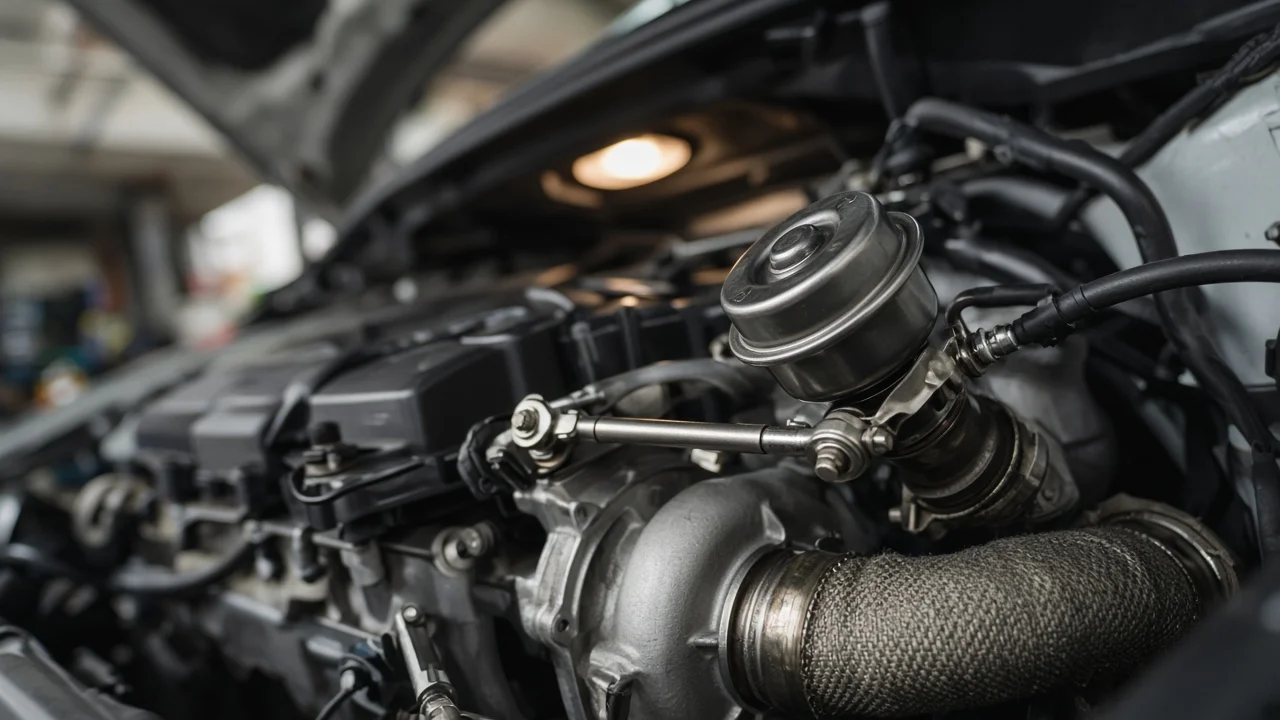
If you are trying to identify the wastegate actuator on an Infiniti Q50, start with the engine under the hood. Only the turbocharged versions have one, and the actuator differs between engine families and between the two turbochargers on the V6. This guide explains which Q50 models use a wastegate actuator, what the part does, how to tell which one you are looking at, and when the vehicle configuration means you need a VIN-based parts lookup or a technician.
Short answer: which Q50 has a wastegate actuator
A Q50 has a wastegate actuator only if its engine is turbocharged. The 3.0t models, including the Red Sport 400, use the twin-turbo 3.0-liter VR30DDTT V6, which has two turbochargers and therefore two wastegate actuators, one per turbo. The 2.0t models use a turbocharged four-cylinder engine with a single turbocharger and its own wastegate arrangement. Q50 versions with the naturally aspirated 3.7-liter V6 or the 3.5-liter hybrid powertrain have no turbocharger, so they have no wastegate actuator at all.
On the twin-turbo V6, the actuators are electronically controlled rather than operated purely by a vacuum or boost-pressure diaphragm. That matters for identification, because you are looking for a small motorized unit with an electrical connector and a linkage to the wastegate valve, not a round canister with a vacuum hose. Whether the actuator is sold separately or only as part of the turbocharger assembly depends on the parts catalog for your specific car, so the presence of a part on the engine does not guarantee a stand-alone replacement exists.
How the wastegate actuator controls boost
Exhaust gas spins the turbine side of the turbocharger, which drives the compressor that pushes air into the engine. The wastegate is a valve that lets some exhaust bypass the turbine. When it opens, the turbine receives less energy and boost pressure drops; when it stays closed, more exhaust drives the turbine and boost rises. The actuator is the device that moves that valve.
On an electronically controlled system, the engine control module decides the target boost from inputs such as throttle position, engine speed and load, then commands the actuator to a specific valve position. The actuator reports its position back so the control module can correct it. Because the module compares commanded and actual behavior, a sticking linkage, a failing motor or a wiring fault can show up as boost that does not match the target, reduced power, a warning light or a stored fault code, even when the turbocharger itself is still healthy.
What changes the answer for your car
Engine family is the first dividing line. The 2.0t four-cylinder and the 3.0t V6 use different turbochargers, mounting, connectors and part numbers, so nothing from one should be assumed to fit the other. Within the 3.0t, the standard and Red Sport 400 outputs share the same basic engine design, but you should still confirm the part against the exact model year and trim rather than assume both versions use identical components.
On the V6, the two actuators are not automatically interchangeable. Each turbocharger sits on its own cylinder bank, and the actuator orientation, linkage geometry or part number can differ between sides. Service information and fault codes refer to the turbos by bank, so match the bank designation in the diagnosis to the correct physical side of the engine using the manufacturer specifications rather than guessing from left and right as seen from the driver's seat.
Production changes, software updates and prior repairs also affect the answer. A car whose service history includes a turbocharger replacement may carry a newer or superseded part, and aftermarket or performance modifications can change actuator calibration or hardware. Operating conditions such as heavy towing, track use or aggressive tuning can increase heat and wear on the wastegate mechanism, but they do not change which part your car was built with.
How to identify the actuator on your Q50
First confirm the engine. The badge on the trunk lid can be misleading after modifications or replacement panels, so check the engine code on the vehicle information label, in the owner documents or through a VIN decode at a dealer or parts counter. Once you know the engine and model year, you know whether to expect one actuator, two actuators or none.
For physical inspection, let the engine cool completely, since turbochargers and exhaust components stay hot long after shutdown. On the V6, the turbos sit low and close to the exhaust manifolds, so access is limited and some views are easier from underneath with the car safely supported. Look for a unit attached to the turbocharger housing with an electrical connector and an arm or rod running to the wastegate valve. A label or casting on the actuator may show a part number; record it exactly, including any suffix, and photograph it before cleaning off grime.
The most reliable identification combines your VIN with the parts catalog. Give the full VIN to a parts supplier or dealer, specify which bank you are working on if the car is a V6, and compare the catalog number with what is stamped on the installed part. If the catalog lists the actuator only as part of the turbocharger assembly, ask whether an approved separate actuator exists before ordering, because some aftermarket offerings may require calibration or may not be appropriate for your vehicle configuration. Before replacing anything, have the fault codes read and note any freeze-frame data, along with symptoms such as low power, a rattle from the turbo area at idle or when lifting off the throttle, or a warning light that returns after clearing. These observations help confirm whether the actuator, its wiring, the wastegate valve itself or another boost-control component is the actual cause.
Limitations and when to get professional help
This guide covers identification, not a confirmed diagnosis for any particular car. Part numbers, supersessions and repair procedures vary by model year and production date, and there is no universal replacement interval for a wastegate actuator in the maintenance schedule; it is replaced when inspection and testing show it has failed. Symptoms such as low boost or a rattle can also come from boost leaks, sensors, wiring or the turbocharger itself, so a code alone does not prove the actuator is bad.
Involve a dealer or a technician familiar with the VR30DDTT or the 2.0t engine when you need live data, actuator commands or position checks from a capable scan tool, when the repair requires removing exhaust or turbo components, or when the replacement actuator needs initialization or a learning procedure after installation. Bring your VIN, the stored codes, the part number you photographed and the relevant service history so the shop can confirm the correct part and procedure for your exact car.