Infiniti Q50 Check Engine Light: Causes and Diagnosis
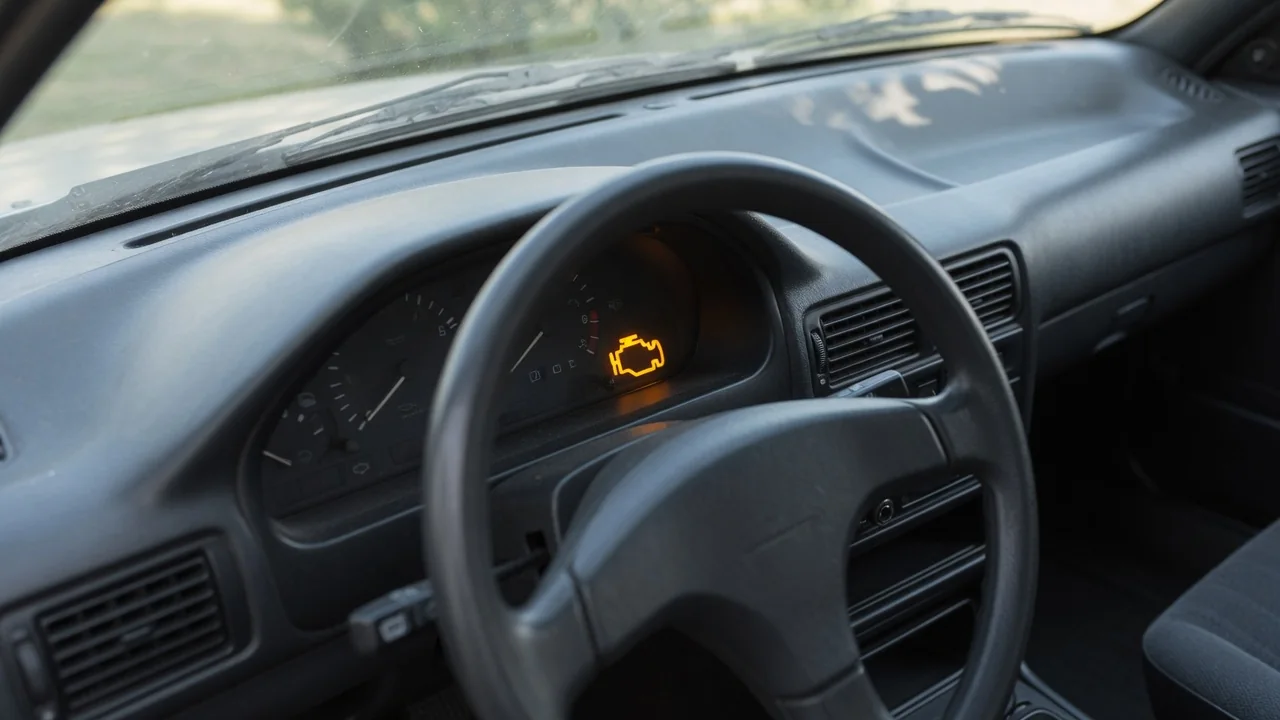
A check engine light Infiniti Q50 owners notice is the malfunction indicator lamp, which reports that engine-management or emissions monitoring has found a condition outside expected limits. The lamp does not identify a failed part. Useful diagnosis starts with model year, Q50 engine configuration, mileage, and recent service, then uses stored OBD-II trouble codes and freeze-frame data to interpret what the control system actually saw.
What the Check Engine Light Means on Your Q50
On an Infiniti Q50, the check engine light is a malfunction indicator lamp tied to onboard diagnostics. When it illuminates, the powertrain control module has stored a detected engine-management or emissions-related condition, often as pending or confirmed OBD-II trouble codes. That report is evidence of a monitored limit being exceeded, not proof that a sensor, coil, catalyst, or other hardware has failed. The same lamp can reflect a wiring issue, a temporary mixture excursion, or an evaporative emissions system leak that still needs confirmation.
Before ranking likely diagnostic paths, record the Q50 model year, engine configuration, current mileage, and recent service history, including oil service, battery work, or fuel-system repairs. Naturally aspirated and turbocharged Q50 engines share some monitors, yet boost-related faults apply only where a turbocharger is fitted. Mileage and recent work can change which observations matter, such as a light after a battery disconnect versus after refueling. The categories discussed later are possible explanations, not a claim that any one is the most frequent Q50 fault.
When the Warning Requires Stopping
A flashing check engine light on an Infiniti Q50 can indicate an active engine misfire while the catalyst is at risk of overheating from unburned fuel. In that situation, reduce load, pull over when it is safe, and arrange assistance rather than continuing at highway speed. Do not try to confirm the misfire by repeatedly accelerating or holding a high engine speed. A flashing lamp is a different urgency than a steady malfunction indicator lamp and should be treated as a reason to stop driving until the condition can be assessed.
Severe shaking, substantial power loss, visible smoke, a strong fuel smell, or an overheating indication raises the urgency of even a steady warning and warrants stopping as soon as it is safe. A steady check engine light without noticeable drivability change still deserves prompt diagnosis; consult the applicable owner's manual for driving guidance rather than assuming the car can wait indefinitely. Oil-pressure and coolant-temperature warnings are separate from the malfunction indicator lamp. Those gauges and lamps require their own immediate response because they protect lubrication and cooling, not just emissions monitors.
Fault Categories That Can Trigger the Light
Ignition and fuel-delivery faults can contribute to engine misfire, rough idle, or hesitation on a Q50, yet those symptoms do not assign a failed coil, injector, or plug by themselves. A misfire monitor simply reports that combustion in one or more cylinders did not meet expected smoothness. Intake leaks, air-metering faults, and mixture-control problems can also push fuel trim outside monitored operating limits. Short-term and long-term fuel trim are adaptive corrections; large corrections are clues for further testing of unmetered air, restricted fuel, or sensor-circuit issues rather than a parts list.
Evaporative emissions system leaks, oxygen-sensor circuit faults, and catalyst-monitor faults are additional diagnostic categories that can illuminate the check engine light Infiniti Q50 drivers see after a drive cycle completes. A loose or damaged fuel-cap seal may set an evaporative code, but that observation does not automatically confirm the entire vapor-control system needs replacement. Oxygen-sensor and catalyst codes describe detected circuit or efficiency conditions that still require confirmation. Boost-control faults belong in the discussion only on turbocharged Q50 engine configurations; naturally aspirated layouts do not use that monitor family.
Safe Observations to Make Before the Appointment
Write down whether the warning appeared after refueling, a cold start, hard acceleration, or recent maintenance such as an oil service or battery replacement. Those timing details help a technician decide whether to start with evaporative-emissions testing, cold-start enrichment, misfire under load, or a monitor reset after a power interruption. Note starting behavior, idle quality, hesitation, unusual odors, and any other dashboard messages. Do not deliberately recreate a dangerous symptom such as a flashing misfire, overheating, or a strong fuel smell just to gather more information.
With the engine off and the Q50 safely parked, confirm that the fuel cap is fully seated if the vehicle uses a traditional cap. A loosely installed cap can affect evaporative emissions system monitoring, but tightening it does not confirm an evaporative-system diagnosis and does not replace a scan. Avoid touching hot exhaust or catalyst components, disconnecting fuel lines, or probing moving belts and fans. Those actions add injury risk and can create new leaks or codes that obscure the original freeze-frame data.
Use Trouble Codes to Direct Q50 Diagnosis
An OBD-II scan retrieves stored, pending, and sometimes permanent trouble codes from the Q50's powertrain module. Recording the exact alphanumeric code, including any manufacturer-specific prefix, matters because generic summaries can collapse different circuit and performance tests into one nickname. Manufacturer-dependent code meanings must be verified against the specific Q50 model year and engine configuration before interpretation. The same numeric code can describe different monitors or wiring layouts across engines, so a printed definition from another Infiniti or another year is not sufficient confirmation.
Preserve freeze-frame data and fault status before clearing codes or disconnecting the battery. Freeze-frame data captures operating conditions when the fault was set, such as engine speed, load, coolant temperature, and fuel trim, which can distinguish a cold-start misfire from a cruise evaporative leak. A code identifies a detected condition or circuit, not a failed part. Professional testing may still require live data, wiring voltage-drop checks, smoke or leak testing of the evaporative emissions system, or other targeted procedures matched to that code family.
Confirm the Cause and Verify the Repair
Bring a practical checklist to the appointment: Q50 year, engine configuration, mileage, exact OBD-II trouble codes, whether the check engine light was steady or flashing, associated symptoms, and recent repairs or refueling. Ask which test supports the proposed repair and whether related wiring, vacuum or evaporative leaks, or operating conditions in the freeze-frame data were evaluated. That conversation keeps diagnosis tied to evidence. Replacing a sensor because a code named it, without confirming the circuit and the conditions that set the monitor, can leave the original fault intact.
Clearing the malfunction indicator lamp alone does not repair the underlying condition and can reset emissions readiness monitors that inspection programs later check. After a genuine repair, verification typically includes a rescan for returning codes, a check that the original symptoms are gone, and confirmation that relevant monitors can complete. There is no single universal drive cycle that finishes every Infiniti Q50 monitor in one outing; completion depends on the engine configuration, ambient conditions, and which tests remain incomplete. Keep records of codes and freeze-frame data until the light stays off through normal driving.