Identifying a Honda Transmission Shift Solenoid
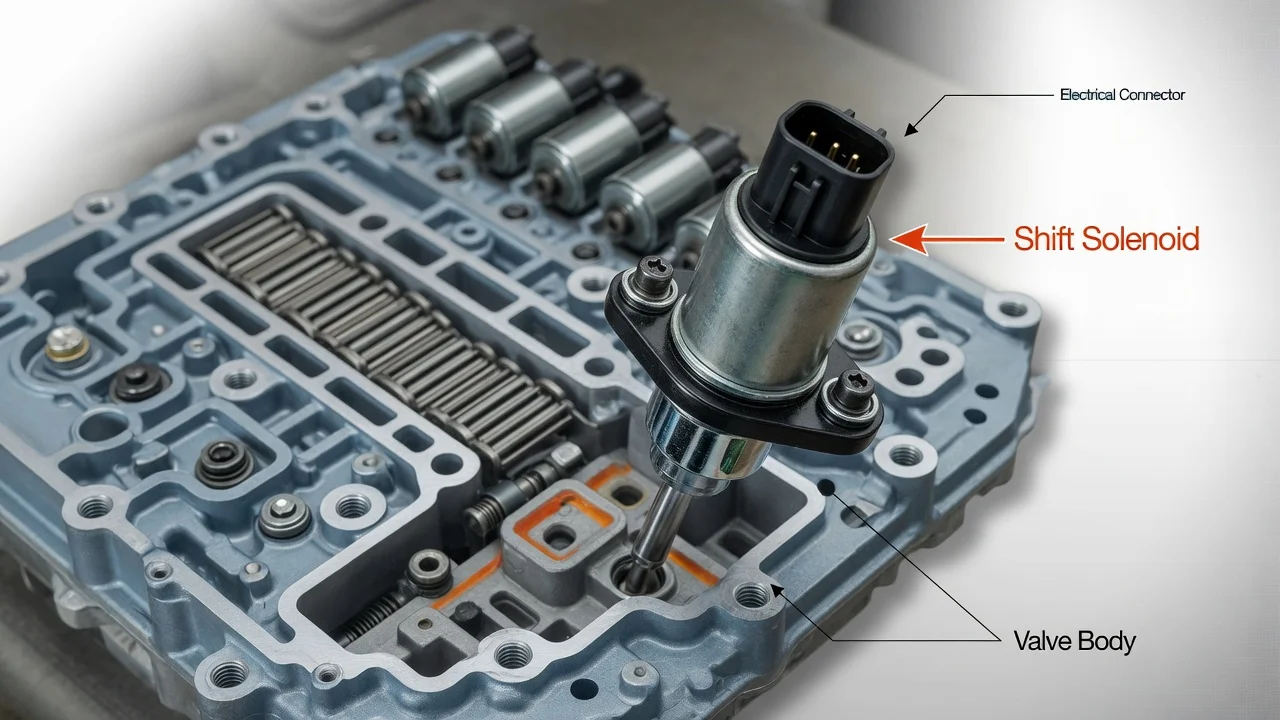
A shift solenoid is an electrically controlled valve that routes hydraulic pressure inside an automatic transmission so the control module can select gears. Identifying the right one on a Honda depends on which transmission the vehicle has. Honda has used several designs, and their solenoid layouts, labels and service procedures differ. This guide covers how to pin down the correct solenoid and why a shifting complaint alone does not prove that a solenoid has failed.
The Short Answer
Start by confirming the transmission type from the VIN or the transmission model code. Then use the service information for that exact unit to see how its solenoids are designated. Honda usually labels them by letter, such as shift solenoid valve A, B or C. A stored diagnostic code normally names the affected circuit by that letter, and the service information shows where that solenoid sits and which connector feeds it. Finally, confirm the replacement part number through a VIN-based parts lookup or from markings on the installed solenoid. Two Hondas of the same model and year can use different transmissions, so the badge on the trunk is not enough to establish fitment.
What a Shift Solenoid Does in a Honda Automatic
The powertrain or transmission control module decides when to shift based on vehicle speed, throttle position, engine load and fluid temperature. It carries out that decision by energizing or de-energizing solenoids. Each solenoid opens or closes a fluid passage, and the resulting pressure moves shift valves that apply or release the clutches for each gear. Many traditional Honda automatics are parallel-shaft designs rather than the planetary layout common in other brands. In those units, each gear typically has its own clutch, and particular combinations of solenoid states select it.
Some solenoids are simple on-off valves. Others are linear solenoids that vary pressure in proportion to the current the module sends, which lets the computer control how firmly a clutch engages. Many Honda units also use pressure switches that report back whether the expected hydraulic pressure actually arrived. This matters for diagnosis because a solenoid can fail electrically, through an open or shorted coil, or mechanically, when debris keeps the valve from moving or blocks its screen.
How the Transmission Type Changes the Answer
Older four- and five-speed Honda automatics commonly mount shift solenoid assemblies on the outside of the transmission case. These are bolted on with a gasket or seal, and some have a small filter screen behind them. On these units the solenoids are usually reachable without removing the transmission, though access depends on the vehicle and engine layout. Several solenoids may be combined into one assembly, which affects what you order.
Honda CVTs do not shift between fixed gears in the same way. Their solenoids control pulley and clutch pressures, and their codes and diagnostic paths differ from those of a stepped automatic. Newer multi-speed automatics generally place the solenoids inside, on or within the valve body, so reaching them means draining fluid and removing covers or internal components. Fluid specification also changes with the transmission type. Many conventional Honda automatics call for Honda ATF DW-1, many CVTs require Honda's dedicated CVT fluid, and other units have their own requirements. The owner's manual or service information for your specific vehicle is the authority. The wrong fluid can produce shift complaints that look like a solenoid problem.
Reading Diagnostic Codes and Shift Behavior
Generic codes such as P0753, P0758, P0763, P0768 and P0773 point to electrical problems in the circuits for shift solenoids A through E. Honda also uses codes describing a solenoid stuck on or stuck off, and codes related to pressure switches or lock-up control. The letter in a code refers to Honda's designation for that transmission, not to a universal position, so match it against the service information for your unit. An electrical circuit code tells you the module saw an abnormal reading. The fault could be the solenoid coil, the connector, the harness or, less often, the control module.
Symptoms often blamed on a bad solenoid include harsh or delayed shifts, flaring RPM between gears, being stuck in one gear, a flashing D indicator on some models, and the transmission defaulting to a limp mode. The same shift behavior can come from low or degraded fluid, worn clutches, a failing pressure switch, wiring damage or software issues. Treat the symptom as a lead to investigate, not as a confirmed failed part.
What the Owner Can Do
Check the fluid level and condition using the procedure for your model, since Honda checking methods vary by transmission. Dark fluid, a burnt smell or visible particles suggest wear beyond a single solenoid. Read codes with a scan tool that can access transmission data, not just generic engine codes, and write down freeze-frame details before clearing anything. Look over the solenoid connectors and nearby harness for corrosion, oil intrusion, loose pins or chafed wires.
If the service information provides a coil resistance specification, measuring across the solenoid terminals can separate an open or shorted coil from a wiring fault. Review the service history as well. A transmission that has gone many miles without a fluid change, or that was filled with the wrong fluid, is more likely to have contamination affecting several components. When ordering a part, give the parts source your VIN and compare the new solenoid against the old one by part number, connector shape and mounting pattern. Replace the gasket or O-ring, and clean or replace any screen if the procedure calls for it. After repair, clear the codes and complete any relearn or road-test procedure the service information requires.
Repair Options to Weigh
Repair options range from fixing a damaged connector or wire, to replacing a single solenoid or a solenoid assembly, to servicing the valve body or rebuilding the transmission. An externally mounted solenoid with a clear electrical fault and clean fluid is often a reasonable owner repair. If the fluid carries heavy debris, a new solenoid may restore normal shifting only briefly, because the debris that clogged the old one is still circulating and the clutches that produced it are still worn. On transmissions with internal solenoids, the labor and risk are higher, and a professional assessment before buying parts usually saves money.
Limitations and Next Step
Solenoid locations, letter assignments, test values, fluid requirements and relearn procedures differ between Honda transmissions and model years, and this guide cannot substitute for the service information covering your VIN. If codes return after a solenoid replacement, if several solenoid or pressure codes appear together, or if the transmission slips, the cause may lie in the hydraulic system, the clutches or the control module. In that case, a transmission specialist with Honda-capable diagnostic equipment can run pressure tests and command individual solenoids to confirm the fault before more parts are replaced.