Identifying a CD4E Transmission Shift Solenoid
The CD4E is a four-speed automatic transaxle that Ford used from the mid-1990s through the late 2000s in vehicles such as the Contour, Mystique, Probe, Cougar, Escape and Mazda Tribute. Owners usually start looking for its shift solenoids after harsh shifts, a missing gear or a stored transmission code. This guide explains what those solenoids are, how to tell which one a fault points to, and why a symptom alone does not prove that a part has failed.
Which part is the CD4E shift solenoid
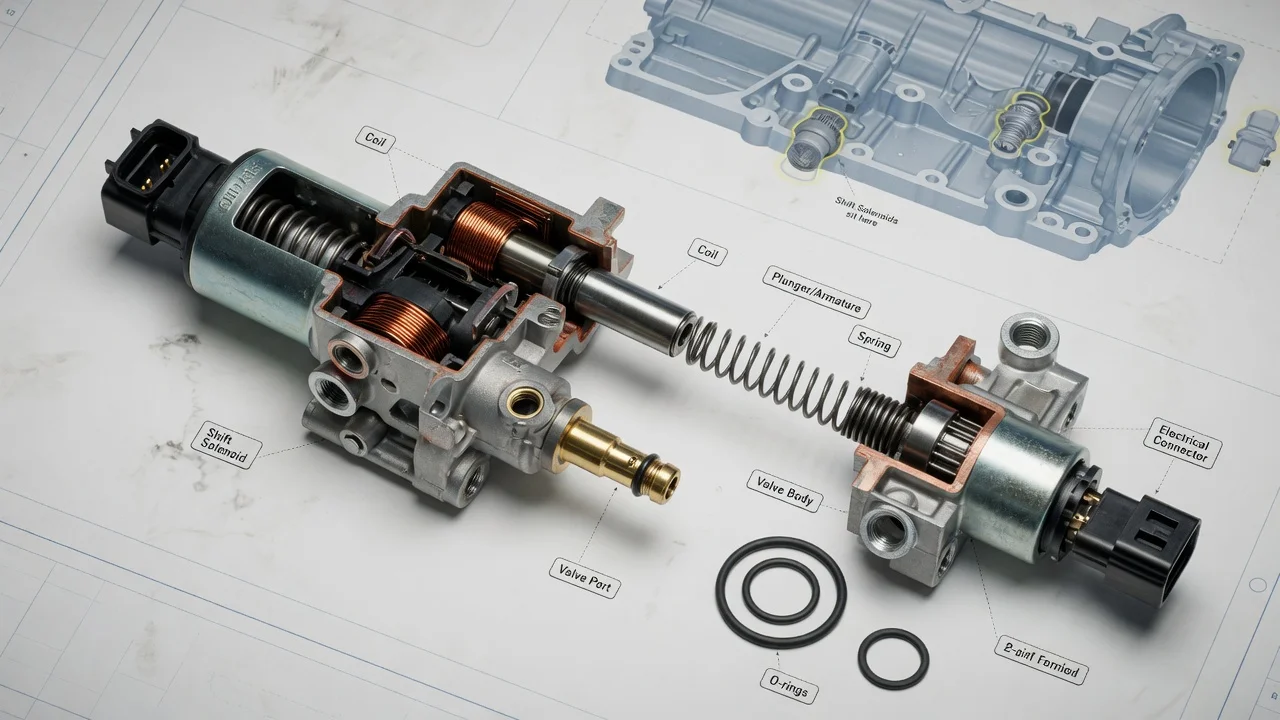
On a CD4E, the shift solenoids are not separate parts bolted to the outside of the case. They are mounted on the main control assembly, or valve body, inside the transaxle behind a cover. They are grouped with other electrical components in an assembly commonly sold as a solenoid body or solenoid pack. Ford diagnostic literature usually calls the two on/off shift solenoids shift solenoid A and shift solenoid B, and some sources label them SS1 and SS2. The same assembly also carries the torque converter clutch solenoid and the electronic pressure control solenoid. On many versions, the transmission fluid temperature sensor shares the same harness.
Identifying the right solenoid therefore involves two steps. First, confirm that the transmission really is a CD4E. Second, match the fault to a specific circuit using diagnostic codes rather than how the car feels on the road. A shift complaint can come from either shift solenoid, the pressure control solenoid, the wiring between the computer and the transaxle, the fluid condition or internal hydraulic wear.
How the solenoids control gear changes
The powertrain control module decides when to shift based on inputs such as vehicle speed, throttle position, engine load and fluid temperature. It switches shift solenoids A and B on or off in set combinations. Each combination directs pressurized fluid to particular shift valves, which apply the clutches and bands for a given gear. The four forward gears come from these on/off patterns rather than from a separate solenoid for each gear. The electronic pressure control solenoid adjusts line pressure, which affects how firm or soft each shift feels. The torque converter clutch solenoid controls converter lockup at cruising speed.
Because each gear depends on a combination, one faulty shift solenoid can disturb more than one shift. A pressure control problem can feel like a shift solenoid fault even when both shift solenoids work correctly. When the module detects an electrical fault in one of these circuits, it typically stores a code and may command a failsafe strategy that holds a fixed gear with raised line pressure, which owners often describe as limp mode. The exact failsafe behavior depends on the fault and the calibration, so the gear the vehicle sticks in is not a reliable way to name the faulty solenoid.
What changes the answer for your vehicle
Start by confirming the transmission type. The CD4E was not the only four-speed automatic in these model lines. Some later four-cylinder Escape and Tribute models used a different transaxle, so model year and engine alone may not settle the question. Check the identification tag on the transmission case, the vehicle certification label, dealer build data for your VIN, or earlier repair invoices that name the unit. Parts, procedures and fluid listed for the wrong transmission will not match.
Within the CD4E family, the solenoid body, connectors and harness routing were revised during production, so fitment varies by model year and application. Match a replacement part to your exact vehicle and transmission rather than to the CD4E name alone. The fluid specification also changed over time and can differ between Ford and Mazda applications. Use the type stated in your owner's manual or marked on the dipstick or fill area instead of assuming one fluid covers every CD4E.
Operating conditions matter too. A complaint that appears only when the transmission is cold, only after it is fully hot, or only over bumps points toward different causes, such as fluid condition, an internal leak or an intermittent connection. Low or degraded fluid can produce shift behavior that closely resembles a solenoid problem.
What the owner can do before buying parts
Read the stored diagnostic codes with a scan tool that can access transmission data, not only engine codes. Generic codes include P0750 for the shift solenoid A circuit, P0755 for the shift solenoid B circuit and P0743 for the torque converter clutch circuit. There are related codes for solenoid performance and for the pressure control solenoid, and Ford also used manufacturer-specific codes on some years. Record every code and any freeze-frame data before clearing anything, because the conditions at the moment of the fault help separate an electrical problem from a hydraulic one.
Next, check the fluid level and condition using the procedure in your owner's manual. A burnt smell, very dark fluid or visible debris suggests internal wear that a solenoid alone will not fix. Write down the exact shift behavior: which shift is missing or harsh, at what speed, and whether it changes with temperature. Inspect the connectors and harness you can see at the transaxle for damage, corrosion, loose locks or fluid inside the connector.
Repair options depend on what that evidence shows. A circuit code calls for testing the wiring and the solenoid against the factory specifications before replacing anything. When a solenoid is confirmed faulty, replacement is commonly done as a complete solenoid body. The work involves removing the valve body cover, catching fluid and refilling to the correct level with the specified fluid. On a high-mileage unit, review the service history, because a transmission that has never had a fluid change may have other wear behind the shift complaint.
Limitations and next step
A shift symptom, or even a code, does not confirm that a particular solenoid has failed. A circuit code shows that the module saw an electrical fault somewhere in that circuit, which includes wiring, connectors and the module itself. A performance code shows that the expected result did not happen, which can also have hydraulic or mechanical causes. Specifications, wiring diagrams, access steps and fluid fill procedures differ by year and application, so vehicle-specific service information is needed before testing or disassembly.
Have a transmission specialist inspect the vehicle if several codes appear together, the transmission slips or loses reverse, the fluid shows debris, or the problem continues after a confirmed solenoid replacement. The practical sequence is to confirm the transmission type, pull and record the codes, check the fluid, and only then choose between electrical repair, solenoid body replacement and a deeper internal inspection.