Hyundai Santa Fe Shift Lock Release: How to Release the Selector
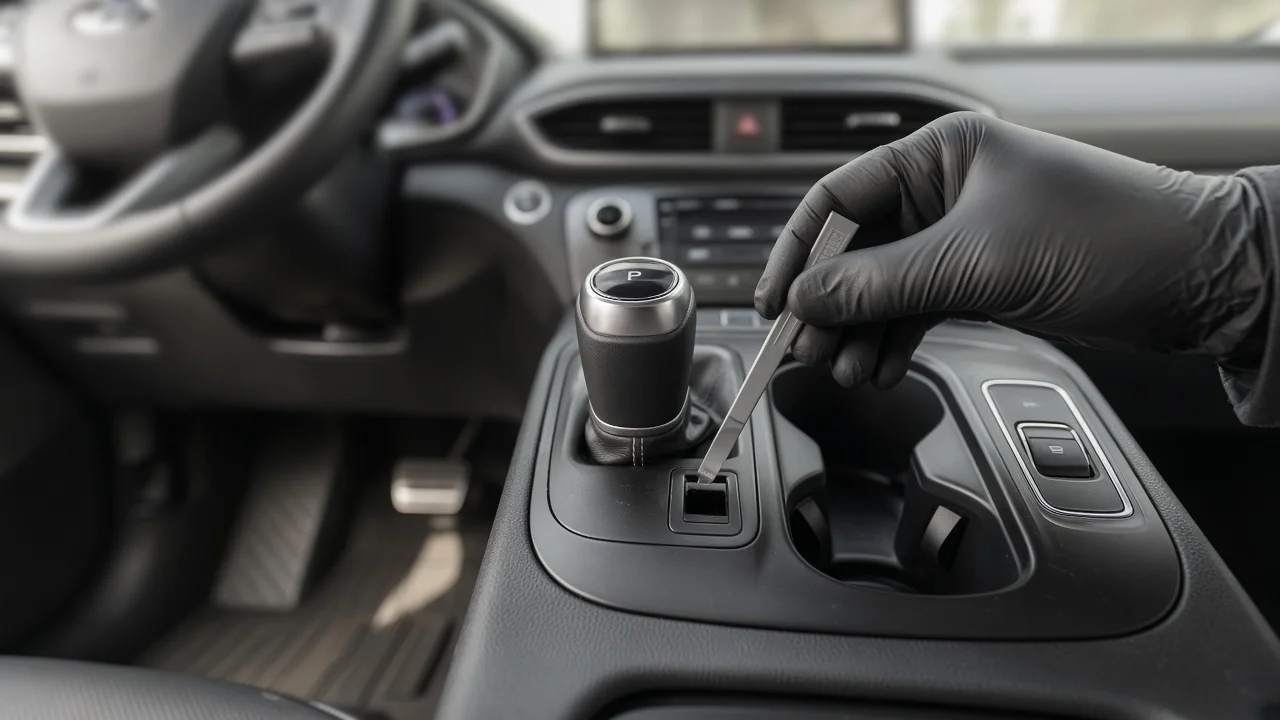
A Hyundai Santa Fe that will not leave Park even with the brake pedal pressed is usually being held by its shift interlock. This safety system releases the selector only when it receives a brake signal. Many lever-equipped models have a manual shift lock release so you can push the vehicle out of a parking space or get it onto a tow truck. This guide explains when the override applies, how to find it on your configuration, and what a stuck selector may or may not point to.
What the shift lock release is meant to do
The release has one narrow job. It mechanically bypasses the interlock so the selector can move out of Park when the normal brake-pedal release does not work. Typical situations include a dead or weak battery, a vehicle that has to be pushed or loaded for towing, and an interlock that no longer responds to the brake pedal. The release gets the vehicle moving. It does not repair anything, and it does not tell you why the lock failed to release on its own.
Before you use it, think about where the vehicle is and what happens next. On a slope, in traffic or on soft ground, the parking brake and wheel chocks matter more than speed. If you only need to get the vehicle onto a flatbed, the tow operator may want it in Neutral. If you plan to drive it, the selector could stick again at the next stop, so plan a route to a safe place or a shop.
Check which shifter and transmission your Santa Fe has
The procedure differs by generation, trim and powertrain, so identify your configuration first. Santa Fe models with a conventional console lever and a traditional automatic transmission generally use a mechanical interlock with a small access slot for the override. Later shift-by-wire models do not use the same mechanical linkage. These include push-button selectors on the console and the column-mounted electronic selector on the newest generation. The owner's manual for those vehicles describes their own procedure for moving out of Park, including what to do when the battery is discharged.
The quickest way to confirm fitment is the owner's manual for your exact model year, plus the VIN-based build information a dealer can read. Note three things: whether the vehicle has a mechanical key or push-button start, the transmission type, and whether it is gasoline, hybrid or plug-in hybrid. These details determine whether a release exists, where it is, and which diagnostic path makes sense later. Advice written for a different year or trim may not match your console.
Using the manual release on lever-equipped models
For Santa Fe models with a console lever, Hyundai owner's manuals describe a sequence along these lines. Stop on level ground if you can, set the parking brake firmly and turn the ignition off. Find the shift lock access cap, a small removable cover on the shifter console near the selector. Lift it out carefully with a thin flat tool so you don't mark the trim. Insert a key or a flat-head screwdriver into the access hole and press down.
Hold the tool down, keep your foot on the brake, and move the selector out of Park, usually into Neutral. Put the cap back afterward so debris cannot fall into the mechanism. Follow the exact order given in the manual for your model year, because the required ignition position and the wording differ between generations. Once the selector moves, treat the vehicle as needing inspection, not as fixed.
Details that change the procedure
Several features affect how the override works in practice. Push-button start vehicles may need the ignition system in a specific mode before the selector will move. Key-start vehicles may let you use the ignition key itself as the release tool. The access cap is not always in the same place, and on some vehicles it sits under a trim piece rather than beside the lever. Shift-by-wire models need electrical power to change range. On those models a flat battery is a different problem from a sticking mechanical interlock, and the fix usually starts with restoring power.
Be skeptical of labels such as universal release tool or plug-and-play shifter repair. A generic tool helps only if it fits the access hole without damaging it. A replacement part is relevant only once the actual fault has been confirmed. The evidence that counts is specific: the part number for your build, the manual procedure for your year, and test results from your own vehicle.
What the release cannot fix and what it may cost
A stuck selector is a symptom with several possible causes. Because the interlock depends on a brake signal, all of the following can produce similar behavior: • a faulty brake light switch; • a blown stop lamp fuse; • low system voltage; • a failing shift lock solenoid; • a misadjusted shift cable; • liquid spilled into the console; A useful first check is whether the brake lights come on when you press the pedal. If they don't, the interlock may never receive its release signal. Don't treat any of these as the confirmed fault until it has been tested.
Diagnosis typically covers battery and charging voltage, the relevant fuses, brake switch operation and any stored diagnostic codes. The service history also matters, especially earlier electrical or shifter work. Transmission fluid level and fluid specification affect overall shift behavior, but adding fluid will not free an interlock that won't release, and the correct fluid depends on the transmission. Check for open recalls by VIN as well, since Hyundai has issued recalls involving brake switches on some older models. Repairs range from a fuse or switch replacement to work on the shifter assembly, so costs vary widely. Get a quote after diagnosis.
Relying on the override repeatedly can hide a brake light fault, which affects other drivers. It also leaves the vehicle without the protection the interlock provides. Use it to move the vehicle once, then arrange a proper check.
A practical checklist before calling for help
Work through these steps in order: 1) Make sure the vehicle is secure with the parking brake applied. 2) Press the brake pedal firmly and try the selector again, since a light press may not trigger the release. 3) Check whether the brake lights come on. 4) Check whether dim dashboard or interior lights suggest a weak battery. 5) Identify your shifter type and model year, then find the shift lock section in the owner's manual. 6) Use the access slot only if your configuration has one, and only with a tool that fits.
Afterward, write down what happened: whether the selector stuck when the engine was hot or cold, any warning lights, recent battery or electrical work, and any spills near the console. Give this to the technician along with the VIN so they can check stored codes and recalls. A clear description of the shift behavior and conditions shortens diagnosis and lets you compare repair options on the same basis.