Hyundai Elantra Tire Pressure and TPMS Guide
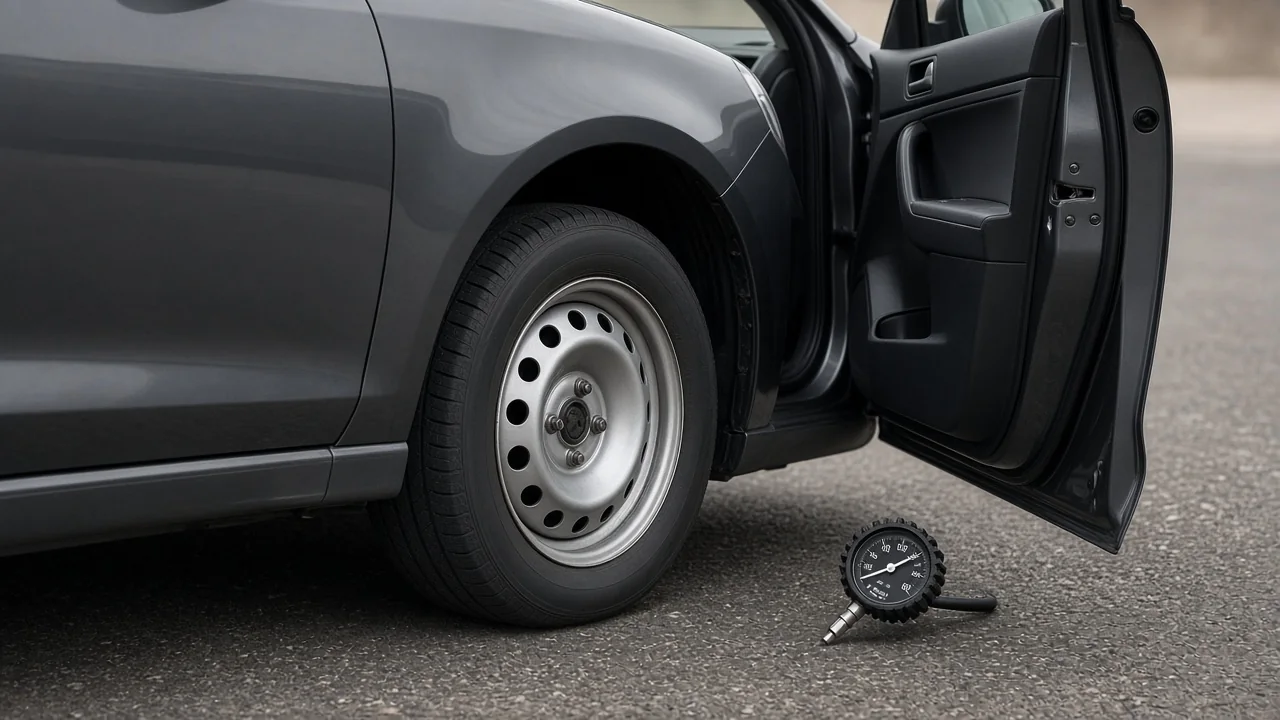
Correct Hyundai Elantra tire pressure starts with the vehicle itself, not a single number copied from another car. The tire information placard lists the recommended cold inflation in PSI for the tires your Elantra was designed to use. A tire pressure gauge, the owner’s manual, and the TPMS warning light help you confirm that inflation is where it belongs and notice when something needs attention.
Find the Recommended Pressure for Your Elantra
The recommended tire pressure for a Hyundai Elantra is the cold inflation value printed on that vehicle’s tire information placard, not a figure borrowed from a different year or trim. Model years, original equipment sizes, and optional wheel packages can list different front and rear PSI values. Treat the placard as the source of truth for your car, then match the listed size to the tires actually mounted before you add or release air.
Read the front and rear entries separately even when they look similar. A compact sedan can carry a higher or lower rear setting than the front, and using one PSI for every position ignores that difference. The large number molded into a tire sidewall is the tire’s maximum inflation capacity, not the Elantra’s recommended cold tire pressure. Inflating to the sidewall maximum can overstress the ride, handling, and contact patch the vehicle was engineered around.
Locate and Read the Tire Information Placard
On most Elantras the tire information label sits in the driver-side door opening, typically on the driver door jamb where the door meets the body. Open the driver’s door and look along the B-pillar and the jamb face for a sticker that lists tire size, cold inflation in PSI or kPa, and sometimes a separate spare-tire line. Confirm the units so you do not set a kPa figure on a gauge that reads only in PSI.
If the label is missing, painted over, or too faded to read, use the owner’s manual for the same information or ask a Hyundai dealer or qualified technician to identify the correct cold settings for that vehicle identification number. When aftermarket wheels or a different tire size are fitted, the placard configuration no longer describes the load and speed the new combination must support. Have a tire professional confirm a safe inflation plan rather than guessing from the original sticker.
Check Tire Pressure When the Tires Are Cold
Cold tire pressure is the reading taken after the Elantra has been parked for at least three hours, or before it is driven more than a short distance. Heat from the road and flexing of the carcass raise internal pressure, so a warm reading looks higher than the placard even when the overnight fill was correct. Park on level ground, unscrew each valve cap, and use a known-accurate tire pressure gauge on every road tire, including the one that looks fine.
Write down each reading, then add air or, if a cold tire is above spec, release a little and recheck until the gauge matches the applicable front or rear placard setting. Recheck after the hose is removed because chucks and inflators can drop a pound or two. Do not bleed a warm tire down to the cold PSI target; the next morning that tire will sit below the recommended pressure and run hotter under load.
Understand Temperature Changes and Repeated Air Loss
A drop in ambient temperature lowers the pressure inside a closed tire even when the casing and valve are sound. Overnight cold or a sudden weather change can move a borderline fill onto the TPMS warning light without proving damage. That is why a gauge check after the car has sat is more useful than assuming a puncture. Still, walk around while the Elantra is parked and look for a tire that sits low, a bulge, cut, or object in the tread.
Repeated air loss after you restore cold tire pressure is a different problem. Adding air may turn the warning off for a day, but a slow leak at the bead, valve, puncture, or rim still needs inspection. Do not drive on a tire that is visibly flat, shredded, or separated from the wheel. Use roadside assistance or a tire-service shop so the vehicle can be moved safely and the cause identified before the next fill.
Handle the TPMS Warning and Reset Process
When the TPMS warning light comes on, consult the owner’s manual for that Elantra model year before you interpret the lamp or look for a reset. Warning behavior, cluster messages, and any reset or relearn steps vary by year and equipment. The first practical step is still the same: measure cold tire pressure on each road tire and correct it to the placard. Many low-inflation warnings clear after a proper fill once the system sees stable pressure, but that is not guaranteed on every car.
Do not assume a universal reset button or a fixed driving sequence will satisfy every Elantra. Some systems need a scan tool or a sensor relearn after a tire service; others only need correct inflation. A light that stays on or flashes after pressures are right is a diagnostic clue, not proof that a particular sensor, module, or tire has failed. Clearing the warning also does not seal a leak. TPMS is a monitor, not a substitute for a regular tire pressure gauge check.