Hyundai Elantra Shift Lock Release: How to Release the Selector
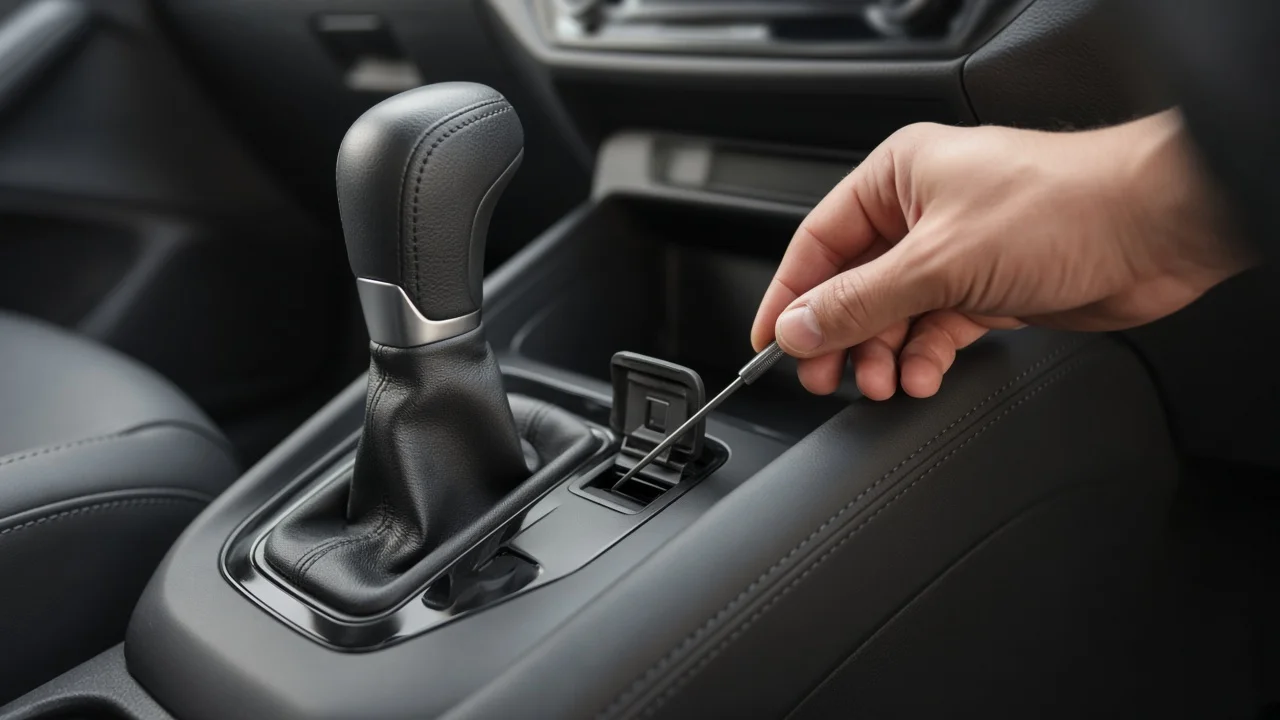
If your Hyundai Elantra won't come out of Park, the shift lock release lets you move the selector manually so the car can be pushed, towed or repositioned. This override is a workaround, not a fix. Below is how the release works, how to find it on your configuration, what a stuck selector can and cannot tell you, and what to check before you drive or book a repair.
Why the Selector Gets Stuck in Park
The brake-shift interlock on automatic Elantras keeps the lever locked in Park until the system detects the brake pedal pressed with the ignition in the correct position. A small solenoid holds the lock. When it receives the signal, it retracts and the lever moves. If power or that signal is missing, the selector stays put even though the transmission itself may be fine. Owners usually reach for the release in a few situations: a dead or weak battery, a car that must be moved onto a flatbed or out of a garage, a selector that sticks after a drink spill in the console, or a lever that refuses to leave Park while the engine runs normally.
Your practical goal matters. If you only need to roll the car a few feet or load it for towing, the manual release is the right tool. If you plan to keep driving, the release only gets you out of Park once. The underlying fault remains, and the lock will reengage the next time you select Park.
Identify Your Transmission and Shifter Layout
The Elantra has been sold with several transmission types across generations, including conventional automatics, a CVT that Hyundai calls an IVT, dual-clutch units on certain turbocharged trims, and manual gearboxes on some versions. A manual-transmission car has no shift lock to release. Automatic and dual-clutch versions with a mechanical lever generally have a release point near the selector, but its exact position, cover shape and required ignition state can differ by model year and trim.
Before you start, confirm the model year, engine and transmission from your registration, window sticker or service history. Then check the owner's manual section on the shift lock release. On many Elantras the release is under a small rectangular cap near the Park position on the shifter trim, sometimes marked with a label. If your car uses a different selector design, follow the manual rather than forcing a generic procedure. Prying in the wrong place can damage the trim or the selector mechanism.
How to Release the Shift Lock
Park on level ground, set the parking brake firmly and, if possible, chock the wheels, because once the selector leaves Park the car can roll. Put the ignition in the position your manual specifies; many procedures call for the engine to be off. Gently lift the release cover with a small flat tool or the edge of your key, working at the notch if there is one.
Press and hold the brake pedal. Insert a key, small screwdriver or similar tool into the release slot and push down on the lever inside. While holding it down, press the shifter button if your lever has one and move the selector to Neutral. Remove the tool, refit the cover and keep the parking brake applied until the car is secured on a tow vehicle or in its new position. If the lever will not move with moderate force, stop. A seized linkage or internal fault is not something to overcome with leverage.
What the Symptom Tells You and What It Doesn't
A selector stuck in Park is a symptom, not a diagnosis. The useful evidence is what else is happening. If the brake lights do not come on when the pedal is pressed, the brake light switch or its circuit is a likely suspect, since the interlock often relies on the same signal. If the dash is dim, the starter clicks or the car won't crank, low battery voltage may be preventing the solenoid from working. If the brake lights work and the battery is healthy, a fuse, wiring, the solenoid itself, or debris and liquid in the console become candidates.
Scanning for diagnostic codes can help, but a shift lock problem may not set a code, and a stored code does not confirm which part has failed. Listen near the shifter while someone presses the brake: many interlock solenoids make a faint click when they release. A click with no movement points toward something mechanical, while silence points toward power or signal. Treat each observation as a direction for testing, not proof that a particular part needs replacing.
Limits of the Override and Ownership Costs
The release does not repair anything. It doesn't restore brake lights, charge a battery or replace a solenoid, and using it to drive daily means bypassing a safety feature designed to prevent shifting out of Park without the brake applied. It also does nothing for shift behavior problems such as harsh engagement, slipping or delayed gear changes. Those relate to the transmission itself, its fluid specification and its condition, and they need a separate diagnosis.
Repair options depend on the confirmed cause. A battery, fuse or brake light switch is typically a simpler repair than selector or wiring work, and cleaning a contaminated shifter assembly may be enough after a spill. When replacing parts, confirm fitment for your exact model year and transmission, since shifter assemblies and switches can differ between configurations. Record the work in your service history so a recurring fault is easier to trace.
Quick Checklist Before You Move the Car or Book Service
Work through these points in order: confirm your transmission type and that the car actually has an automatic shift lock; find the release location in the owner's manual; secure the car with the parking brake and wheel chocks; check whether the brake lights work; note battery condition and any warning lights; listen for the solenoid click; and scan for codes if you have a tool.
Then decide on the next step. If the car only needs to be moved once, use the release and arrange towing or a short push. If the brake lights are out, avoid driving until that is fixed, because following traffic cannot see you braking. If the electrical checks pass and the lever still sticks, a shop can test the interlock circuit and selector assembly before any parts are ordered.