Hybrid Battery Chargers, Grid Chargers and 12V Tenders Explained
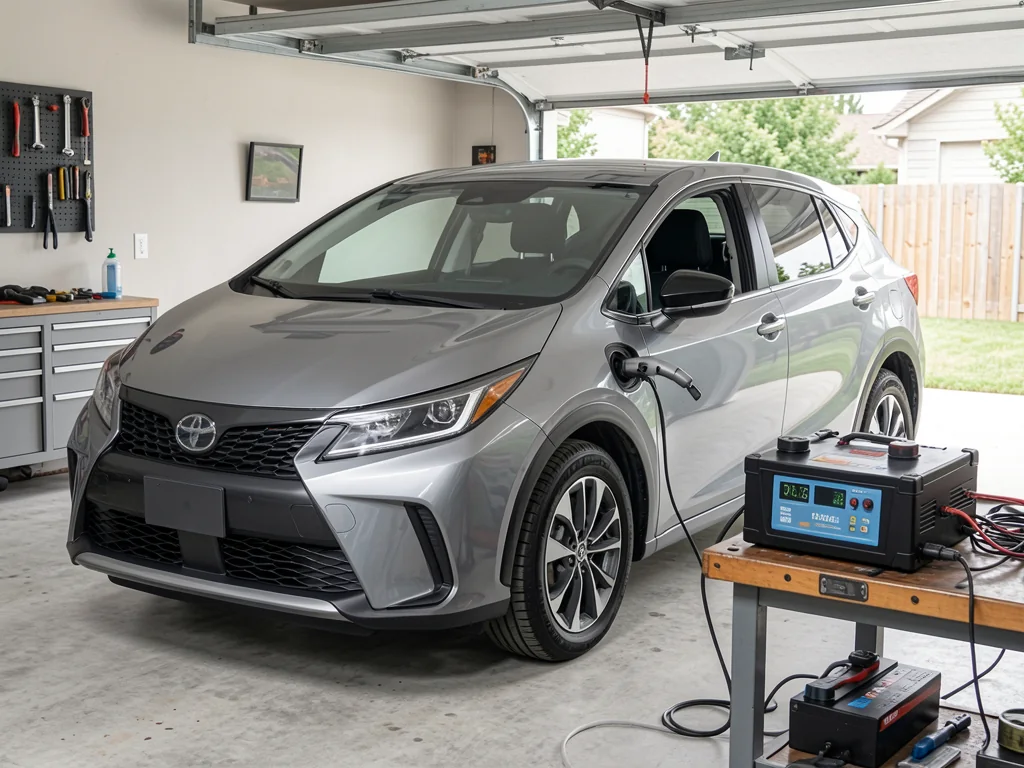
A charger for hybrid battery service is not one device. Hybrids carry a high-voltage traction battery and a 12V auxiliary battery, and each has different charging rules. External hybrid battery charger equipment is specialized, while a battery tender for hybrid cars or a trickle charger for hybrid battery storage usually serves only the 12-volt system. Matching the tool to the pack, chemistry, and vehicle type keeps charging useful and avoids unsafe connections.
Identify Which Hybrid Battery Needs Charging
A hybrid uses two electrical stores with different jobs. The traction battery supplies high-voltage power for the electric motor and captures regenerative braking energy. The 12V auxiliary battery supports computers, lighting, and the systems that bring the vehicle to READY. A DC-DC converter normally keeps that 12-volt battery charged from the high-voltage side while the vehicle operates. When a pack sits unused, storage discharge can lower either battery, so the first diagnostic step is identifying which battery is actually low rather than assuming one charger fits both.
Vehicle architecture also changes what external charging means. A conventional hybrid typically charges the traction pack onboard through the engine, motor-generators, and control software, so an external pack charger is specialized service equipment rather than a driveway accessory. A plug-in hybrid uses its designated charging inlet and approved charging equipment to replenish the traction pack from the wall. That inlet equipment is not a reconditioning charger. Confirming conventional versus plug-in status, then confirming which battery is depleted, prevents connecting the wrong charger for hybrid battery work.
What Grid Charging and Reconditioning Can Accomplish
Grid charging means supplying external electrical power to a traction pack through specialized equipment instead of relying only on the vehicle's onboard charging path. The term appears often in hybrid battery reconditioning discussions because some shops use a hybrid battery charger to apply a controlled charge after modules have been tested or after a pack has sat discharged. The process is equipment-specific and depends on battery chemistry, module arrangement, and how the vehicle's battery control unit monitors cell groups. It is not the same as plugging a portable maintainer into the 12-volt posts.
When a supported pack develops charge imbalance, controlled charging may help bring weaker groups closer to the rest of the pack so the control system can use more of the available energy. Suitability still depends on chemistry and system design; nickel-metal hydride and lithium-ion packs do not share the same charging behavior. Reconditioning, as offered by some equipment, may involve controlled charge and discharge cycles intended to even modules, not a universal restore. Charging cannot repair internal damage or guarantee restored capacity. Persistent warnings and reduced performance need professional diagnosis rather than repeated charging alone.
Check Prolong Charger Suitability Before Considering Treatment
Prolong is a brand associated with hybrid battery charging and reconditioning equipment, and a Prolong hybrid battery charger belongs to that line rather than to generic 12-volt tenders. Brand recognition does not prove the unit is effective for a given car or compatible with a given pack. Before considering treatment, verify the exact vehicle application, battery chemistry, equipment version, and any manufacturer-stated requirements for that charger. A name on a box cannot substitute for matching the tool to the traction battery actually installed.
Charger hardware, discharger functions, connection fittings, and cooling needs vary with the specific high-voltage system. One product name cannot establish that those requirements are met. If the pack, chemistry, or vehicle application does not match the equipment documentation, skip the treatment rather than adapting hardware. Installation of traction-pack charging equipment and assessment of the high-voltage battery belong with a qualified hybrid technician. That assessment should confirm whether imbalance, capacity loss, or another fault is present before any grid charging is attempted.
Determine the Charging Need on a Toyota Prius
Choosing a Toyota Prius hybrid battery charger starts with more than the nameplate. Prius vehicles include conventional hybrids and plug-in variants, and traction-battery chemistry plus charging provisions change across model years and exact trims. Start with the model year, the precise Prius variant, and which battery is affected. Only then does it make sense to discuss an external pack charger, the plug-in inlet, or a 12-volt maintainer. A plug-in Prius can accept wall charging at its inlet, while a conventional Prius still charges the traction pack onboard.
A no-start or no-READY complaint is equally ambiguous. Those symptoms can come from a depleted 12V auxiliary battery, a traction pack that will not support READY, or another system entirely. Symptoms alone cannot assign blame. Use the applicable owner's manual for approved 12-volt charging provisions and, on plug-in models, for charging-inlet instructions. Traction-pack charging decisions, including any grid charger, belong with qualified assessment after the correct battery and configuration are identified. The manual is the first reference for what the vehicle is designed to accept.
Choose a 12V Battery Tender for Hybrid Storage
When a hybrid will sit unused, a compatible automatic battery maintainer can support the 12V auxiliary battery if the vehicle manufacturer permits that use. A battery tender for hybrid cars in this context is a 12-volt device, not a traction-pack charger. Storage discharge on the auxiliary battery can leave computers unpowered and prevent READY even when the high-voltage pack still holds energy. Maintaining the 12-volt battery therefore protects starting and control power during storage, but only within the limits the manufacturer publishes for that vehicle.
Match the maintainer to the battery's specified voltage, chemistry, capacity range, and any vehicle charging restrictions, including whether the maker allows a maintainer while the vehicle is stored. Automatic maintenance mode, an environmental rating suited to the storage location, and manufacturer-approved connection accessories matter more than a low advertised current. Maintaining the 12-volt battery does not mean the traction pack is being charged. Follow vehicle-specific storage guidance for both systems so the high-voltage pack is not neglected while the auxiliary battery sits on a tender.
Use a Trickle Charger Only Within Approved 12V Limits
A trickle charger for hybrid battery storage is still a 12-volt tool. Low charging current alone does not make a unit safe for unattended storage. The charger must explicitly support automatic maintenance of the installed battery chemistry so it does not overcharge after the pack is full. Follow the vehicle and charger manuals for designated connection points, ignition state, ventilation, and permitted connection duration. There is no universal hookup sequence that fits every hybrid, so the manuals for that vehicle and that charger govern the connection.
An ordinary 12V trickle charger must never be connected to a high-voltage traction pack or its wiring. Those systems use different voltage, isolation, and connector designs, and a 12-volt charger cannot service them. Stop charging and seek help if the auxiliary battery shows visible damage, leakage, unusual heat, or odor. Repeated discharge also warrants testing of battery condition, charging operation, including the DC-DC converter path, and parasitic draw. A charger that keeps fighting a drain is covering a problem rather than solving it.