HX35 Wastegate Actuator: Identification and Checks
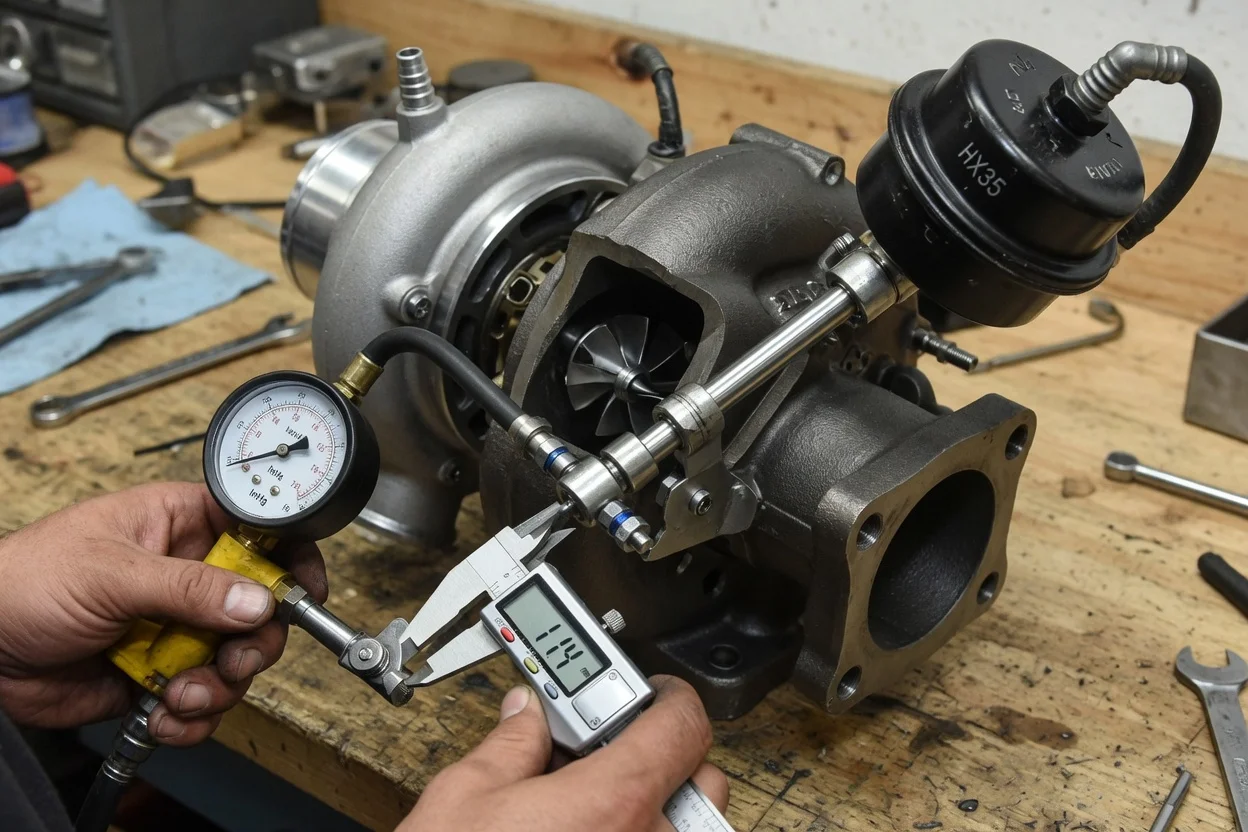
The wastegate actuator on a Holset HX35 turbocharger controls how much exhaust bypasses the turbine wheel. When it fails, boost is usually too low, too high or inconsistent. Before blaming the actuator, confirm that your turbo actually has one, then work through the symptoms and checks in a logical order. This guide explains how to identify the actuator, which observations point toward it and which point elsewhere, and what a technician needs to know before any parts are replaced.
Establish the symptoms
Start by confirming what is fitted. The HX35 was produced in both wastegated and non-wastegated forms, and the wastegated version is commonly identified by an HX35W designation. A wastegated unit has a round canister on a bracket near the compressor housing. A rod runs from the canister to a lever on the turbine housing, and a small hose supplies boost pressure. If there is no canister and no lever, there is no actuator to diagnose. Note the part and assembly numbers from the turbo nameplate, along with the engine, model year and any aftermarket changes. The correct actuator and its settings depend on the exact vehicle configuration.
Next, record what the engine is actually doing. Low boost and sluggish acceleration, especially under load or on grades, can mean the wastegate is opening too early. Boost that climbs higher than usual, surging, or a sudden rise in exhaust temperature can mean the wastegate is not opening. Also note the following: whether the problem is constant or appears only hot, cold or at certain speeds; whether there is black smoke, a rattle from the turbine side or a warning light; and what changed recently, such as a turbo swap, exhaust work, tuning or a new hose. A boost gauge reading taken under repeatable operating conditions is far more useful than a general impression that the truck feels weak.
Distinguish plausible causes
On the actuator side, the usual suspects are a torn or leaking diaphragm, a weakened internal spring, a rod that has come off the wastegate lever or lost its retaining clip, and a cracked, loose or blocked pressure hose. A rod length altered during earlier work is another possibility. The wastegate flapper and its pivot inside the turbine housing can also seize from carbon or corrosion. That fault is not in the actuator itself but produces the same symptoms.
Several other faults can look like an actuator problem. Low boost can come from a leak at the intercooler, its boots or clamps, a restricted air filter, an exhaust leak ahead of the turbine, a worn turbo with damaged wheels or excessive shaft play, or a fuel delivery problem that limits power. High boost can follow added fueling from tuning or an actuator that does not match the turbo. Use your observations to weigh these options. A hiss or oily residue at intake joints under load favors a boost leak. A lever that will not move by hand favors a seized gate. An actuator that moves smoothly and holds pressure on a bench test makes the actuator itself less likely.
Checks in a useful order
Begin with safe visual checks, with the engine off and the turbo fully cooled. Inspect the actuator hose for splits, softness and secure fittings at both ends. Confirm that the rod is attached to the wastegate lever and that its clip is in place. Look for a cracked or loose mounting bracket, heavy corrosion on the rod, and soot traces around the exhaust manifold and turbine flange. Check the intake side as well: air filter condition, intercooler boots and clamps. Note anything disturbed, kinked or missing before touching it.
The next stage needs tools and published data. A hand pressure pump with an accurate gauge, connected to the actuator port, shows whether the rod begins to move and whether the diaphragm holds pressure without bleeding down. Compare the pressure at which the rod moves with the manufacturer specifications for your exact assembly. Do not judge it against figures quoted for other turbos or engines. A boost gauge or data log taken under load, ideally with a helper or recorder so the driver can watch the road, shows how actual boost compares with the expected range.
Some tasks belong with a qualified technician. These include adjusting rod length, smoke-testing the intake system, pressure-testing for exhaust leaks, checking turbo shaft play with the intake removed, and freeing or replacing a seized wastegate. Changing rod length changes boost, so it should only be done to a known specification.
Interpret the findings
A disconnected rod, missing clip or split hose can fully explain the symptoms. Repair it, then recheck boost under the same conditions you recorded earlier. If the diaphragm will not hold pressure, the actuator is confirmed as faulty. Before ordering a replacement, though, make sure the wastegate itself moves freely, because a new actuator cannot overcome a seized flapper. If the actuator moves correctly on the bench but boost is still wrong, the remaining candidates are the pressure hose, boost or exhaust leaks, incorrect adjustment, the gate pivot, or a fault outside the turbo.
Even with the fault confirmed, a few points still need checking before you buy parts. The replacement must match the nameplate assembly number, and you need to know whether it arrives preset or requires setup. Your service history should be reviewed for earlier turbo or tuning work that may have changed the original setup. After the repair, a road test with a gauge should show boost behaving within specification. Without that test, the repair is unverified.
Urgency and next action
Suspected overboost calls for immediate caution. If boost rises well beyond normal or exhaust temperatures climb quickly, stop working the engine hard, because continued operation can raise cylinder pressures and heat. Stop driving and arrange an inspection if you also notice blue or white smoke, oil around the turbo, or grinding, rubbing or whistling noises that change with engine speed. Low boost with no other warning signs is usually less pressing, but avoid towing or heavy loads until it is diagnosed. No safe remaining mileage can be promised for either condition.
When you book a repair, bring the engine and model year, the turbo nameplate numbers, details of any modifications, and your symptom log with gauge readings and the conditions under which they were taken. Include the results of any inspection or pump test already done, plus maintenance schedule records for the air filter and intake system. That information lets the technician confirm the cause rather than start from scratch.