How to Use a Cargo Net in a Car
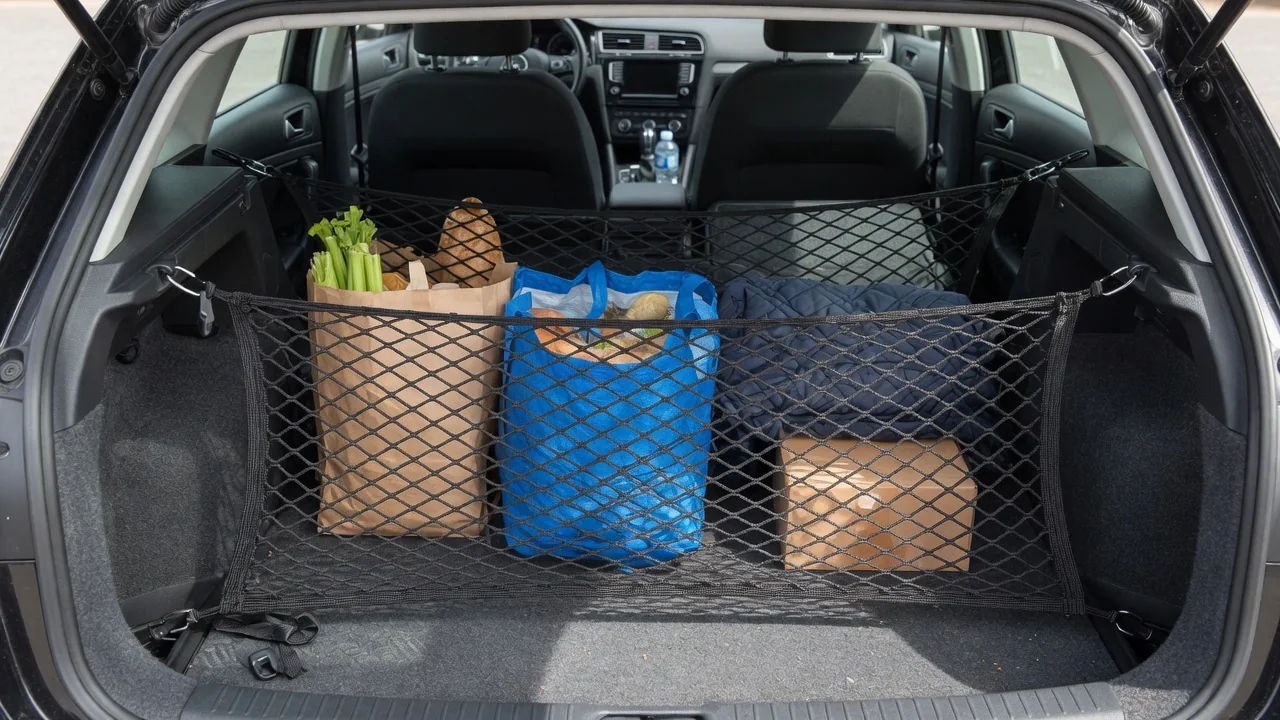
A cargo net looks simple, yet many drivers leave it bunched in a corner of the trunk. Learning how to use a cargo net in a car comes down to three things: finding the factory attachment points, shaping the net to the load, and understanding what an elastic mesh can and cannot hold. The sections below walk through each step with practical examples.
Locate anchors
Start by emptying the cargo area and looking along its edges. Most sedans, hatchbacks and SUVs have small hooks, molded plastic loops or metal D-rings set near the floor corners, the side trim panels or the rear sill. Some sit under flip-up covers or behind carpet flaps, so run a hand along the trim if nothing is visible. The owner's manual usually has a diagram of the luggage compartment showing each tie-down point and what it is meant for.
Anchor layout decides which style of net fits. Four floor-level points suit a flat net that stretches over luggage like a blanket. Two upper hooks paired with two lower ones suit an envelope or hammock net that stands upright against the rear seatback or the trunk opening. Pickup beds and wagons may offer sliding rails with movable cleats instead. Avoid hooking to wiring, seat latches, trim clips or the spare tire hold-down, because those parts were not designed to take a pulling load.
Fit around cargo
With a floor net, place the heaviest items first, low and tight against the seatback, then fill gaps with softer bags so the load forms one compact block. Hook the two forward corners, pull the net over the top, and attach the rear corners last so the mesh is stretched evenly. The elastic should sit taut across the cargo with no loose slack, yet the hooks should not be straining so hard that they pull sideways out of their loops.
An envelope net works differently, forming a pocket that keeps grocery bags, washer fluid bottles or a sports ball upright rather than pressing them down. Slip items between the two mesh layers and make sure the opening faces up. Watch the mesh size as well: small objects such as cans or a tire gauge can slide through wide openings, so group them in a bag or bin first. Sharp corners on toolboxes may snag or cut cords, and a folded towel protects both.
Check restraint after driving
Elastic cords settle once the vehicle starts moving. After the first few miles, or at the next fuel stop, open the trunk and see whether the load has shifted, whether any hook has rotated in its anchor, and whether the net has gone slack because soft bags compressed. A quick tug at each corner tells whether the attachment is still seated. Re-tensioning takes seconds and is easier than repacking a load that has slid into the corner behind a wheel well.
Sounds from the road offer clues too. A new thump over bumps, a rolling noise in corners or a rattle under braking suggests something has worked free beneath the mesh. Rough roads, sharp turns and hard stops put the most demand on the restraint, so check again after those conditions rather than assuming the morning setup still holds. On a long trip, each time items are added or removed, the net's shape changes and the corners deserve another look before driving away.
Everyday Use and Observations
For daily errands, many drivers leave the net hooked in place and simply lift one edge to slide bags underneath. That habit keeps a gallon of milk from tipping, stops a gym bag from sliding forward, and holds an emergency kit or jumper cables in a predictable spot. When the cargo floor is needed for a bulky item such as a stroller or flat-pack box, unhook the net and stow it in a side pocket so it does not tangle around the load.
Over time, watch the condition of the net itself. Cords that feel limp, look frayed or stay stretched after unhooking have lost elasticity and will hold less firmly. Plastic hooks can crack in cold weather or deform in a hot trunk, and a bent hook may pop off under a modest pull. Factory nets are sized for a particular cargo area, while universal versions vary in dimensions and hook style, so compare the fit to the anchor spacing before relying on one.
Limits and Next Steps
A cargo net is an organizer and a light-duty restraint, not a barrier for heavy objects. Stretchy mesh keeps groceries, soft luggage and loose gear from sliding around during normal driving, but it cannot be expected to stop a loaded toolbox, a full cooler or a spare wheel in a collision. The anchor points also carry ratings that differ between vehicles, and those figures appear in the owner's manual when the manufacturer publishes them. Treat any unlabeled plastic hook as suitable for light items only.
Heavier cargo calls for a different method. Ratchet or cam straps attached to metal tie-down rings hold dense items far more securely, and a rigid cargo barrier or partition net approved for the vehicle is the proper choice when a load is stacked above seatback height in a wagon or SUV. If the anchors are missing, broken or loose in the trim, a dealer parts department or body shop can confirm the correct replacement hardware before the net goes back into service.