How to Track a Car's Storage Condition Over Months
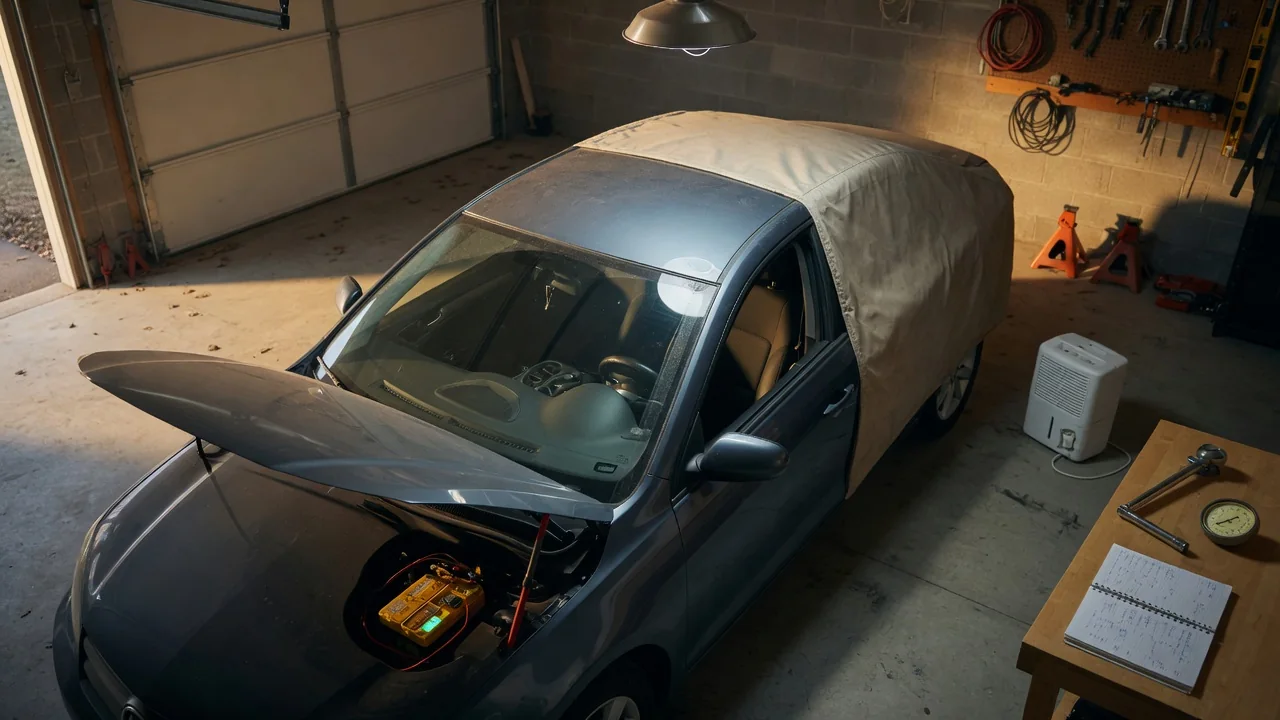
A car that sits for months does not stay frozen in time. Its battery slowly loses charge, its tires gradually lose air, and small changes are easy to miss unless they are written down. Knowing how to track a car's storage condition over months comes down to a simple habit: record a clear starting point, then check the same few items on a regular schedule. A basic car storage condition log built around dates, battery, and tire pressure turns vague worry into readable trends.
Dates: Building the Timeline of Your Storage Log
Every useful storage log starts with a baseline entry made on the day the car is parked. Record the date, the odometer reading, and the date of the last drive. Note when the oil was last changed, whether a fuel stabilizer was added and when, and the fuel level at the time of storage. If the vehicle has an upcoming registration, inspection, or insurance renewal, write those dates down as well, because a car that is out of sight is easy to forget on paper too. This first entry is the reference point that every later reading will be compared against.
After the baseline, choose a fixed check interval and stick to it. Many owners pick something like every two to four weeks, but the right interval depends on the vehicle, the storage environment, and whether a battery maintainer is connected. What matters most is consistency: readings taken at regular intervals reveal gradual change, while irregular checks make it hard to tell whether a drop happened slowly or suddenly. Each entry should carry its own date and time, plus a short note on the conditions, such as approximate ambient temperature or whether the garage was unusually cold or humid. Those context notes become important later when interpreting battery and tire numbers.
Battery: Recording Charge Before Problems Appear
A parked car's 12-volt battery loses charge in two ways. All batteries self-discharge to some degree, and most modern vehicles also have a small parasitic draw from electronic modules, alarm systems, keyless entry receivers, and clocks that stay active with the ignition off. How quickly the charge falls varies widely between vehicles, battery types, and battery ages, so there is no single timeline that applies to every car. That variability is exactly why tracking your own battery over time is more informative than relying on general rules.
The most practical measurement is resting voltage, taken with a digital multimeter across the battery terminals after the car has been sitting undisturbed. For a conventional 12-volt lead-acid battery, a fully charged resting reading is commonly cited as roughly 12.6 volts or slightly higher, and lower readings indicate a partially discharged state. AGM, lithium, and other battery types can have different characteristics, so check the battery label or manufacturer guidance for its specific values. In the log, record the voltage, the date, and any visible issues such as corrosion on the terminals or a swollen case. The trend across several entries is usually more telling than any one number.
Also record how the battery is being managed. If a smart charger or battery maintainer is connected, note its status indicator at each check and whether it reports any faults. If the battery was disconnected instead, log the date it was disconnected, since reconnecting can reset radio presets, clocks, or certain learned settings on some vehicles, and knowing the timing helps explain any behavior after storage ends.
Tire Pressure: Separating Temperature Swings From Real Leaks
Start with the correct reference value. The recommended cold tire pressure for a specific vehicle is listed on the placard usually found on the driver's door jamb and in the owner's manual. The number molded into the tire sidewall is the tire's maximum pressure, not the recommended operating pressure. Some owner's manuals or tire manufacturers suggest a pressure adjustment for long-term storage; if that guidance exists for your vehicle or tires, follow it and record the target you chose, but never exceed the sidewall maximum.
Tires naturally lose a small amount of air through the rubber over time, and pressure also rises and falls with temperature. A commonly cited rule of thumb is a change of about 1 psi for every 10 degrees Fahrenheit, so a cold snap can make every tire read lower without any leak. To keep the log meaningful, check pressure when the tires are cold, use the same gauge every time, and write down the ambient temperature next to each reading. When all four tires drop together in step with a temperature change, that is normal behavior. When one tire falls noticeably faster than the others under similar conditions, it may have a slow leak worth inspecting.
A handheld gauge is the better tool during storage. Reading pressures through a tire pressure monitoring system often requires switching on the ignition, which adds load to a battery you are already trying to preserve. While at each tire, it is also worth noting any visible deformation where the tread contacts the floor, since tires that sit in one position for long periods can develop temporary flat spots.
Practical Implications and Limits
A storage log is a trend-spotting tool, not a diagnostic instrument. It can show that something is changing faster than expected, but it cannot by itself explain why. A battery that loses charge quickly between checks might be aging, might be facing a higher-than-normal electrical draw, or might simply be affected by cold storage temperatures. Each of those causes calls for a different response, and identifying which one applies may require a proper battery load test or an electrical inspection by a qualified technician.
Measurement quality also limits what the numbers can tell you. Inexpensive multimeters and tire gauges can differ from one another by small amounts, which is why switching tools mid-storage can create false changes in the record. Readings taken right after the car was moved, after a charger was disconnected, or at a very different temperature are not directly comparable to earlier entries. Writing down these circumstances lets you discount readings that do not reflect a real change. It is also worth remembering that dates, battery, and tire pressure are only part of a stored car's condition; fluids, rodent activity, and moisture deserve their own attention.
The log pays off most at the end of storage. Before driving, review the full record rather than only the latest entry. Restore tire pressures to the door-placard value if they were adjusted for storage, and if the battery readings declined steadily or the maintainer reported faults, have the battery checked before relying on the car. A completed log also gives a useful baseline for the next storage season, making it easier to judge whether the same car is behaving normally.