How to Test an EV Battery: State of Health Checks and Tools
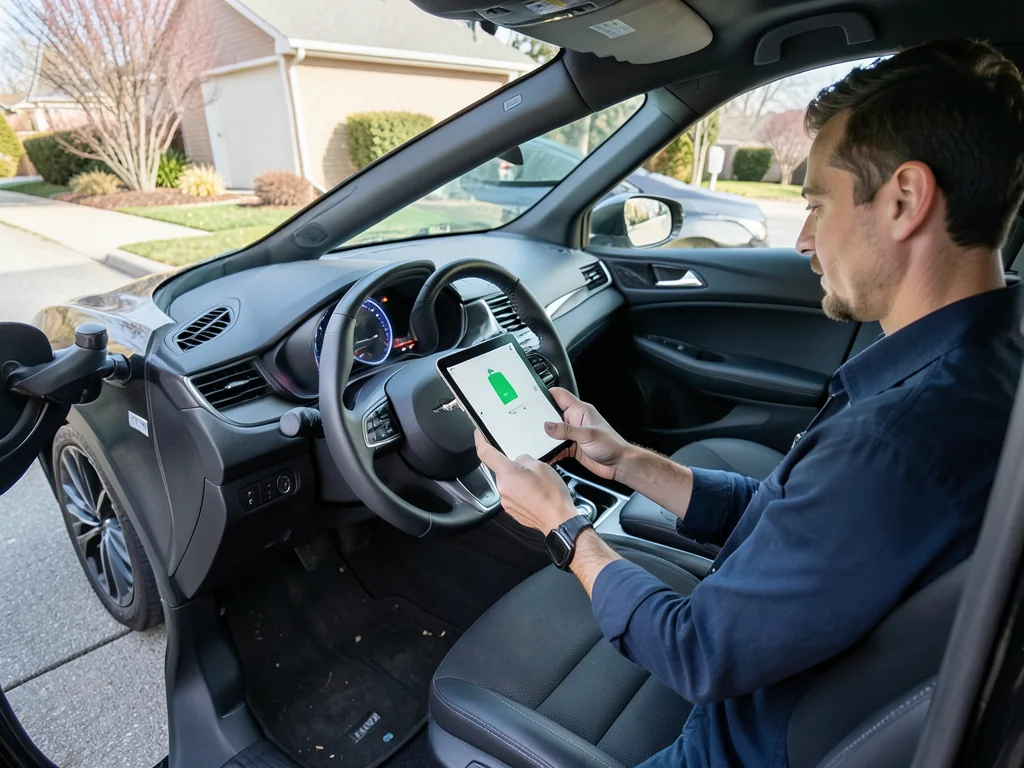
An EV battery test is a practical way to check EV battery health before you buy, sell, or keep driving. Owners can start with dashboard range data, then move to an EV battery monitoring app, a compatible OBD2 scanner for EV battery health, or a dealer or third-party EV battery tester. Results describe current condition, not a guaranteed remaining life, and they apply to the high-voltage traction battery rather than a simple accessory-battery check.
What an EV Battery Health Test Can Tell You
State of health describes remaining energy storage compared with a new pack, while state of charge is the present fill level of that remaining energy. Usable battery capacity is the portion the vehicle actually makes available after the battery management system keeps buffers at the top and bottom. An EV battery health check should target the high-voltage traction battery. Testing the 12-volt accessory battery with a conventional EV car battery tester does not establish traction pack condition.
Figures from EV battery testing depend on the data source, the calculation method, and conditions such as battery temperature and recent driving. A dashboard estimate, an app reading, and a shop EV battery tester can disagree because they sample different signals or apply different reference values. Capacity degradation is real over time, yet a health estimate cannot guarantee remaining battery life or rule out every fault. Diagnostic trouble codes and cell voltage readings may still need follow-up even when the displayed percentage looks acceptable.
Safe Battery Checks Using the Dashboard and Driving History
Start an EV battery check with the information the vehicle already shows. Some models display a battery health screen, a capacity bar, or a service menu; others show only state of charge and estimated driving range. The owner's manual explains where those screens live and how the maker intends them to be read. Record charge level, estimated range, battery temperature if shown, and recent energy consumption under similar routes and climate. Consistent notes make later EV battery diagnostics more useful than a single snapshot.
Displayed range is a prediction, not a laboratory measurement of usable battery capacity. Cold weather, highway speed, cabin heating or cooling, cargo, and recent driving style all change energy use, so a short range reading does not by itself prove capacity degradation. How to check EV battery health from the cabin is therefore a matter of trends, not one trip. Watch ordinary charging and driving over weeks. Do not deliberately drain the pack empty or run repeated full-charge cycles just to test it.
Choosing a Compatible OBD Reader or Battery Monitoring App
An OBD2 scanner for EV battery health is only useful if the adapter and software support the exact vehicle, model year, and battery data you want. The diagnostic connector is a physical port, not a promise of traction-pack access. A supported EV battery monitoring app or EV battery checker may show battery management system estimates, module temperatures, diagnostic trouble codes, and cell voltage readings, but availability varies widely. Confirm live support lists before buying a tool, because a generic powertrain reader often cannot perform a meaningful EV battery health test.
Use only supported read-only functions. Avoid clearing codes, changing coding, or sending unsupported diagnostic commands that the vehicle was not meant to receive from a consumer tool. Cell voltage readings need operating context and specialist interpretation; an isolated imbalance cannot establish a failed module. Review app permissions and account access before pairing, and treat a displayed percentage as an estimate unless the product documents a validated capacity measurement. An EV battery health tester that only restates the battery management system figure is still useful, but it is not a laboratory discharge test.
Understanding Professional Tests and Battery Health Reports
A professional EV battery inspection or shop EV battery testing session can add measurements that a dashboard cannot. Ask a dealer or independent provider which vehicles they support, what procedure they use, which data they collect, and which results are measured versus estimated. An EV battery health report should identify the vehicle, test date, mileage, charge level, battery temperature, method, and stated limitations. If those fields are missing, the EV battery report is harder to compare later and weaker as a used EV battery health check.
Any capacity percentage needs an identified reference value and a clear distinction between usable battery capacity and gross pack size. Recurrent EV battery health reports compile connected-vehicle and related data into a battery condition summary; before relying on a Recurrent EV battery result, confirm current vehicle eligibility, data sources, and report scope. A printed or digital EV battery health report documents findings at a particular time. It does not by itself determine warranty eligibility, remaining life, or future reliability, and it cannot replace a technician's diagnosis when warnings are present.
Checking Battery Health Before Buying a Used EV
How to check EV battery health before buying starts with paperwork, not a guess from advertised range. Request a recent EV battery health report, available service records, and documentation of any traction battery repair or replacement. Confirm that VIN, mileage, and test date on the used EV battery health documents belong to the vehicle in front of you. Then take a normal test drive and, with permission, a routine charging session to watch for warning messages, charging interruptions, unexpected power limits, or abrupt state-of-charge jumps.
When records are incomplete, symptoms are unexplained, or a used EV battery health check needs verification, arrange an independent EV battery inspection rather than relying on the seller's summary. Ask the inspector which EV battery tester or procedure they will use and whether they can produce a written EV battery report. Owners and buyers should observe only accessible cabin and charging-port behavior. Underbody assessment, battery enclosure inspection, and any high-voltage work belong with a qualified professional who has the correct isolation equipment and training.
Battery Warnings That Need Professional Diagnosis
An EV battery warning light or message may concern the traction pack, the 12-volt system, charging equipment, or another electrical circuit, so record the exact wording and follow the vehicle manual. Recurring charging failures, unexpected power limitation, abrupt charge-level changes, or a persistent EV battery warning light all justify professional EV battery diagnostics. Do not assume the traction battery has failed because a symbol appeared. Seek testing that can read manufacturer-specific data rather than guessing from a generic code list.
Verify diagnostic trouble code meanings for the exact vehicle before interpretation, especially for manufacturer-dependent codes that look similar across brands but are defined differently. Fault codes guide EV battery testing; they do not prove that the traction battery requires replacement. A code can point to a sensor, coolant circuit, charger, wiring, or battery management system issue that still needs confirmation. If the vehicle instructs you to stop driving, park safely and seek assistance. Do not open the pack, probe high-voltage terminals, or attempt repairs that require isolation procedures.