How to Test a Mass Air Flow Sensor With Scan Data and a Multimeter
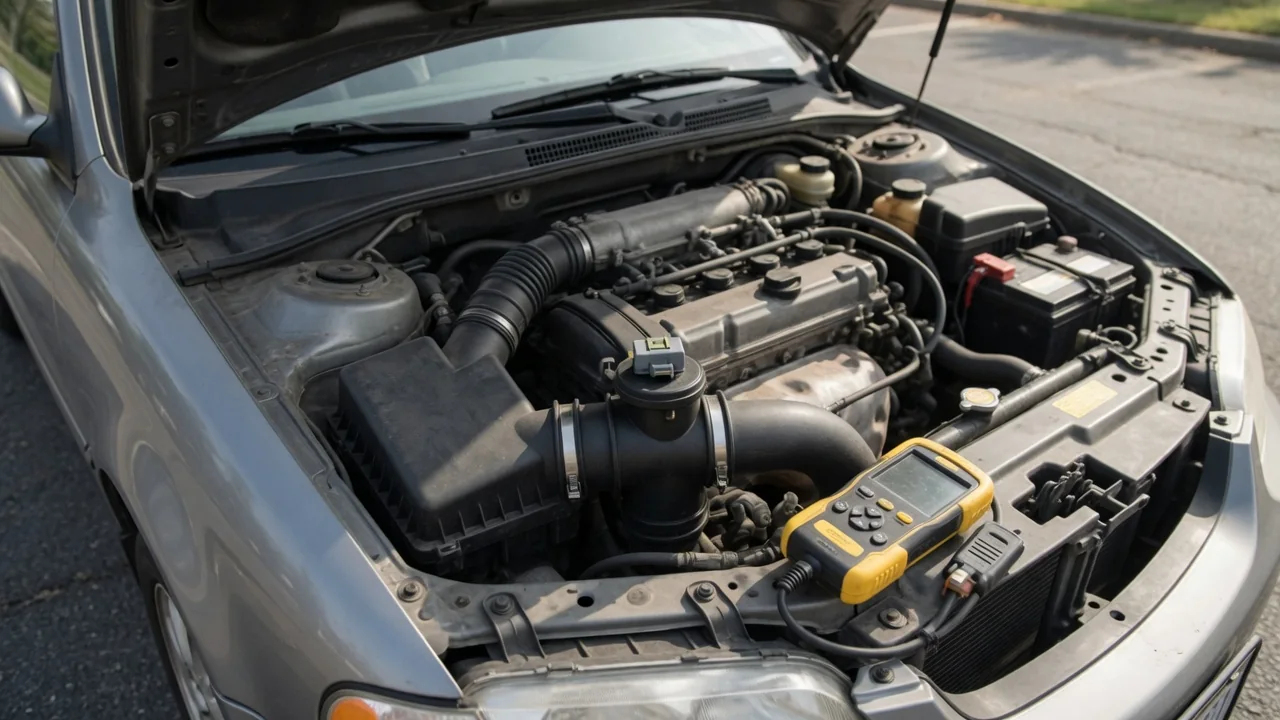
Can you test a mass air flow sensor at home? Yes, but a useful MAF test takes more than one reading. This guide covers how to check a mass air flow sensor with live data and what a normal idle reading depends on. It also explains what multimeter testing can prove, how to test without a multimeter, and why unplugging the sensor is a weak shortcut.
Prepare a MAF Test That Can Support a Diagnosis
Mass air flow sensor testing can show that the airflow signal is implausible, but that alone does not prove the sensor has failed. A skewed reading can come from an unmetered air leak, a restricted intake, damaged wiring, a poor sensor ground, or a supply problem. To diagnose a bad mass air flow sensor with confidence, check the signal, its circuit, and the intake path it measures, then see whether the evidence agrees.
Start by identifying the engine, the sensor design, and whether it outputs an analog signal voltage or a frequency signal. Confirm which parameters your scan tool actually supports, and find the vehicle-specific test procedure. Before you disconnect anything or clear learned values, record the existing live data. Then secure the vehicle in park with the brake set and ventilate the area. Keep hands, leads, and tools away from belts, fans, and hot exhaust parts.
Check the Sensor and Intake Without a Multimeter
A basic mass air flow sensor check starts with the engine off and with what you can see. Inspect the accessible ducting between the sensor and the throttle body for cracks, loose clamps, and collapsed sections. Make sure the connector is fully seated and its lock is engaged, and look for chafed, melted, or stretched wiring. Don't take the sensor housing apart or touch the sensing element, which fingers or tools can easily damage.
Intake integrity matters because the sensor never measures air that enters downstream of it. If the duct is split after the MAF, the reading looks low even when the sensor is accurate. To test a mass air flow sensor without a multimeter, use a compatible scan tool that shows airflow, RPM, and fuel trims. A visual check alone can't establish accuracy. A dirty element, or better running after cleaning, doesn't prove an electrical fault either.
Interpret MAF Readings at Warm Idle
Find the MAF parameter in the scan tool's live data list and confirm its units. Most tools report grams per second, but some show kilograms per hour, pounds per minute, or raw voltage or frequency. Comparing mismatched units leads to false conclusions. A mass air flow sensor reading at idle only means something when the engine is fully warm, RPM is stable, and accessory load is known. Air conditioning, electrical load, and idle-speed strategy all change how much air the engine needs.
What is a normal mass air flow sensor reading? The only reliable answer is the value the manufacturer specifies for that engine under those conditions. Engine displacement, cam timing, and intake air temperature all shift airflow. That means a universal idle range or a displacement rule of thumb can suggest plausibility but can't give a pass or fail. Stability matters too. A steady value with steady RPM and reasonable fuel trims is reassuring, though a slow scan-tool refresh rate can hide brief dropouts.
Assess Airflow Under Load and Use Calculators Carefully
Airflow readings should rise smoothly as engine demand rises and fall when demand drops. Revving the engine in park shows whether the signal responds. However, free revving puts little load on the engine, so it can't confirm accuracy near full load. A better approach is to review a data log that records RPM, calculated load, throttle position, and airflow together. Leave any road test to a helper or a professional. Never watch a scanner while you drive.
A mass air flow sensor calculator estimates airflow from displacement, RPM, air density, and an assumed volumetric efficiency. Every one of those inputs is an assumption. Boost, variable valve timing, and engine control strategy can push the real value well away from the estimate. Treat the result as a plausibility check, not a calibrated test. If your data is in kilograms per hour, divide by 3.6 to get grams per second before you compare figures.
Understand What Multimeter Checks Can Establish
Testing a mass air flow sensor with a multimeter starts with the correct wiring diagram for that vehicle. You need the terminal identification, the signal type, and the manufacturer's test specifications, because sensors vary in pin count, supply arrangement, and output style. Without that information, a voltage reading has nothing reliable to be compared against. No universal pinout or normal signal voltage applies across makes.
Within those limits, a multimeter check has three jobs. It confirms the sensor receives its specified supply, shows that the sensor ground has low voltage drop while the engine runs, and checks that the signal changes plausibly with airflow. A standard meter struggles with frequency-based or digital outputs and can miss brief dropouts, which an oscilloscope captures better. Never pierce insulation, bridge terminals, or measure resistance on a powered circuit. If you lack proper back-probe access, have a technician do this testing.
Understand the Limits of Unplugging the MAF Sensor
Unplugging the mass air flow sensor while the car is running is a common suggestion, but it's not a sound test, and you shouldn't disconnect the sensor with the engine running. Unplug and reconnect the connector only with the ignition off, following any vehicle-specific procedure. With the MAF unplugged, many engine controllers switch to substitute airflow values calculated from RPM, throttle position, and other inputs. How the engine behaves depends on the vehicle.
That's why the result is ambiguous. If the engine runs better with the sensor unplugged, the substitute values may simply be hiding a leak or another problem, so the improvement doesn't prove the sensor is defective. If nothing changes, that doesn't prove the sensor is healthy either. Disconnecting it can also store faults, disrupt adaptive learning, or trigger reduced-power operation. Driving with the sensor unplugged as a diagnostic shortcut adds risk and gives poor evidence.
Decide Whether the Evidence Supports Sensor Replacement
Replacing the sensor is justified when several lines of evidence agree. You want airflow readings that are implausible every time under verified conditions and an intake system confirmed free of leaks and restrictions. The supply and ground checks should pass, with only the signal failing. One idle value, one calculator estimate, or a change after unplugging isn't enough, because each can have a cause other than a failed sensor.
Some findings call for professional diagnostics rather than more guesswork. These include intermittent signal loss, uncertain wiring or ground integrity, and load data that doesn't match how the engine behaves. After a confirmed repair, repeat the check under the original conditions, with the same engine temperature, the same accessory load, and the same logged parameters. Comparing the before and after data shows whether airflow and fuel trims now make sense, which is the real proof the diagnosis was correct.