How to Test a Car Starter Solenoid
Establish the symptoms
Begin by recording exactly when the starting problem occurs and what the vehicle does. A starter solenoid issue can appear as a single loud click when the key is turned, repeated rapid clicking, or no click at all while the dash lights remain normal. Note whether the engine cranks slowly, cranks but does not start, or fails to crank after the vehicle has warmed up. Also record recent changes such as a replaced starter, a new battery, added electrical accessories, or work near the wiring.
Pay attention to whether the problem is temperature-sensitive, intermittent, or consistent. A heat-related no-crank can be associated with a failing solenoid or a poor connection near the starter. If the battery terminals are clean and tight and the system voltage is normal, but the starter does not receive a strong signal, the focus should move toward the solenoid control circuit.
Distinguish plausible causes
A no-crank condition is not automatically a failed starter solenoid. Weak or corroded battery terminals can produce similar symptoms because they restrict current before the solenoid is even energized. Low system voltage may cause rapid clicking, while a large voltage drop in the main battery cable can mimic a bad solenoid. A faulty ignition switch, neutral safety switch, clutch interlock, or anti-theft relay can also prevent the solenoid control wire from receiving power.
A single firm click with a hot engine supports a solenoid or starter circuit concern, but the same sound can come from a seized starter or an engine that is difficult to turn. A quiet response with bright lights points more to the control side of the starter circuit than to the main battery feed. Comparing battery voltage at rest and during the start attempt helps separate a battery or cable fault from a solenoid control fault.
Checks in a useful order
Begin with safe observations before touching tools. Make sure the transmission is in Park or Neutral and the parking brake is set. Inspect the battery terminals for looseness, corrosion, or broken connections. A battery that passes a visual check may still need a resting voltage measurement with a digital multimeter.
Battery and power checks
With the engine off and electrical loads shut down, measure voltage across the battery terminals. A fully charged starter battery at moderate temperature is typically around 12.6 volts or slightly higher; lower readings warrant charging and retesting. While an assistant turns the key to the start position, watch how far the battery voltage drops. A reading that falls well below the normal range indicates a weak battery, excessive current draw, or resistance in the main starter circuit.
Solenoid control signal check
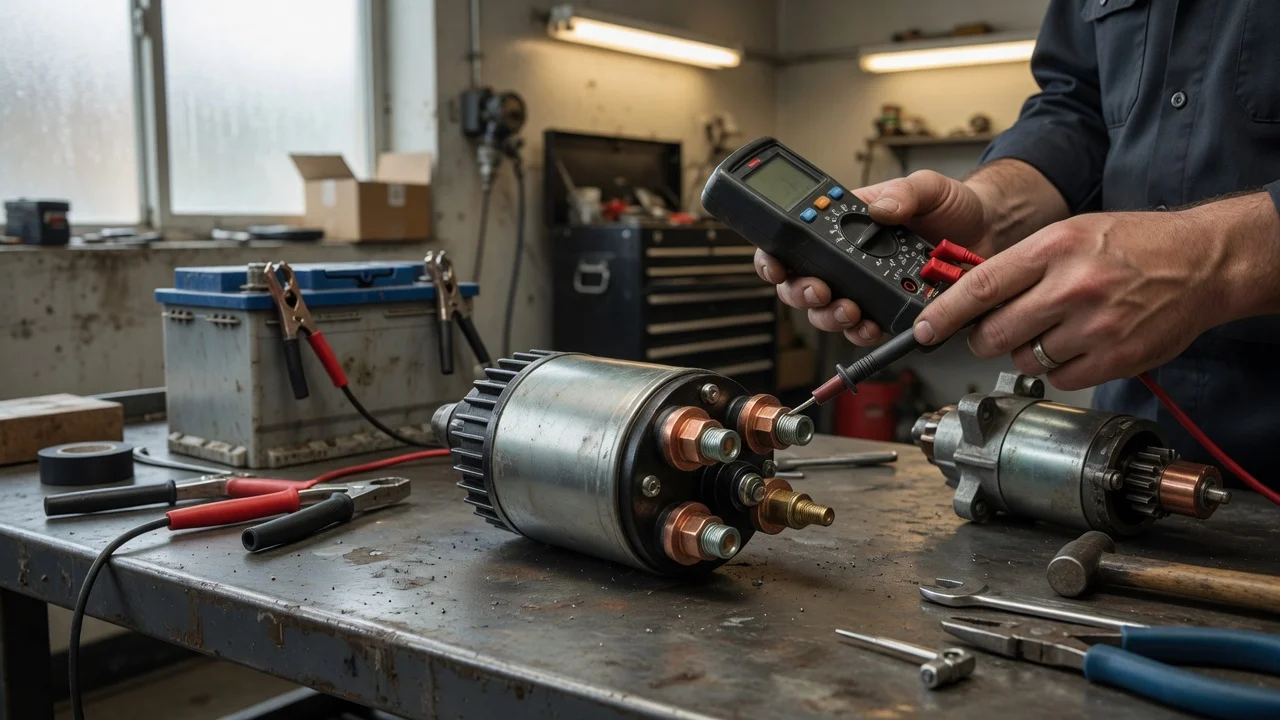
Locate the solenoid control terminal, often the smaller wire at the starter solenoid. With the key held in the start position, measure between that terminal and a clean engine ground. On a conventional 12-volt starter circuit, the control signal should be close to system voltage. If battery voltage is present but the solenoid does not click, the solenoid itself or its internal contacts are suspect.
Voltage drop tests
A voltage drop test on the main starter cable can reveal resistance that a simple continuity check misses. With the multimeter set to DC volts, place one lead on the positive battery terminal and the other on the starter main power stud during a start attempt. More than a few tenths of a volt while cranking suggests excessive resistance in the cable or connections. A similar check can be performed on the ground side between the starter case and the negative battery terminal.
Compare your results with the vehicle wiring diagram and the manufacturer test procedure before removing parts. High-voltage traction system components require isolation and service procedures that are separate from the 12-volt starter battery system. If the vehicle is a hybrid or electric model, do not apply conventional starter tests to high-voltage cables or components unless the manufacturer instructions specifically cover the low-voltage side.
Parasitic draw and charging output context
A parasitic draw can drain the starter battery overnight and create a no-crank symptom that seems like a solenoid failure. If the battery is repeatedly low after the vehicle sits, a controlled draw test may be needed after the start circuit checks. Charging output is not part of the solenoid test itself, but a charging system that undercharges the battery will cause repeat starting complaints.
Interpret the findings
The interpretation depends on which measurement failed and which passed. A strong control signal with no click and good main power at the starter points to the solenoid or starter itself. A missing control signal points upstream to the ignition switch, security system, neutral safety switch, relay, or wiring. A large voltage drop in the main positive circuit points to a cable or connection, while a drop on the ground side points to a grounding fault.
Battery voltage that remains strong during the start attempt but produces no crank usually means the starter circuit is not drawing current, supporting a control or internal contact problem. A battery that drops far below the expected minimum during start may still be the root cause even if the solenoid is also noisy. Confirm the wiring diagram, fuse rating, and vehicle-specific specifications before replacing parts.
Urgency and next action
Stop use and arrange inspection if the starter circuit shows signs of heat damage, melted insulation, burning odor, sparking, or a battery that is hot after starting attempts. A starter that remains engaged after the key is released should also be treated as an immediate repair concern rather than a part to keep testing.
For the next repair step, bring the recorded symptom, the control signal result, the resting and cranking battery voltage, and the voltage drop readings. Because many solenoids are replaced as part of a starter assembly, replacement should be based on the complete evidence rather than the solenoid sound alone. If the vehicle is a hybrid or electric model, a qualified technician may be required for work near the traction system.