How to Store a Car Key Fob During Long-Term Parking
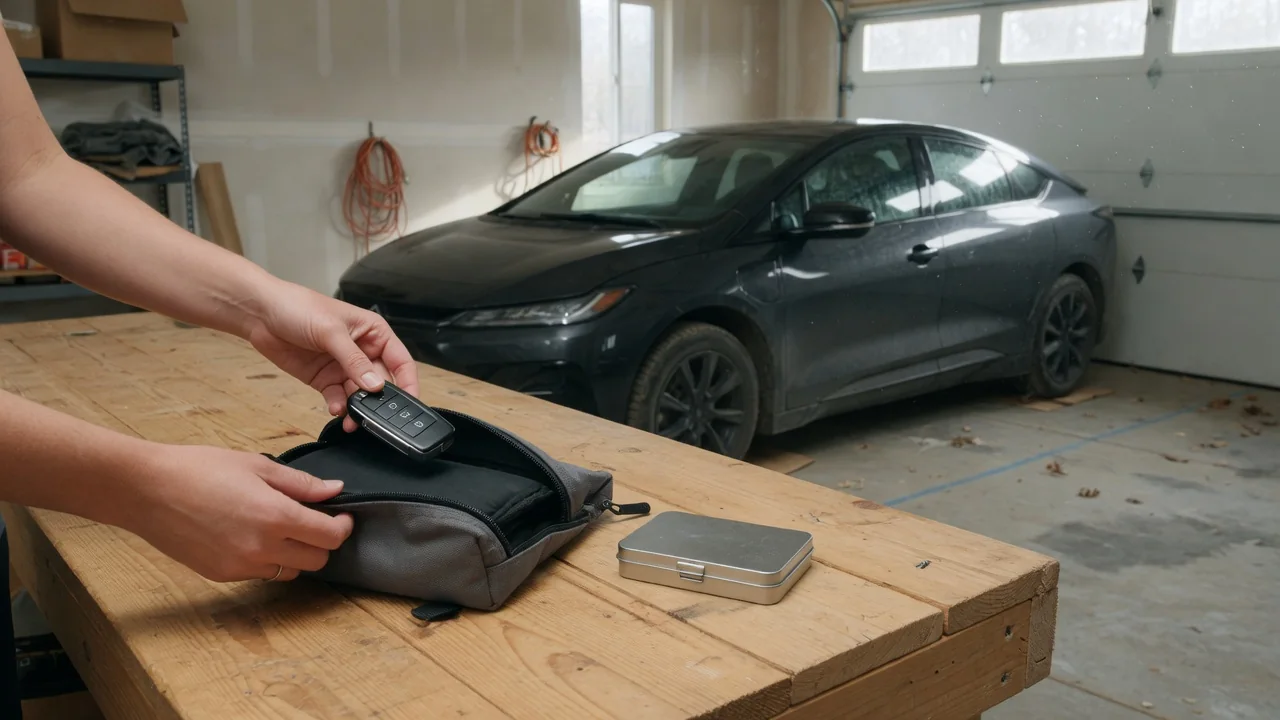
Working out how to store a car key fob during long-term parking involves more than dropping it in a drawer. The fob has its own small battery, the vehicle has a larger one, and the distance between them can influence both. This guide covers placement, battery behavior, and what to check on your return, without promising any particular security outcome.
Key and spare placement
With many passive keyless entry systems, the vehicle and fob exchange short radio signals whenever they sit close together. A fob left on a hook beside a garaged car, or inside a bag in the trunk, may keep that conversation going for weeks. Storing the fob indoors, well away from the parked vehicle, in a dry spot at moderate room temperature is a sensible starting point. How close counts as too close differs by make, so the owner's manual is the reference for your particular system.
The spare deserves the same thought, and it should not live in the same place as the primary key. Keeping both in one drawer means a single misplaced box or a locked house leaves you without either. Some owners leave the spare with a trusted household member or at a separate address when the car is parked at an airport or storage facility. Never leave a spare inside the cabin; besides the obvious access concern, some vehicles detect a fob inside and behave differently when locking.
Vehicle battery implications
A parked vehicle is never fully asleep. Control modules, the alarm, and the keyless receiver draw a small standing current, and the twelve-volt battery slowly discharges as a result. If a fob stays within range, some vehicles wake modules more often than they otherwise would, which can add to that drain over a long stay. Whether this effect is meaningful depends on the design, and many newer models reduce keyless polling after a period of inactivity, so the behavior you see may not match another owner's.
The fob's own coin cell is the other battery in the picture. A fob that keeps answering a nearby vehicle may use its cell faster than one resting quietly out of range. Certain fobs include a motion sensor that puts them to sleep when still, and some manufacturers describe a button sequence that switches off the transmitter for storage. These features are model dependent, so confirm them in the manual rather than assuming. For very long storage, a battery maintainer or the manufacturer's storage guidance addresses the vehicle side.
Restart check
When you return, a few observations tell you how both batteries fared. Press unlock from a normal distance and note whether the car responds promptly, weakly, or not at all. Reduced range or a need for repeated presses often points toward a tired fob cell, while dim interior lights, a slow crank, or a clicking sound point toward the vehicle battery. A dashboard message about a low key battery, where fitted, is a helpful hint, though it deserves confirmation rather than blind trust.
It helps to know the backup access method before you need it. Most fobs hide a mechanical key blade, and the driver's door usually has a lock cylinder, sometimes under a small cover. Many push-button start vehicles also have a designated spot where a fob with a weak cell can be held so the car still recognizes it. The location varies widely, from the start button itself to a console pocket or steering column marking, so look it up for your vehicle before the trip.
Everyday Use and Observations
Habits formed in daily driving carry over to storage. If the fob normally sits on a shelf just inside the garage door, the car may already be sensing it every night, and a long trip simply extends that pattern. Watching for small clues, such as mirrors unfolding, puddle lamps lighting, or door handles presenting as you walk past with the key, shows roughly how far the system reaches. That informal range test gives you a practical idea of where the fob should rest.
Storage conditions matter for the fob itself too. Heat, damp, and pressure on the buttons are the usual troublemakers, so a packed suitcase pocket or a sunny windowsill is a poor choice. A fob squeezed among luggage can transmit repeatedly, wearing its cell and possibly unlocking or opening a liftgate if the car is within range. Some people use signal-blocking pouches; these can limit communication, but their performance varies with product and condition, and they should not be treated as a guarantee of anything.
Limits and Next Steps
No storage routine can promise that a vehicle will start after weeks of sitting or that it will remain untouched. Battery age, temperature swings, aftermarket accessories, telematics features, and software settings all influence how quickly charge falls, and none of them are controlled by where the key rests. Fob placement is one modest factor among several. If a car has previously struggled after short periods of sitting, that history suggests a battery or parasitic draw question worth having tested before the trip.
If the car does not respond on your return, treat the symptoms as clues rather than conclusions. A warning light or stored fault code after a low-voltage event is evidence to interpret, not proof a component has failed, and manufacturer-specific codes need vehicle-specific confirmation. Replacing the fob cell with the type listed in the manual is a reasonable first step. Beyond that, a battery test, or help from a dealer or qualified locksmith for key recognition problems, is the sound path forward.