How to Remove Mud From Car Carpet
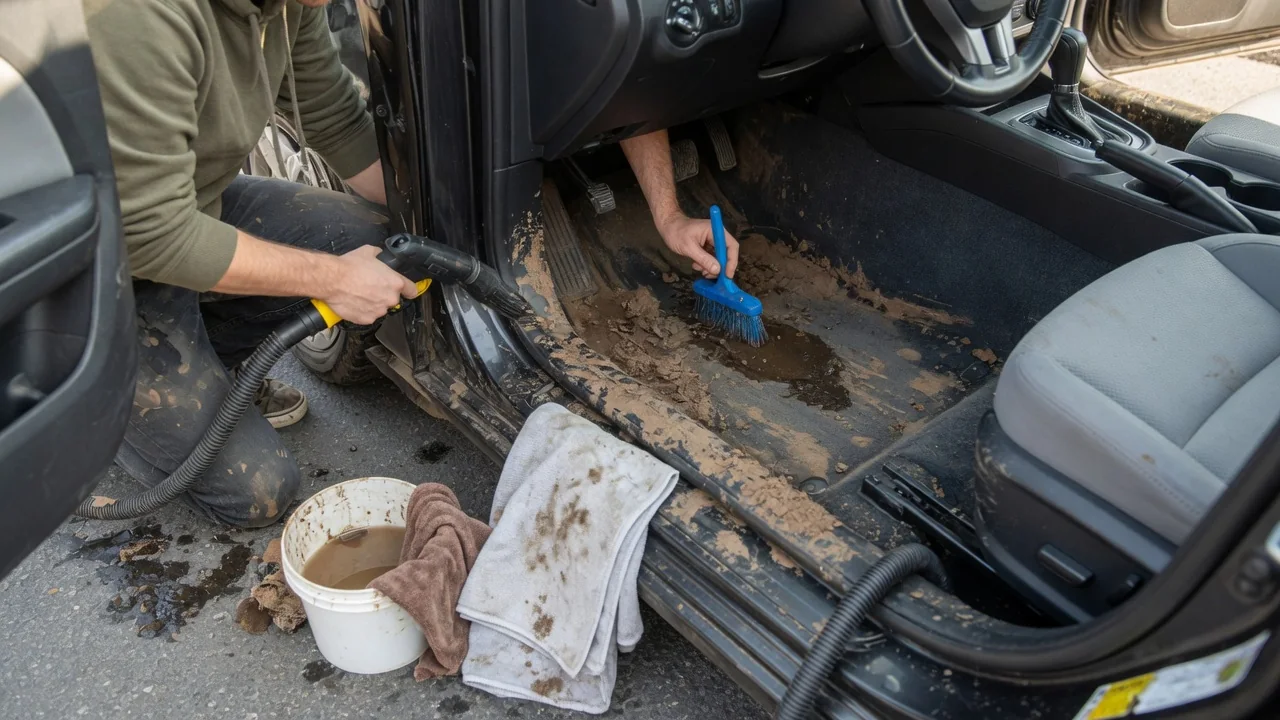
Learning how to remove mud from car carpet is mostly about patience. Wet mud smears into the pile and pushes fine silt toward the backing, while dried mud breaks apart and lifts away. The approach that works best keeps the soil contained, uses as little liquid as possible, and finishes with thorough drying so the padding underneath never stays damp.
Dry and vacuum
Fresh mud behaves like a paste, so wiping or scrubbing it while wet drives clay and grit deeper into the fibers and widens the stain. Letting it dry first changes the job entirely. Scoop away any thick clumps with a plastic scraper or spoon, lifting rather than dragging, then leave the doors open or run the cabin fan so the rest hardens. Once the patch turns lighter in color and feels crumbly to the touch, it is ready to be broken up.
Loosen the dried soil with a stiff-bristled brush, working from the outer edge toward the center so the debris stays in one area instead of drifting across clean carpet. Follow immediately with a vacuum, using a crevice nozzle along seat rails, the pedal area and the edges of the center console where grit collects. Removable floor mats are easier to handle outside the vehicle, where they can be shaken and beaten out. Several slow passes pick up more than one fast one.
Target residue
After vacuuming, a brownish shadow often remains because fine silt and clay pigments cling to the fibers. This is the stage for moisture, but only a little. Mist a carpet or upholstery cleaner, or a mild solution of dish soap in water, onto a microfiber towel or lightly onto the stain rather than pouring it on. Automotive carpet sits over foam padding and sometimes sound insulation, and liquid that reaches those layers is slow to leave and can carry dirt back up.
Blot with a clean towel, pressing down and lifting, and rotate to a fresh section as the cloth picks up color. Gentle agitation with a soft brush helps on textured or looped pile, yet hard scrubbing can fuzz the fibers and spread the mark. Red clay and soils with heavy mineral content tend to leave more stubborn discoloration than sandy dirt, so repeated light applications work better than one heavy soak. Test any cleaner on a hidden spot first, since carpet dyes and materials vary between vehicles.
Dry fully
Drying matters as much as cleaning. Press dry towels firmly into the treated area to pull out as much moisture as possible, or use a wet-dry vacuum if one is available. Then encourage airflow by parking in a sunny spot with the windows cracked, aiming a household fan through an open door, or running the climate control with the air conditioning on, which removes humidity from the cabin air. Leave floor mats out until the carpet beneath feels dry.
Dampness left behind shows up in recognizable ways: a musty smell after the car has been closed overnight, windows that fog more readily, or a spot that feels cool and slightly tacky under the hand. Padding thickness differs by model, so some floors dry in an hour while others hold moisture much longer. Some vehicles also route wiring or mount electronic modules beneath the seats and carpet, which is another reason to keep liquid use minimal and confirm the area is dry before replacing mats.
Everyday Use and Observations
Mud arrives in predictable places. The driver's heel area beneath the pedals takes the most, followed by the door-sill edges where shoes swing in, the rear footwells used by children or pets, and the cargo floor after hiking or sports gear. Checking these zones after a wet outing lets you deal with deposits while they are still sitting on the surface. Knocking boots together before climbing in and keeping a small brush in the door pocket reduce how much soil ever reaches the carpet.
Protection also changes how the cleanup goes. Deep-lipped rubber or all-weather mats trap slurry so it can be carried out and rinsed away, whereas carpeted mats absorb it and need the same dry-then-vacuum routine. Light-colored interiors reveal every faint tint, while dark carpet hides staining but shows dried dust as a gray haze. A ring appearing around a cleaned spot days later usually means dirt wicked up from below as it dried, and another light blotting pass generally clears it.
Limits and Next Steps
Home methods have boundaries. Mud that has been ground in for weeks, soil mixed with road salt, oil or grass stain, and carpet that was saturated by floodwater or a spilled bucket may not respond to blotting and brushing. If a musty odor persists after several days of ventilation, or the padding still feels wet when pressed, moisture is likely trapped below the surface. Continuing to add cleaner at that point usually makes matters worse instead of better.
A professional detailer with a hot-water extractor can flush and recover soil from deep in the pile, and in severe cases a shop may lift the carpet to dry or replace the underlay. Before reaching that stage, a rented or portable extractor is a reasonable middle step, provided it is used sparingly and followed by thorough drying. The owner's manual may include interior care guidance or product cautions specific to the vehicle, and it is worth reading before trying stronger cleaners on a persistent stain.