How to Read a Car Battery Date Code
The short answer
A car battery date code is a short mark on the battery case or label that shows when the battery was made, or in some systems when it was shipped. It usually takes one of two forms. The first is a plain month and year, such as 03/24 or 03-24, meaning March 2024. The second is a letter-and-number code, where a letter stands for the month (A for January, B for February, and so on) and a digit stands for the last number of the year. Under that scheme, C4 would mean March 2024.
Two conditions can change how you read it. First, formats differ between manufacturers and brands, and some codes are partly internal production data rather than a simple date, so a letter-number reading is only reliable when you know the scheme for that brand. Second, a single year digit repeats every ten years. A 4 could mean 2014 or 2024, so use the battery's condition, the label design and the vehicle's service history to decide which decade applies.
Terms worth knowing
Date code: a printed, stamped or sticker mark showing the battery's production or shipping month and year. Heat-stamped or molded code: characters pressed into the plastic case, often on the top or one side. These can be faint and are easier to read with angled light. Shipping or sale sticker: a separate label, sometimes with a punched or marked month and year, added by the distributor or retailer. It may differ from the factory code. 12-volt battery: the conventional starting or auxiliary battery found in petrol, diesel, hybrid and electric vehicles. This guide covers only this battery, not the high-voltage traction battery in hybrids and EVs.
Common date code formats
Format | Example | Typical meaning; Numeric month/year | 11/25 or 11-25 | November 2025; Month letter + year digit | C4 | March of a year ending in 4; Year digit + month letter | 4C | Same information in reverse order, on some brands; Punched or marked sticker | Hole or mark next to a month and a year | Month and year shown by the marked positions; Longer alphanumeric string | Mix of letters and numbers | Can include plant, line or shift data. Only part of it is the date, so check the manufacturer's key
Read the month-letter row with caution. A straight A-to-L sequence for January to December is common, but not every manufacturer follows it. Some may skip letters that look like numbers or use their own sequence. If the battery's maker publishes a decoding chart, follow that chart instead of the generic pattern.
How to find and read the date code
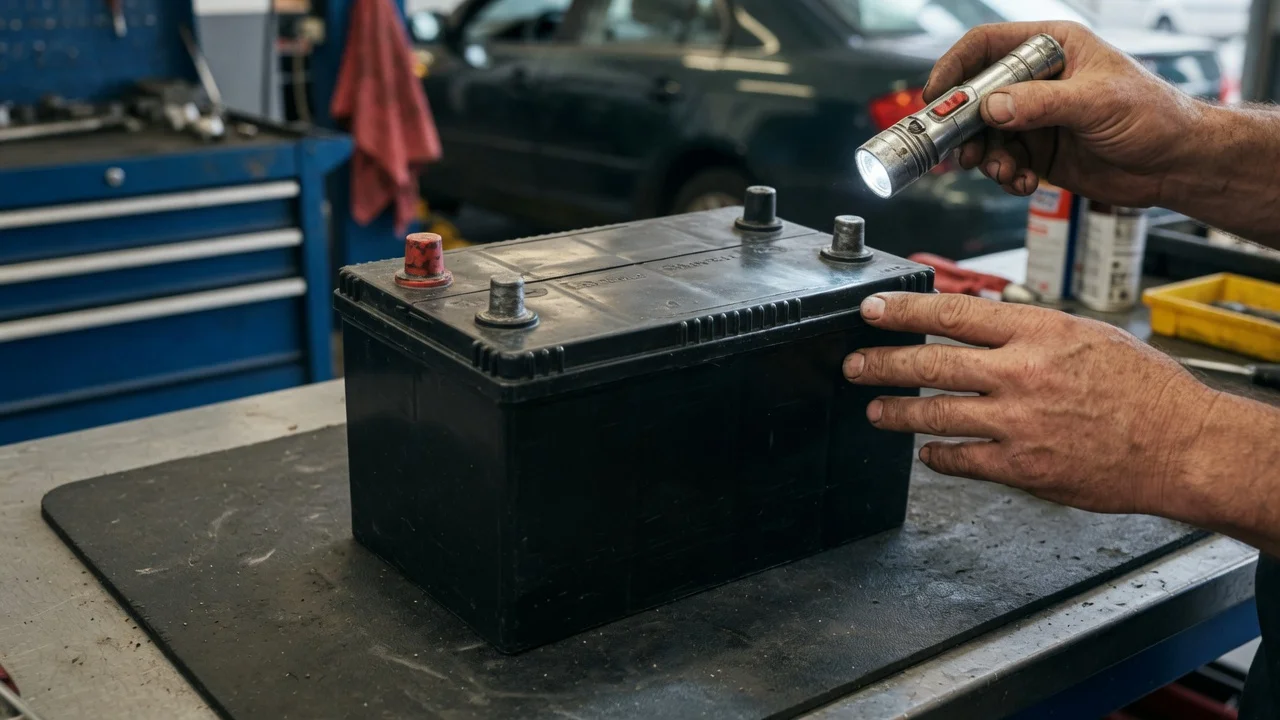
Prerequisites and equipment: the vehicle parked on level ground with the engine off and the key or smart key away from the ignition, a flashlight, a clean dry cloth, and safety glasses. Gloves are advisable because battery cases can carry acid residue. A phone camera helps photograph codes in tight spaces. You do not need tools to read the code. Avoid putting metal tools near the terminals.
1) Locate the 12-volt battery. It is often under the hood, but some vehicles place it in the trunk, under a seat or under a floor panel. Your owner's manual shows the location for your model. In hybrids and electric vehicles, look only at the 12-volt battery and do not touch high-voltage components, which are usually marked with warning labels and orange cabling. 2) Inspect before handling. If the case is cracked, swollen or leaking, or if you smell rotten eggs, stop. Do not handle the battery further, and have it dealt with by a qualified technician or battery retailer. 3) Look for a sticker first. Check the top and the sides for a small label with a month and year, a letter-number code or a punched month grid. 4) Look for a stamped code. If you find no clear sticker, shine a light at a low angle across the top cover and the case sides to reveal heat-stamped or molded characters. Wipe away dirt with a dry cloth, keeping the cloth and your hands clear of the terminals. 5) Do not remove the battery just to read the code unless you are already replacing it. Disconnecting a battery can reset electronic settings and, on some vehicles, requires specific procedures. Follow the manufacturer's instructions or use a qualified service provider if removal is necessary. 6) Decode the mark. Match it to the formats above. If you see more than one date, note both: the factory code and a later shipping or retailer sticker. 7) Resolve the decade. If the year is a single digit, compare it with the battery's apparent wear, the vehicle's service records or a purchase receipt. 8) Check your result. You are done when you can state a specific month and year and explain which mark it came from. If the code is unreadable or doesn't match any known pattern, the battery maker, a retailer that stocks the brand or a battery testing service can usually interpret it.
What the date code does not tell you
The date code shows age, not condition. Two batteries made in the same month can perform very differently depending on climate, driving patterns, charging system health and how long each sat in storage. To judge whether a battery is still serviceable, have it checked with a battery tester. Many auto parts stores and repair shops offer this. This guide cannot give a reliable replacement age, because service life varies widely by battery type, vehicle and conditions. Use the battery maker's guidance and test results instead.
Using the code when buying a new battery
When buying a replacement, read the date code before purchase and prefer the most recently made stock available. A battery that has sat on the shelf for a long time may need charging before installation. Ask the retailer whether stock is maintained or tested, and follow the manufacturer's storage and charging instructions. Also confirm that the battery's group size, terminal layout, type (for example flooded, EFB or AGM) and ratings match what your vehicle's manufacturer specifies. A fresh date code does not make up for an incompatible battery.