How to Plan a Trip Through Areas With Few Services
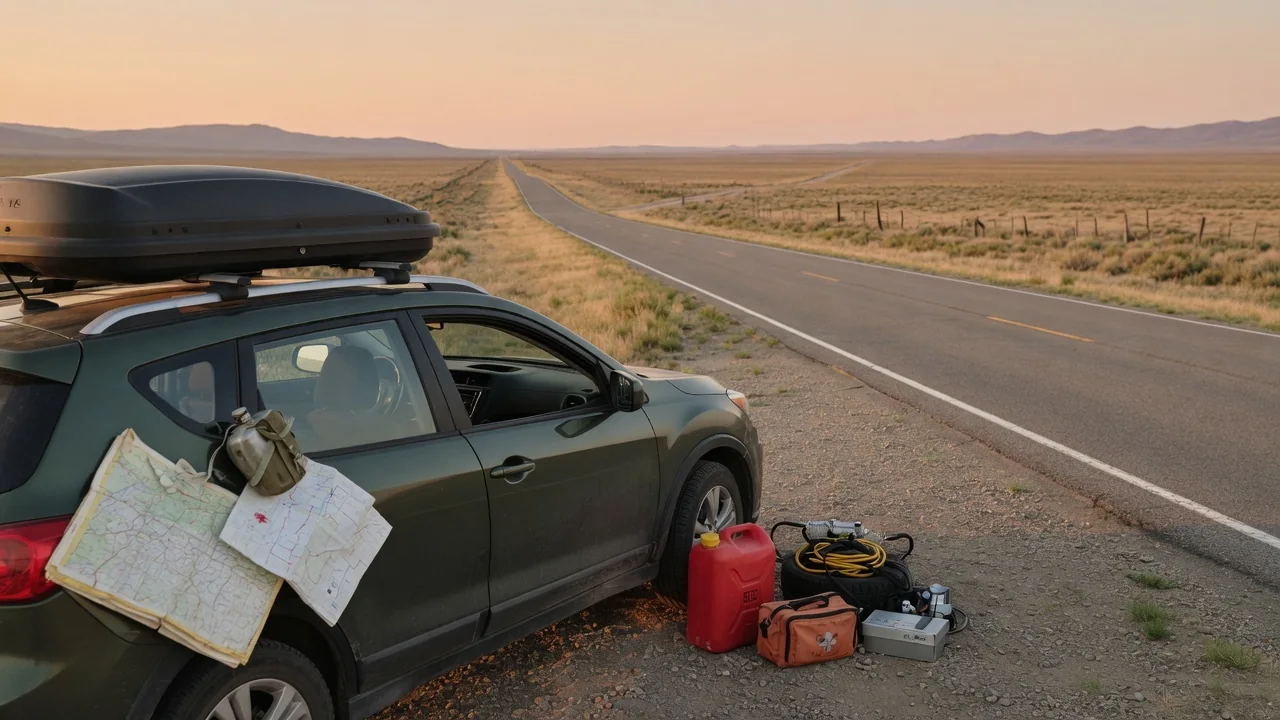
Driving through areas with few services changes the planning problem. In towns, a missed fuel stop or a dead phone is an inconvenience. On a long, empty stretch, it can leave you waiting for hours. Good remote road trip preparation comes down to three things: carrying more energy than the route seems to need, having navigation that works without a signal, and preparing backups for the failures that matter most. This guide explains how to plan each one.
Fuel or charge margin
Start with the longest distance between reliable refueling or charging points, not the total trip length. Map every planned stop and measure the biggest gap between them. Then compare that gap with what your vehicle can realistically cover in the conditions you expect. Do not rely on the window-sticker rating or the dashboard range estimate alone. Rated efficiency comes from standardized test cycles, and the trip computer usually bases its estimate on recent driving. Neither accounts well for sustained highway speed, long climbs, headwinds, heavy loads, roof boxes, towing, or extreme temperatures. Each of those increases energy use, and they often stack up on remote routes. Your owner's manual lists fuel capacity and any guidance on loads or towing, so use it as the reference for your specific vehicle.
Build the margin by refueling or recharging at every reasonable opportunity rather than waiting for the warning light. A practical habit is to set a personal top-up level: when you reach it, you stop at the next available station even if it seems early. Confirm that stations on sparse stretches are actually open, because small rural stations may keep limited hours or close for the season. For electric vehicles, check that chargers are working and compatible with your connector and payment method. Plan to arrive with a buffer rather than near empty, and remember that a single charger at a remote site may be occupied or out of service. Cold weather and cabin heating can reduce usable range, so plan more conservatively in winter.
Offline maps
Phone navigation depends on a data connection to load map tiles, calculate routes, and update traffic. In areas with few services, cell coverage is often patchy or absent. A route that loaded at the start of the day may fail to recalculate after a missed turn or a road closure. Most major navigation apps let you download regions for offline use. Do this on Wi-Fi before you leave, and make sure the downloaded area covers the whole route plus a generous surrounding buffer so detours stay within the saved map. Then confirm that offline routing works, not just map display, by switching the phone to airplane mode and requesting a route. Built-in vehicle navigation may store maps locally, but that data can be out of date if it has not been updated.
A paper road map or printed atlas is still a useful layer. It does not depend on batteries or software, and it shows the wider road network in a way a phone screen often does not. Before departure, write down the sequence of towns, road numbers, distances between stops, fuel and charging locations with their hours, and where you expect to regain signal. Share your planned route and expected arrival time with someone who is not traveling with you, and agree on what they should do if they do not hear from you. GPS positioning generally works without cell service, so an offline map can still show where you are even when calls and data are unavailable.
Backup
Backups should match the failures most likely to strand you far from help. Start with the vehicle. Check tire condition and pressures, including the spare if there is one. Find out whether the vehicle carries a full-size spare, a compact spare, or only a repair kit, because that determines how far and how fast you can drive after a puncture. Confirm that the jack and wheel wrench are present, and look up the jacking points in the owner's manual. Inspect fluid levels, wiper blades, the visible belts and hoses under the hood, and the battery terminals. Fixing a known issue before departure is far easier than diagnosing it on an empty road.
Then pack for waiting. Carry more drinking water than you expect to need, along with nonperishable food, layers suited to overnight temperatures, a flashlight, and a basic first-aid kit. Bring a charged power bank so you can keep phones running without idling the engine for long periods. Jumper cables or a portable jump starter, a tire inflator, and a reflective warning triangle cover common roadside problems. If the route has no coverage for long stretches, a satellite messenger or a phone with satellite emergency features can give you a way to call for help. Confirm in advance how your device works and whether it needs a subscription. For combustion vehicles, extra fuel in an approved container is an option where it is legal, as long as the container is secured and handled according to its instructions.
Practical implications and limits
Planning for sparse services trades speed and convenience for resilience. Frequent top-ups add stops, a conservative top-up level means refueling with fuel still in the tank, and a heavily packed vehicle uses somewhat more energy, which feeds back into the margin calculation. Every item you add for safety slightly changes the range you planned around, so recheck the longest gap after packing, not before. Seasons matter too. The same route can be straightforward in summer and demanding in winter, when daylight is shorter, roads may close, and services may cut their hours.
No plan removes all risk, and some limits are outside your control. Station hours and charger availability can change without notice, online listings may be outdated, and vehicle range figures remain estimates. Equipment only helps if you know how to use it, so practice changing a tire or running the inflator at home. If conditions get worse, the safest choice is often to wait in the last reliable town or turn back rather than press on. Vehicle-specific details such as range behavior, spare tire type, and towing limits should come from the owner's manual or the manufacturer, not from general advice.